LinkedIn for EdTech Companies: Building Pipeline Around the Academic Calendar
By Marcus Webb, Tools & Automation. Last updated: 2026-05-30
- Education buys on long cycles, by committee, with hard budget seasonality, so a generic cadence wastes most of the year.
- The people who sign (superintendents, curriculum directors, IT, procurement, L&D leads) are usually the ones who post least.
- There is roughly one window per cycle when budgets actually open, and the founder who is warm going into it wins the pilot.
Who decides in the LinkedIn buying committee for EdTech companies?
In education, no single person decides, and the person who replies to your message is rarely the person who signs. K-12 districts route purchases through a committee that typically includes a curriculum or instruction director (the practitioner champion), an IT or technology lead (security, integration, data privacy), a finance or procurement officer (the budget gate), and a superintendent or assistant superintendent (the executive sign-off). Universities add deans, department chairs, and instructional-design or teaching-and-learning units. Corporate L&D buying looks similar: an L&D or talent-development lead champions the tool, IT vets it, and finance approves the spend.
The practical move is to map the committee before you write a single message. Identify the champion who feels the pain, then identify the economic buyer who controls the budget, then identify the blockers (IT and procurement) who can stall a deal for a term. Reaching only the champion is the most common EdTech mistake, and it is the same single-threading trap that sinks founder-led outreach in general.
How do you sell to schools and districts on LinkedIn?
You sell to schools by leading with outcomes and proof, not features, because education buyers are accountable to students, boards, and regulators rather than to a quarterly number. Frame the first touch around a result an institution like theirs achieved (a measurable learning gain, a retention lift, hours saved per teacher) and offer something useful before you ask for time. District and university staff are wary of vendors, so a message that opens with a relevant outcome and a low-friction resource outperforms one that opens with a demo request.
Multithreading matters more here than in almost any other vertical. Connect with the champion first, earn the conversation, and use that relationship to get warm introductions across the committee rather than cold-messaging the superintendent directly. Keep daily volume disciplined; the data behind 1,000 connection requests shows that grinding volume against a niche audience burns the niche fast, and the education world is small enough that a bad reputation travels.
Want to put this into practice?
Reachium automates LinkedIn outreach, content publishing, and inbox management in one platform.
Start Free →When in the academic year should EdTech founders run outreach?
You run outreach against the budget and pilot calendar, not the clock, because education spend is seasonal in a way most SaaS verticals are not. For K-12, budgets are often set in spring for the fiscal year that starts in summer, purchase decisions cluster before the new academic year, and the slowest months are mid-year and the deepest weeks of summer break when buildings are empty. Higher ed and corporate L&D have their own rhythms, but the pattern holds: there is a planning window, a buying window, and dead zones.
The winning sequence is to warm in the off-season and push in the window. Use the quiet months to build relationships and publish content so that when budget season opens, the committee already knows your name. Trying to start cold the week budgets open is too late. This is the same logic as picking the right time to send LinkedIn messages, scaled up from the time of day to the time of year.
How do you reach educators and administrators who rarely post?
You reach them through precise targeting and trigger signals, because waiting for them to engage with content will not work. Most administrators and procurement staff have thin LinkedIn presences and post rarely, so an inbound-only strategy starves. Target by role and institution type instead, then layer in trigger events that signal a buying window: a new curriculum director or CIO hire, a fresh grant or bond measure, a district reorganization, or a published technology plan.
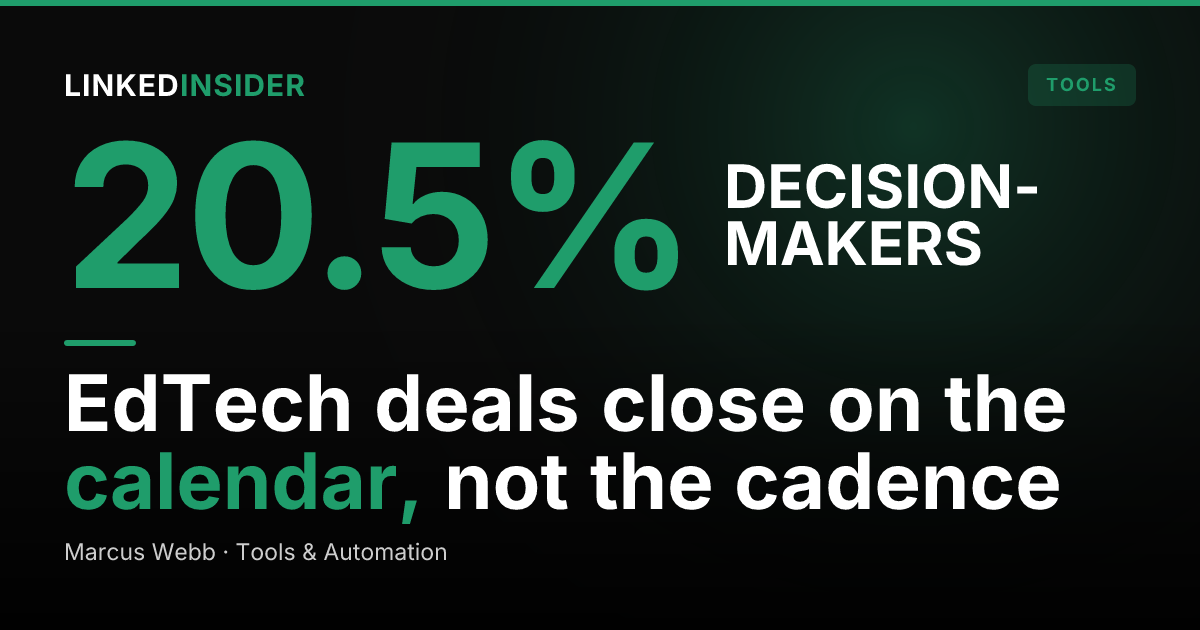
This is where targeting depth decides the outcome. Reachium's analysis of its lead universe found multi-million B2B contacts with a large share flagged as decision-makers, which is the kind of role-level filtering that lets an EdTech founder build a committee list rather than a vague "schools" list (see the LinkedIn outreach benchmarks). Reaching the right four people at one district beats reaching forty random teachers. [SYNTHESIS]
What content earns EdTech inbound from educators and L&D buyers?
Proof-led, resource-rich content earns inbound, and the highest-leverage format is the lead magnet. Educators and L&D buyers respond to things they can use: a planning template, a research summary, an implementation checklist, a benchmark report for their segment. The pattern is consistent across verticals: lead-magnet posts (the comment-to-DM format) reliably draw many times the impressions and engagement of regular posts.
Length discipline helps, too. Mid-length posts consistently out-engage the ones that sprawl past a couple of thousand characters. For EdTech, that means a tight outcome story plus a free resource beats a long manifesto. Run that content between budget windows so the committee arrives warm, the same warm-then-push motion that works for sibling EdTech founders.
Want to put this into practice?
Reachium automates LinkedIn outreach, content publishing, and inbox management in one platform.
Start Free →How do you run pilots into paid contracts?
You convert pilots by multithreading the committee during the pilot, not after it, because a successful pilot with only a champion still dies at procurement. While the champion runs the trial, build relationships with the economic buyer and the IT and procurement blockers so the contract path is already mapped when results land. Time the conversion to the renewal or budget calendar; a pilot that ends two weeks after budgets close waits a full cycle for a yes.
Tie every pilot to a documented outcome the committee can defend to a board. Education buyers need to justify spend publicly, so a pilot that produces a clean before-and-after metric gives your champion the ammunition to win the internal argument. The structural risk is the same one any niche faces as more vendors crowd in; if you are wondering whether LinkedIn outreach is saturated for education, the answer is that precise targeting and genuine proof still cut through where spray-and-pray does not.
How do you measure pipeline against a seasonal cycle?
You measure against calendar-adjusted targets and leading indicators per term, because a flat monthly quota misreads a seasonal business. Track committee coverage (how many of the required roles you have reached per target account), pilot starts, and pilot-to-paid rate as the indicators that predict revenue, rather than raw message volume. A quiet month in deep summer is not underperformance; a quiet month entering budget season is a fire.
Set targets by window. Expect most closed business to cluster around the buying season and most relationship-building to happen in the off-season, then judge each period against what that period is for. If you hit a wall on daily sends while building lists, the playbook for a LinkedIn connection limit explains why staying under the platform's safe ceiling protects the account you need for the next cycle.
FAQ
How do EdTech companies build pipeline on LinkedIn?
By syncing outreach to the academic calendar and mapping the education buying committee. They warm prospects with proof-led content in the off-season, time direct outreach to budget and pilot windows, and reach multiple committee roles per target account instead of single-threading a champion.
Who are the real decision-makers in an education buying committee?
In K-12 districts, the committee usually includes a curriculum or instruction director (the champion), an IT or technology lead, a finance or procurement officer, and a superintendent for executive sign-off. Universities add deans and instructional-design units, and corporate L&D buying involves an L&D lead, IT, and finance.
When in the academic year should EdTech founders run outreach?
Outreach should target the budget and pilot windows, which for K-12 often cluster in spring planning and before the new academic year starts. Founders use the quiet mid-year and deep-summer months to build relationships and publish content so the committee is warm when budgets open.
What content earns EdTech inbound from educators and L&D buyers?
Proof-led, resource-rich content, especially lead magnets like templates, research summaries, and implementation checklists. Reachium's data found lead-magnet posts drew many times the impressions and engagement of regular posts in Reachium's earlier internal analysis, and the 600-1,200 character range drove the most engagement.
Want to put this into practice?
Reachium automates LinkedIn outreach, content publishing, and inbox management in one platform.
Start Free →