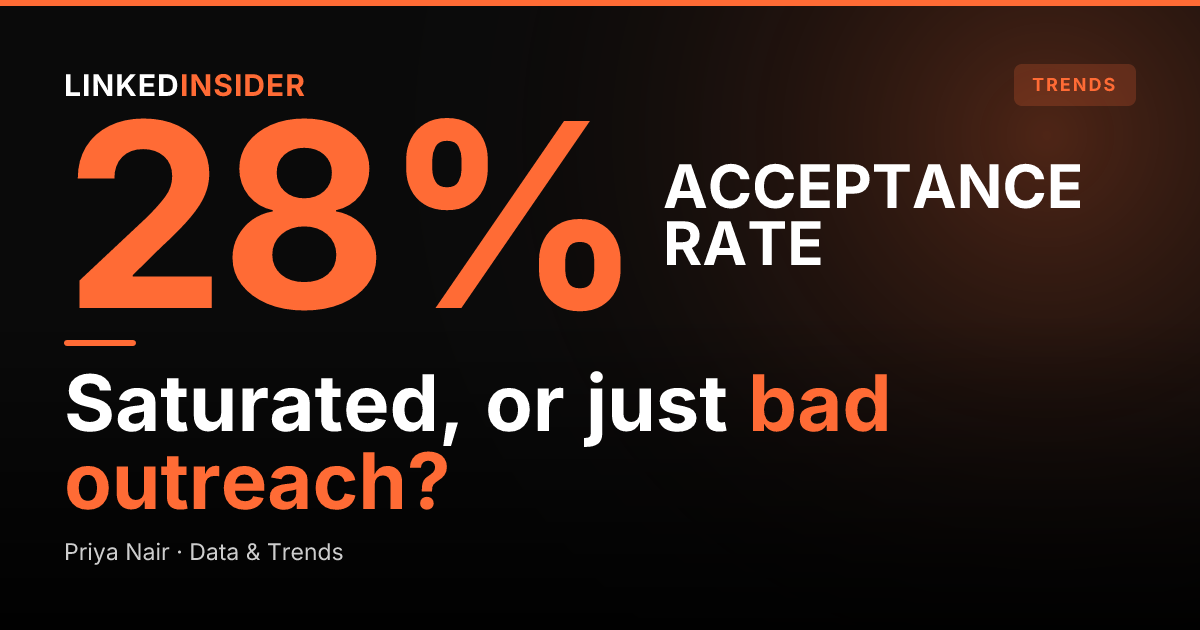
Is LinkedIn Outreach Saturated in 2026?
By Priya Nair, Data & Trends. Last updated: 2026-05-28
What sales leaders and individual reps keep saying in 2026 budget reviews:
- "Our reply rates have quietly halved versus this time last year."
- "The same playbook that booked 12 meetings a month is booking five now."
- "Half the LinkedIn influencer feed is yelling that the channel is dead, and the other half says it's never been better. Which one is right?"
The honest answer is that both feelings are real, and they have the same cause. Here is what the data actually shows is happening to the channel.
What does it mean for an outreach channel to be "saturated"?
A saturated channel is one where so many senders compete for attention that average response collapses regardless of message quality. The defining test is that better outreach stops outperforming average outreach, because the inbox is too crowded for anyone to be heard.
That is a specific claim, and it is different from the claim most "LinkedIn is saturated" posts actually make. The other claim, the one the data supports, is that average response is falling because average quality stayed flat while the bar rose. In that world, differentiated outreach still wins. The fix is not to leave the channel. The fix is to be the differentiated sender.
From a single rep's seat the two look identical. Replies are down, the inbox feels louder, and the dashboard looks worse than it did a year ago. The implications are opposite, though. If the channel is genuinely saturated, the rational move is to reallocate effort somewhere else. If the channel is rewarding quality and punishing volume more than it used to, the rational move is to upgrade the outreach. Most teams reading the same dashboards conclude the first thing when the data points to the second.
Are LinkedIn reply rates actually declining?
Yes, and the decline is real, measurable, and concentrated at one stage. The published data from Reachium's platform makes the trend visible.
Reply rate of accepted connections drifted down year over year, from 32.19% in 2025 to 21.98% in 2026 at matched maturity [SYNTHESIS]. That is a roughly ten-point drop. Acceptance held steady, moving from 26.33% to 28.11% across the same window [SYNTHESIS]. The front door of the channel is still open at roughly the rate it was a year ago. The conversation after the accept is what got harder.
Cross-channel research corroborates the broader softening. Cold-outbound reply rates have drifted down across email and social through 2025 and into 2026, which is consistent with a buyer-attention shift rather than a LinkedIn-specific collapse. Buyers are doing more independent research and engaging with sellers later in the cycle, which compresses the surface area where any cold reply is rational, regardless of channel.
A genuinely saturated channel would show acceptance falling faster than reply (the door slams shut on everyone). What the data shows instead is acceptance holding while reply softens, which is the signature of an attention-economy shift, not a channel collapse. Differentiated, signal-based first messages still get through the door. Generic first messages get through and then go nowhere.
Want to put this into practice?
Reachium automates LinkedIn outreach, content publishing, and inbox management in one platform.
Start Free →Does LinkedIn outreach still book meetings in 2026?
It does, at rates a truly saturated channel could not produce. In Reachium's data across 180,155 matured connection requests and 180,155 connection requests, the funnel still works end to end: 27.11% average connection acceptance, 27.55% reply of accepted, and accounts averaging 10 plus meetings per account per month [SYNTHESIS]. Those are the per-stage numbers of a healthy channel.
The matured-funnel number tells the same story. Acceptance on requests past the 30-day maturity cutoff, where the funnel has had time to fill, settles at 27.11% [SYNTHESIS]. A channel where senders cannot get through would not produce a steady mid-twenties acceptance rate across that volume.
The honest nuance is that those numbers come from a specific shape of outreach. They are measured on accounts running targeted, safe-volume, personalized sequences on the verified LinkedIn API. They are not the numbers you should expect if you are blasting a thousand requests a week on a browser extension with a templated first line. The full per-stage benchmark set, with cohort breakdowns and the matured-funnel cuts, lives in the LinkedIn outreach benchmarks 2026 flagship study. The reply-stage context lives at LinkedIn response rate benchmarks, and the meetings-per-rep context at LinkedIn meetings per rep benchmark.
Is the channel saturated, or is bad outreach just dying faster?
This is the reframe the data forces. The two scenarios look the same from inside one account, but they have opposite implications, and the difference is testable.
The cleanest test is the volume tax. If the channel is genuinely saturated, sending fewer requests should not improve conversion much, because the underlying inbox crowding is the constraint. If bad outreach is dying instead, sending fewer (better-targeted, better-personalized) requests should outperform sending more, because the constraint is per-message quality, not per-channel attention.
Reachium's volume-tax data shows the second pattern clearly. Acceptance peaked at 32.01% for accounts sending 10 to 19 invites a day and fell to 26.65% for accounts pushing 20 to 29 a day [SYNTHESIS]. More volume produced fewer accepts per send. That is the signature of a channel that rewards quality and punishes generic high-volume sends, which is the opposite of what a truly saturated channel would show. The deep dive on the volume finding lives at stop sending 100 connection requests per day.
What this also explains is why the "is LinkedIn dead" discourse is so loud in 2026. The loudest complaints come from the cohort whose specific motion (generic high-volume outreach on browser automation) has degraded the fastest. Their dashboards genuinely got worse. The mistake is in the diagnosis. The channel did not break under them. Their motion stopped working under the channel.
What kind of LinkedIn outreach still works in a louder inbox?
The surviving playbook is narrower than the 2024 version, and the pieces of it are not new. They are just non-optional now.
Tight targeting. The marginal meeting comes from being in front of the right person at the right level of authority, not from being in front of more people. In Reachium's lead universe of a multi-million-lead B2B universe, roughly a large share flagged as decision-makers [SYNTHESIS], which means the bulk of any cold list is gatekeepers or non-buyers. Sequences targeted at the decision-maker slice convert at materially different rates than sequences run against the full list.
Signal-based first messages. A first line that references the prospect's recent post, a job change, or a company event lands differently than a generic role-and-industry opener. Per-step personalization is what the reply-stage softening makes mandatory, because the bar rose specifically at that stage.
Safe volume, more accounts. Capping a single account around 25 invites a day and adding accounts when the team needs more capacity outperforms pushing one account to a higher ceiling. This is the volume tax in reverse: leave room at the top of each account, run more accounts in parallel, and the per-send conversion stays in the healthy band.
Multi-step sequences with conditional logic. Linear send-everywhere flows are how prospects label your team spammers. Conditional sequences that pause when a prospect replies, pivot to email if LinkedIn goes quiet, and route signal-engaged contacts into warm follow-ups are now the floor.
Content paired with outreach. Lead-magnet posts (the comment-to-DM mechanic) drew many times the impressions and engagement of regular posts in Reachium's earlier content analysis. Teams that run a content layer alongside cold outreach capture engagers as warm leads and convert them at materially higher rates than the cold cohort. The operational playbook lives at build a sales pipeline on LinkedIn.
The common thread is relevance over reach. The version of LinkedIn outreach that worked in 2021, where volume and templates produced predictable returns, is the version that is dying. The version that is alive and producing 10 plus meetings per account per month is the one that has adapted to a louder inbox. Teams that want this playbook running without building the logic themselves can start a free trial and launch targeted, conditional sequences on the verified API.
Want to put this into practice?
Reachium automates LinkedIn outreach, content publishing, and inbox management in one platform.
Start Free →Should you keep investing in LinkedIn outreach in 2026?
The verdict the data supports is yes, with a condition. Keep investing if your team can run differentiated outreach (tight targeting, per-step personalization, safe volume, conditional sequences, and a content layer). Reallocate if the only motion available to you is high-volume blasts on browser automation, because that motion is the one genuinely degrading, and the trajectory is one-way.
The risk of leaving the channel for the wrong reason is real. The accounts holding their reply rate and booking meetings are still booking meetings. Abandoning the channel cedes pipeline to the senders who adapted, in a market where the pool of differentiated senders is smaller than the pool of complainers. The competitive advantage of doing the boring work (targeting, personalization, content) compounded over the last 18 months specifically because so many teams went the other direction and blamed the channel.
The metric to judge by is not "did our LinkedIn volume go up." It is acceptance rate, reply rate of accepted, and meetings booked per account per month, measured against the matured-funnel benchmark. If those numbers are in the healthy band, the channel is working for you. If they are not, the diagnosis is almost always on the motion, not the channel. The annual read on the channel's trajectory lives at the state of LinkedIn outreach 2026 report, and the broader adjacent question of whether LinkedIn lead generation still works is treated head-on in its own piece.
FAQ
Is LinkedIn outreach dead?
No. Acceptance held at 27.11% in Reachium's data across 180,155 connection requests, with 27.55% of accepted connections replying and 10 plus meetings per account per month for adapted senders [SYNTHESIS]. The "dead" framing conflates a real softening at the reply stage with a wholesale collapse the data does not support. What is dead is the high-volume, generic-template playbook from 2023.
Why are my LinkedIn reply rates dropping?
Three causes usually stack. The market: reply of accepted on Reachium's platform softened from 32.19% in 2025 to 21.98% in 2026 at matched maturity, so some decline is the channel-wide trend [SYNTHESIS]. The motion: per-step personalization has moved from nice-to-have to mandatory, and generic three-step sequences underperform their old cohort math. The targeting: wider lists with more non-decision-makers drag the cohort down regardless of copy quality. Fix the motion and targeting first.
Is cold email better than LinkedIn outreach in 2026?
It is a complementary channel, not a replacement. Cold-email reply rates have softened on the same trajectory as LinkedIn reply rates, which is consistent with a buyer-attention shift across cold outbound generally. Multi-channel sequences that combine LinkedIn touches with email fallback book materially more meetings per prospect than single-channel flows. The right question is not LinkedIn versus email. It is whether the team is running a conditional multi-channel sequence at all.
How do you stand out in a saturated LinkedIn inbox?
Tight targeting (decision-makers, not the full list), signal-based first messages (recent posts, job changes, company news), safe volume (around 25 a day per account), conditional sequencing that pauses on reply and pivots to email when LinkedIn goes quiet, and a content layer that captures engagers as warm leads. The combined motion produces materially different cohort math than any single piece run in isolation.
Is it too late to start LinkedIn outreach in 2026?
No. The data supports the opposite read. The channel rewards quality more than it did two years ago and punishes high-volume blasts more than it did, which is the right environment for a new entrant doing the work. A team starting fresh on the verified API, with targeted lists and per-step personalization, will outperform an established team running the same generic 2023 motion.
Sources
- Reachium published benchmarks (441,965 outreach sequences, 180,155 connection requests, 2025 to 2026): https://reachium.io
- Linked Insider, LinkedIn outreach benchmarks 2026: https://linkedinsider.blog/linkedin-outreach-benchmarks-2026
- Linked Insider, State of LinkedIn outreach 2026: https://linkedinsider.blog/state-of-linkedin-outreach-2026
- DemandSage, LinkedIn statistics 2026: https://www.demandsage.com/linkedin-statistics/
- McKinsey, The new B2B growth equation: https://www.mckinsey.com/capabilities/growth-marketing-and-sales/our-insights/the-new-b2b-growth-equation
- LinkedIn Professional Community Policies: https://www.linkedin.com/legal/professional-community-policies