What Is the Best Time to Send LinkedIn Messages?
By Daniel Okoro, Outreach Tactics. Last updated: 2026-05-29
A few scenarios that come up often:
- You send 80 connection requests on Monday morning before 8 a.m. and wonder why reply rates are low.
- Your prospect list spans three timezones and you blast everyone at 9 a.m. Eastern.
- You spend fifteen minutes each morning deciding when to hit send, as if splitting Tuesday from Wednesday will move the needle.
The data answers all three. The window matters, the timezone matters more than the day, and the deliberation is the part you can eliminate.
What does the data say is the best day to send LinkedIn messages?
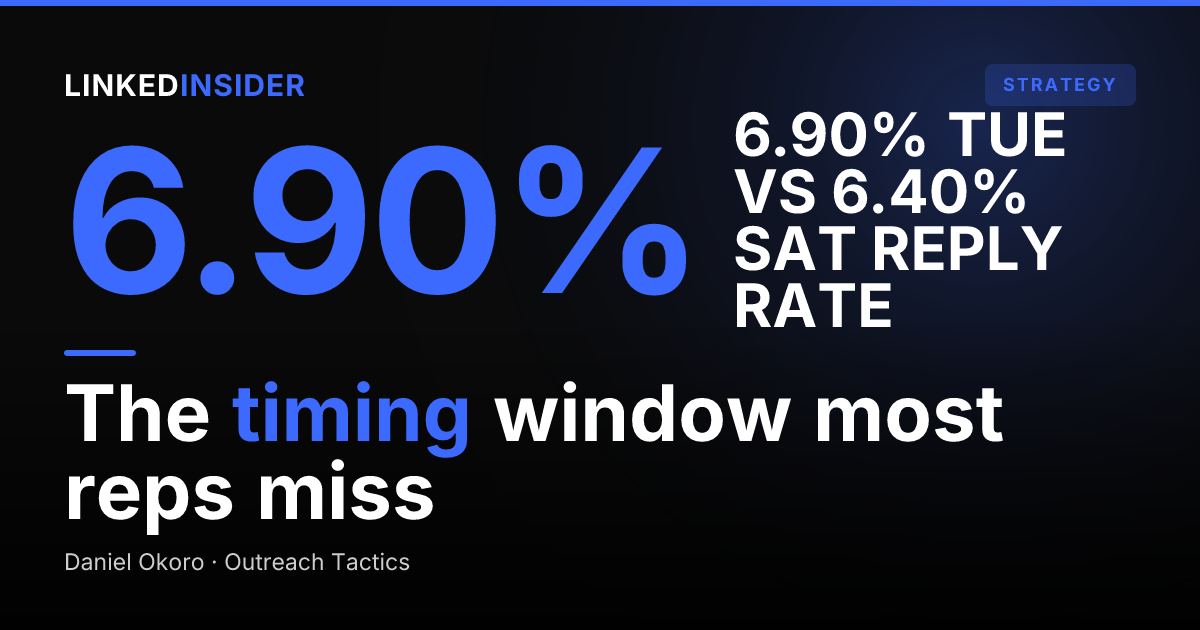
Tuesday leads, followed closely by Monday and Thursday. Closely's analysis of LinkedIn reply rates by day found Tuesday at 6.90%, Monday at 6.85%, Thursday at 6.63%, Wednesday at 6.62%, Friday at 6.58%, and Saturday at 6.40% (the floor). The absolute gap between the best weekday and the worst is about half a percentage point. [SYNTHESIS]
The practical implication is not that Tuesday is special. It is that the floor matters: weekends see replies drop and, more importantly, accepted requests sit unread until Monday, which compresses follow-up windows and disrupts sequence pacing. A connection accepted Friday evening may not generate a reply thread until the following week.
Expandi's 2026 dataset (13.2 million connection requests) reinforces the day pattern from the acceptance-rate side: Monday holds the highest connection acceptance rate, followed closely by Thursday and Wednesday. Monday requests catch prospects in triage mode at week-start, reviewing notifications before the meeting calendar takes over. For the full benchmark picture, see LinkedIn outreach benchmarks 2026. [SYNTHESIS]
The quotable one-liner: across Closely's response-rate dataset, Tuesday produces the highest LinkedIn reply rate at 6.90%, and Saturday the lowest at 6.40%, a gap that is real but modest, roughly half a percentage point separating the best from the worst weekday. [SYNTHESIS]
What is the best time of day to send LinkedIn messages?
9 a.m. to 11 a.m. in the prospect's local timezone is the primary peak window, consistent across multiple 2026 practitioner datasets (Salesrobot, Konnector.ai, We-Connect). Professionals have settled in, cleared initial notifications, and are in an active decision-making mindset before back-to-back meetings dominate the calendar.
A secondary window appears at 5 p.m. to 6 p.m., driven by end-of-day mobile scrolling, a pattern more pronounced since remote and hybrid schedules became standard. Konnector.ai's 2026 data supports this secondary window for shorter, conversational messages.
The times to avoid are midnight to 7 a.m. Beyond the obvious engagement drop, messages sent outside business hours generate activity signatures that resemble automated bulk sends, which LinkedIn's detection systems flag regardless of actual volume. This is an operational risk layer on top of the performance issue: the worst window for replies is also the riskiest window for account health.
Want to put this into practice?
Reachium automates LinkedIn outreach, content publishing, and inbox management in one platform.
Start Free →Does the prospect's timezone matter more than your timezone?
Yes, substantially. A 9 a.m. send in your timezone lands at 6 a.m. in a prospect's timezone eight hours behind you. The optimal window data is meaningless if it is applied to the sender's clock rather than the recipient's.
For a single timezone, this is manageable manually. For a prospect list spanning EST, GMT, and APAC, applying the right send window to each region without automation is operationally painful: the rep would need to stagger sends by timezone throughout the day, every day.
We-Connect's LinkedIn timing analysis supports the recommendation to anchor the send window to the recipient's local time, not the sender's. The reply-rate advantage of Tuesday at 10 a.m. only materializes if it is 10 a.m. for the prospect.
Does timing matter more than targeting and copy?
No. The reply-rate gap between Tuesday at 10 a.m. and Saturday at 9 a.m. is roughly 0.5 percentage points. The gap between a generic outreach sequence and a well-targeted, personalized message is measured in multiples.
Belkins' 2025 B2B LinkedIn Outreach Study found personalized connection requests generate a 9.36% post-connection reply rate versus 5.44% for generic messages, a 72% lift. No timing optimization produces anything close to a 72% lift. [SYNTHESIS]
For context on what the reply-rate baseline looks like in 2026, see LinkedIn response rate benchmarks. The honest mental model: fix targeting and first-line personalization first, then lock timing into a campaign schedule and stop thinking about it. Timing solves avoidable friction. It does not compensate for weak personalization or misaligned targeting.
What is the best time to send a LinkedIn connection request?
Connection requests follow the same day-of-week pattern as messages, with an important nuance around acceptance timing. Botdog's study of 16,492 LinkedIn invitations found that 21% of acceptances happen within the first 60 minutes, 63% within 24 hours, and 88% within 7 days. [SYNTHESIS]
Sending during peak hours (Tuesday through Thursday, 9-11 a.m. in the prospect's timezone) frontloads acceptances into the same business day, keeping sequence pacing tight. A connection accepted within 60 minutes can receive a follow-up message the same day while the prospect's attention is still active. A connection accepted Friday afternoon sits until the following week, adding days of latency to the sequence.
Expandi's 2026 data (13.2 million requests) confirms Monday holds the highest acceptance rate, followed by Thursday and Wednesday. Monday requests catch prospects clearing their notification queue at week-start, a decision-making posture that favors quick accepts. [SYNTHESIS]
For what to put in the connection request itself, the note versus no-note decision is a separate variable covered in should you add a note to a LinkedIn connection request. And for the message that goes out after the connection is accepted, connection request message examples covers the openers that produce replies.
Want to put this into practice?
Reachium automates LinkedIn outreach, content publishing, and inbox management in one platform.
Start Free →Does automated scheduling solve the timing problem for reps doing volume?
Yes, and it is the only scalable solution once the rep is sending across multiple timezones. At 30 sends a day, manual timing is feasible: the rep picks the right window and executes. At 80-100 sends across EST, GMT, and APAC, manual scheduling breaks down and defaults to whenever the rep logs in, which may be 7 a.m. or 9 p.m. depending on their schedule.
Browser-extension tools have an architectural constraint here: they execute sends when the rep's browser is open. If the rep works a standard U.S. business day and their APAC prospects are active at 9 a.m. Singapore time, the browser is closed. Cloud-based campaign scheduling decouples the rep's working hours from the prospect's active window.
The compliance layer matters too. LinkedIn's detection is sensitive to burst sending: 50 requests fired in two minutes is a recognizable pattern. Sending within human-pattern windows, distributed across the day, is both a performance factor and an account safety factor. The right scheduling approach is not just about hitting the peak window; it is about matching the send cadence to human behavior, not to when the rep's computer is on.
For a broader comparison of tool architectures and their scheduling capabilities, see best LinkedIn automation tools 2026. For how to structure the sequence that follows an accepted connection, LinkedIn follow-up sequence covers pacing and spacing across multi-step outreach.
Note on this data: day-of-week and time-of-day findings cited here come from vendor platform datasets (Closely, Expandi, Botdog, Belkins). These reflect their user base and methodology rather than a controlled independent study. Direction is consistent across sources; treat exact percentages as directional benchmarks, not precision figures.
FAQ
What is the best day to send LinkedIn messages?
Tuesday produces the highest reply rate (6.90%) in Closely's response-rate dataset, followed by Monday (6.85%) and Thursday (6.63%). The gap between the best and worst weekdays is about 0.5 percentage points. More important than day selection is avoiding weekends, where replies drop and accepted connections sit unread until Monday, disrupting follow-up pacing.
Should you send LinkedIn messages on Mondays?
Yes. Monday performs second only to Tuesday in reply rates (6.85% vs 6.90% per Closely), and Expandi's 2026 data (13.2M requests) shows Monday has the highest connection acceptance rate, because prospects triage their LinkedIn notifications at the start of the week. The concern that Monday morning is "too busy" is not supported by the data.
Is it safe to send LinkedIn messages early in the morning, before 7 a.m.?
No, for two reasons. Engagement is low because prospects are not yet active. And messages sent outside business hours generate activity signatures that LinkedIn's detection systems flag as potential automation abuse, regardless of message volume. The safest and most effective window is 9-11 a.m. in the prospect's local timezone.
Does timing matter differently for connection requests versus follow-up messages?
The best-day pattern is similar for both: Tuesday through Thursday leads for reply rates on messages, and Monday through Thursday leads for acceptance rates on connection requests. The timing nuance is that frontloading connection request accepts into the same business day (by sending at 9-11 a.m. prospect-local) keeps follow-up pacing tight, since Botdog's study found 21% of acceptances happen within 60 minutes and 63% within 24 hours.
Can you schedule LinkedIn messages without automation tools?
Technically yes, by manually sending during the target window each day. At low volume (under 30 sends a day, single timezone), this is feasible. At higher volume or across multiple timezones, it is not: you cannot be active at 9 a.m. GMT and 9 a.m. APAC simultaneously from a single machine without an automation layer. The manual approach also ties your send cadence to your working schedule rather than the prospect's active window.
Does LinkedIn penalize accounts for sending messages outside business hours?
LinkedIn does not publish an enforcement policy tied specifically to send times. The practical risk is that out-of-hours sends, particularly overnight batches, produce activity patterns that resemble automated bulk operations, which is what LinkedIn's detection systems flag. The risk is behavioral (pattern matching) rather than a stated rule against off-hours messages. Keeping sends within 7 a.m. to 8 p.m. prospect-local time is the operational guidance consistent with what practitioners report.
Sources
- Closely - LinkedIn Response Rates by Day: When to Send Messages for Maximum Replies
- Expandi - LinkedIn Outreach Benchmarks 2026 (13.2M data points)
- Botdog - LinkedIn Connection Request Acceptance Rates Study (16,492 invitations)
- Belkins - B2B LinkedIn Outreach Benchmarks 2025
- Konnector.ai - Best Time to Send LinkedIn Messages (2026 Data)
- We-Connect - Best Time to Send LinkedIn Connection Requests
- Reachium
- Linked Insider: LinkedIn outreach benchmarks 2026
- Linked Insider: LinkedIn response rate benchmarks
- Linked Insider: LinkedIn follow-up sequence