Account Managers: Grow Your Book of Business With LinkedIn White-Space Mapping
By Daniel Okoro, Outreach Tactics. Last updated: 2026-05-30
A few things account managers actually run into:
- The renewal is fine, but expansion is flat, and net revenue retention is the number on the scorecard.
- The only person they know inside a six-figure account is the original champion.
- Prospecting "inside" an account they already won feels awkward, so it never happens.
What drives account manager book of business growth on LinkedIn?
Your existing accounts are the cheapest pipeline you have, because the trust is already built. An account manager who expands inside a known logo starts with a champion who returns messages, a deployed product, and a reference, none of which a net-new prospect offers. Industry research from firms like Gartner and Forrester consistently finds that expanding an existing customer costs less than acquiring a new one, which is why net revenue retention has become the metric AMs are graded on.
The problem is that most LinkedIn-outreach advice treats every contact as a stranger and optimizes for cold volume. That framing skips the highest-leverage move available to an account manager: turning one trusted relationship inside an account into five. The territory is not the market. The territory is the org chart of the accounts you already own, and most of it is white space you have never been introduced to.
What is white-space mapping inside a named account?
White-space mapping is charting an account's org by department and seniority, then marking who you are already connected to versus the gaps you need to fill. The output is a simple grid: functions across the top (RevOps, Finance, IT, the line-of-business owner), seniority down the side, and a mark on every stakeholder you can reach through an existing relationship. The empty cells are your expansion pipeline.
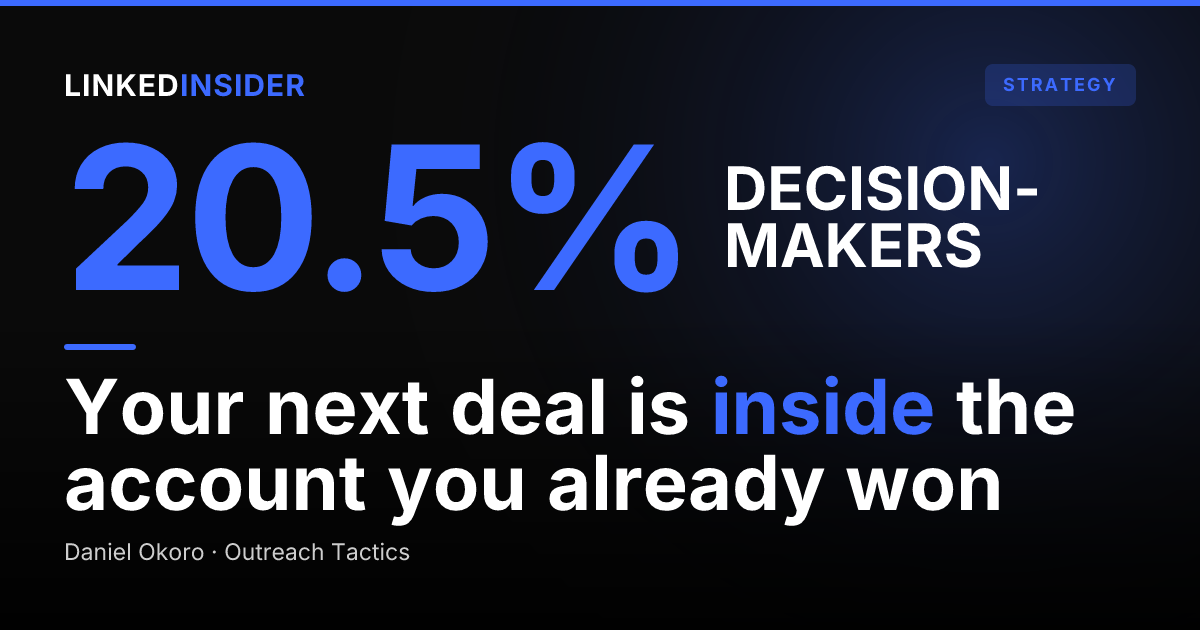
Prioritize the cells that sit on the buying committee. Reachium's data shows that of a multi-million-lead B2B universe in its lead universe, a large share flagged as decision-makers, which is a useful reminder that roughly four in five contacts you map are influencers and users, not the budget holder. Map both. Users give you adoption stories, and decision-makers approve the expansion, so an account graph with only one tier is a graph that stalls. For the legwork of confirming titles and reporting lines before you reach out, a tight pre-outreach research routine keeps the map accurate. [SYNTHESIS]
Want to put this into practice?
Reachium automates LinkedIn outreach, content publishing, and inbox management in one platform.
Start Free →How do you multi-thread without sounding like a cold sweep?
You multi-thread cleanly by leading with shared context, not a pitch. Every new touch inside an account should reference the outcome the champion already cares about, the project you are jointly running, or a result the team has seen. That single line of context is the difference between a relationship message and a blast, and it is the reason in-account expansion converts where cold outreach does not.
Stagger the touches so the account never feels swept. Reaching seven stakeholders in one afternoon reads as a campaign, even if each message is personalized. Spreading those same seven touches across two or three weeks reads as a manager working a relationship. The same discipline that protects a warm LinkedIn account from looking automated protects an account relationship from looking transactional: pace it, personalize it, and tie every message to a real, named outcome. If a trigger event hits the account, such as a funding round or a new hire in your buyer's function, a trigger-based message script gives you a non-cold reason to widen the thread that day.
How do you turn one champion into five warm intros?
You ask the champion for a specific, low-effort introduction, not a vague favor. "Could you point me to whoever owns onboarding on your side?" is far easier to act on than "Can you introduce me around?" Make the intro trivial: offer to draft the two-line message the champion can forward, name the exact person, and state the one outcome the introduction serves.
Expand laterally first, then upward. Peers of your champion (the other team leads who feel the same problem) are the safest next connections, because the champion can vouch from experience. Once you have two or three lateral relationships reinforcing the same value, the introduction upward to the budget holder carries social proof from inside the account. A clean way to keep this organized is matching every lead back to its account so you always know which champion unlocks which gap on the map.
"Quick one. We just hit [shared outcome] with [champion's team]. I think [name] in [function] runs into the same thing. Mind if I send you a two-line intro you can forward, or would you rather I reach out and mention you sent me?"
Why it works: it leads with a proven result, names the exact person, hands the champion a forward-ready option, and gives them an easy out, which is what makes a busy champion say yes.
What cadence grows an account without burning it?
A paced, relationship-led cadence grows accounts, and raw volume quietly shrinks them. Reachium's analysis of 180,155 matured connection requests surfaced what it calls the volume tax: acceptance peaked at 32.01% for accounts sending 10-19 invites a day and fell to 26.65% at 20-29 a day. More requests produced fewer accepts. For an account manager, that finding is doubly true, because every touch inside a named account either deepens or damages a relationship you cannot afford to lose. The full benchmark study lays out where acceptance and reply rates land across the dataset. [SYNTHESIS]
Pair one-to-one outreach with content that warms the whole account at once. When you publish something the buying committee finds useful, your direct messages land against a backdrop of visible expertise rather than out of nowhere. Hold individual outreach to a modest daily count, lead every message with account-specific context, and let content carry the broad awareness. That is how you stay present across a dozen stakeholders without any single one feeling chased. The same pacing logic underpins a deliberate account warm-up before any heavier sending.
Want to put this into practice?
Reachium automates LinkedIn outreach, content publishing, and inbox management in one platform.
Start Free →How do you track the relationship graph across a whole portfolio?
You track it by maintaining one living map per account and watching leading indicators, not just closed expansion. For each account, record the stakeholders you have reached, the champion who connects them, the white space still open, and the next planned touch. Across the portfolio, the metrics worth watching are new connections accepted inside target accounts, replies from newly mapped stakeholders, and booked expansion calls, all of which move weeks before revenue does.
This is exactly where a CRM that captures the LinkedIn relationship graph earns its place, because a spreadsheet of fifty accounts and three hundred stakeholders falls apart the moment a champion changes roles. Reachium's data shows reply rates of accepted connections drifted down through 2025 into 2026, so treating relationship signals as the leading indicator (and revisiting accounts that have gone quiet) matters more than it used to. Connection-to-meeting math from the funnel data gives you a realistic conversion expectation for each new thread you open.
FAQ
What is white-space mapping for account expansion?
White-space mapping is charting an account's org chart by function and seniority and marking who you already know versus the stakeholders you are not yet connected to. The unfilled cells, especially the ones on the buying committee, are your expansion pipeline for that account.
How do you multi-thread an existing account without sounding cold?
Lead every new touch with shared context (the outcome the champion cares about or the project you jointly run), and stagger the touches across weeks rather than hitting many people in one day. Context plus pacing is what makes outreach read as a relationship instead of a cold sweep.
How do account managers use a champion to get warm intros?
Ask for a specific, low-effort introduction by naming the exact person and the outcome it serves, and offer to draft the two-line message the champion can forward. Expand to the champion's peers first, then upward to the budget holder once lateral relationships reinforce your value.
What outreach cadence grows net revenue retention?
A modest daily volume with account-specific personalization, paired with useful content that warms the whole buying committee at once. Reachium's data shows acceptance peaks for accounts pacing 10-19 invites a day before the volume tax bites, so steady relationship-building beats blasting.