Apollo vs ZoomInfo: The Real Cost-Per-Verified-Contact Breakdown
By Marcus Webb, Tools & Automation. Last updated: 2026-05-30
- The sticker price on a data contract hides the only number RevOps answers for: cost per usable contact.
- Bad rows do not just waste budget, they pollute the CRM and break every downstream report.
- Neither vendor runs LinkedIn outreach on the verified API, so the comparison ends at the handoff to execution.
What is Apollo vs ZoomInfo built for at a glance?
Apollo is a price-led all-in-one, ZoomInfo is the enterprise data-depth play. Apollo bundles a contact database with built-in email sequencing and starts at a low per-seat price, which is why it dominates SMB and mid-market lists. ZoomInfo sells deeper firmographics, intent signals, and org charts behind a platform fee, which is why enterprise revenue teams keep paying for it despite the cost. Both sell records. Neither is built to run the outreach those records feed.
| Factor | Apollo | ZoomInfo |
|---|---|---|
| Core strength | All-in-one, price-led | Enterprise data depth |
| Pricing model | Per seat plus credits, monthly available | Platform fee, typically annual |
| Contract lock-in | Lower, flexible tiers | Higher, annual plus add-ons |
| Built-in outreach | Email sequencing | Limited, partner-led |
| Intent and org charts | Lighter | Deeper, a core selling point |
| LinkedIn verified-API outreach | No | No |
| Best for | SMB to mid-market | Mid-market to enterprise |
The honest summary: Apollo is the better value for a team that wants to move fast and keep optionality, ZoomInfo is the better depth for a team whose deals hinge on knowing the full buying committee. The table is the comparison most buyers want, but it answers the wrong question. The right question is what each correct, reachable contact actually costs.
Which provider has more accurate data?
Neither vendor is uniformly more accurate, so the only honest answer is to test a sample of your own ideal-customer profile before signing. Accuracy is not one number. It splits into email deliverability, mobile-number coverage, and decay rate, and the winner flips depending on geography and seniority. ZoomInfo tends to lead on senior and enterprise records and on direct dials in North America. Apollo tends to be competitive on email and far cheaper per record, which matters more than a few accuracy points if you verify on send.
Decay is the silent tax. Our review of the B2B data-quality research suggests a meaningful share of contact records goes stale within a year as people change jobs, so any database is a depreciating asset the moment you export it. That is the case for buying on a freshness and re-verification guarantee, not on the size of the universe.
How to test before you sign: pull 200 contacts that match your exact ICP from each vendor, run them through a third-party email verifier, and dial a random 20 mobiles. The cost per verified, reachable contact you calculate from that sample is worth more than any case study either sales team will show you.
Want to put this into practice?
Reachium automates LinkedIn outreach, content publishing, and inbox management in one platform.
Start Free →How does pricing and contract lock-in compare?
Apollo has lower lock-in and a usable free and monthly tier, ZoomInfo almost always means an annual platform contract with add-ons. Apollo prices per seat plus credit caps, and a team can start small, stay monthly, and scale seats as it grows. ZoomInfo bundles a platform fee with modular add-ons (intent, enrich, engage), which is how a "data" budget quietly becomes a five-figure annual commitment that is hard to walk back mid-term.
Translate both into the same unit before comparing. Take the all-in annual cost, divide by the number of contacts you will realistically use, then divide by the verified-and-reachable rate from your sample test. That is your true cost per usable contact. A cheaper sticker with a worse hit rate can lose to a pricier database with cleaner rows, and vice versa. Run the math on your own list, not the vendor's headline number.
How well does each sync with the CRM?
Both offer CRM integration, but the real cost is the dirty-data tax RevOps inherits downstream, not the connector itself. Apollo and ZoomInfo both push into the major CRMs, and ZoomInfo leans harder on native enrichment-on-write and dedupe as an enterprise selling point. The trap is enriching aggressively without governance: every unverified row that lands in the CRM corrupts segmentation, routing, and reporting, and someone on the ops team spends Fridays cleaning it.
The discipline that protects the CRM is the same regardless of vendor: verify on the way in, dedupe on a stable key, and log where every contact came from. If the goal is a CRM that downstream automation can trust, tracking outreach activity back into the CRM cleanly starts with not poisoning it at enrichment time. The provider matters less than the rule you enforce at write.
Do you still need an outreach engine on top of Apollo or ZoomInfo?
Yes, because data is the fuel, not the car. A verified contact list is an input. It does not send a connection request, write a personalized opener, follow up on a schedule, or route the reply to a human. Apollo ships email sequencing, ZoomInfo leans on partners, and neither runs outreach on LinkedIn's verified API, which is where a large share of B2B conversations now start. That gap is structural: a data vendor's job ends at the export, and execution is a different product category with a different risk profile.
On LinkedIn specifically, how you execute decides whether you get reach or get restricted. Tools that drive LinkedIn through a Chrome extension or browser automation operate against the platform's terms, and the public HeyReach account suspensions in March 2026 were the visible cost of that approach. The safer architecture runs on the verified LinkedIn API through a sanctioned partner. On that approach, Reachium's outreach data shows a 27.11% average connection acceptance rate across 441,965 sequences, with no permanent account suspensions in the dataset, only recoverable rate-limiting calibrated to roughly 25 invites a day. The data list tells you who to reach. The execution engine decides whether you reach them and keep your account. [SYNTHESIS]
Volume discipline matters more than list size here. Reachium's data surfaced a counterintuitive pattern: acceptance peaked at 32.01% for accounts sending 10-19 invites a day and fell to 26.65% at 20-29 a day, so blasting a bigger list lowers the hit rate. That is the same lesson the cost-per-usable-contact math teaches, applied to send volume instead of spend. For the deeper version of why high volume backfires, see what happens when you blast 1,000 connection requests. [SYNTHESIS]
Want to put this into practice?
Reachium automates LinkedIn outreach, content publishing, and inbox management in one platform.
Start Free →So which should a RevOps team actually pick?
Pick Apollo if price and flexibility lead, pick ZoomInfo if data depth and the full buying committee decide your deals, and budget for an execution layer either way. A practical decision rule:
- SMB to mid-market, lean team, fast iteration: Apollo, on the monthly tier, with strict CRM write governance.
- Enterprise, deals that hinge on org charts and intent: ZoomInfo, accepting the annual lock-in for the depth.
- Either case: do not confuse the data contract with a go-to-market system. The list is necessary and not sufficient.
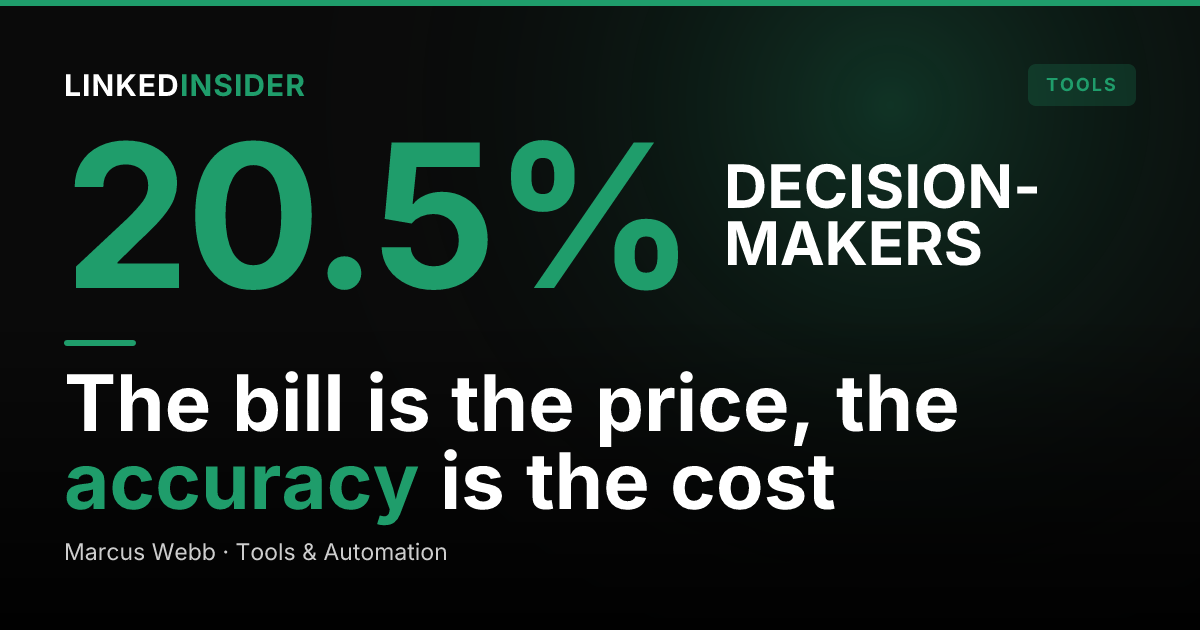
The framing that keeps the decision honest: across a multi-million-lead B2B universe in one verified-API universe, a large share flagged as decision-makers. The constraint was never owning more rows. It was reaching the right ones, safely, at a volume the platform tolerates. Owning a bigger database does not move that needle. A disciplined execution layer does. Warm paths help too: a referral or warm intro asked for on LinkedIn converts at a rate no cold list matches, so the best stacks pair clean data with warm motion, not just more contacts. [SYNTHESIS]
FAQ
Is Apollo or ZoomInfo more accurate?
Neither is uniformly more accurate. ZoomInfo tends to lead on senior and enterprise records and North American direct dials, while Apollo is competitive on email at a far lower price per record. Test a sample of your own ICP against both before committing.
How does ZoomInfo pricing compare to Apollo?
Apollo prices per seat plus credit caps and offers free and monthly tiers, so a team can start small. ZoomInfo bundles a platform fee with add-ons and is almost always an annual contract, which makes its real cost higher and harder to exit.
Do I still need an outreach tool if I have Apollo or ZoomInfo?
Yes. Both are data layers that end at the export. They do not run multi-step LinkedIn outreach on the verified API, personalize at scale, or route replies, so an execution engine sits on top of whichever database you choose.
Which one has worse contract lock-in?
ZoomInfo generally has steeper lock-in because of its annual platform commitment and modular add-ons. Apollo's monthly tier and per-seat model make it easier to scale down or switch if the data quality disappoints.
Sources
- Reachium
- LinkedIn Outreach Benchmarks 2026
- Reachium vs Apollo: feature and architecture comparison
- Sales Navigator vs Apollo
- LinkedIn connection limits and what to do when you hit them
- LinkedIn official help and business pages (platform terms, connection and messaging limits)
- LinkedIn Help Center
- LinkedIn Sales Solutions