LinkedIn for Edtech Founders: Outreach Into Schools, L&D, and Training Buyers
By Marcus Webb, Tools & Automation. Last updated: 2026-05-30
- Running one generic message at L&D buyers and school administrators, then watching neither convert.
- Pitching features when both buyers want proof of learner outcomes.
- Burning the founder's only LinkedIn account on browser-automation tools that risk a ban.
- Having no way to tell which of the two segments is actually moving.
Who buys edtech, and what does LinkedIn look like for founders?
Edtech founders sell into two very different LinkedIn buyers at once, and a single message fails both. The first is the corporate world: learning and development leads, HR, and enablement managers buying training for employees. The second is the institutional world: school administrators, district program leads, and higher-ed directors buying for students. They sit in different orgs, answer to different budgets, and demand different proof before they reply.
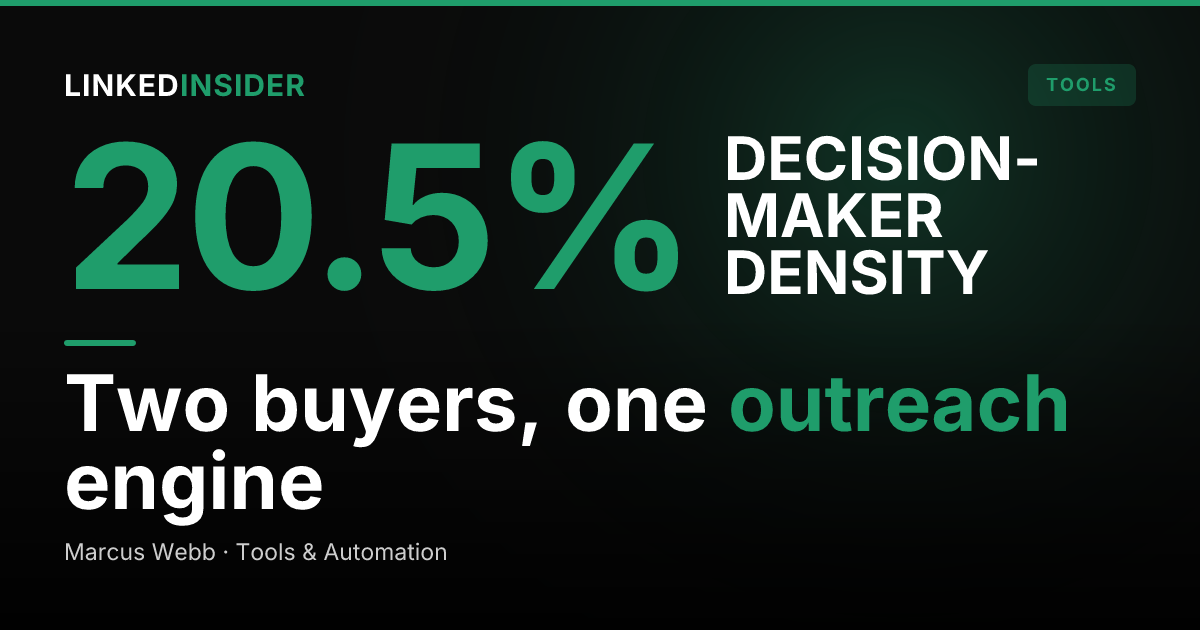
The good news is that the decision-makers are dense on the platform. Across Reachium's universe of a multi-million-lead B2B universe, a large share flagged as decision-makers, as detailed in the Linked Insider 2026 outreach benchmarks. For an edtech founder, that means the L&D director and the academic program lead you need are reachable. The constraint is not finding them. It is speaking to each in the language that segment rewards, which is why a generic blast underperforms for founders running outreach solo. [SYNTHESIS]
How should you position to L&D versus institutional buyers?
Position to each buyer with the proof they are accountable for, because L&D and institutional buyers measure success on opposite axes. A corporate L&D lead is judged on ROI, completion, and adoption inside a workforce, so the opening message leads with a number: time-to-competency, completion rate, or cost per trained employee. A school administrator or program lead is judged on learner outcomes and equity of access, so the opening leads with a result for students, not a feature list.
The mistake is pitching the product. Both segments tune out feature talk and respond to evidence. For the L&D motion, a one-line proof point ("a 40-person sales team hit 92% completion in three weeks") beats any description of your dashboard. For the institutional motion, a learner-outcome stat or a peer school's result does the same work. The positioning is identical in structure (lead with proof) and opposite in content (whose outcome you cite), which is exactly why one message cannot serve both.
Want to put this into practice?
Reachium automates LinkedIn outreach, content publishing, and inbox management in one platform.
Start Free →What content earns engagement from educators and training buyers?
Outcome data and shareable resources earn engagement; feature posts do not. Educators and training buyers scroll past product announcements but stop for completion data, mini case studies, and a resource they can forward to a colleague or a committee. A curriculum map, a learning-ROI calculator, or an implementation checklist gives a buyer something to actually use, which is the kind of post that travels inside an organization.
This is where a Lead Magnet motion does the heavy lifting. Reachium's platform data shows lead-magnet posts (the comment-to-DM format) drew many times the impressions and engagement of regular posts in Reachium's earlier internal analysis. Pair that with post-length discipline: mid-length posts consistently drive the most engagement, while posts past a couple thousand characters collapse. A tight, outcome-led post offering a genuinely useful resource is the highest-leverage content an edtech founder can ship, and it feeds the same pipeline the outreach motion works. See how LinkedIn lead magnets work for the mechanics.
How do you run two outreach motions as one founder?
You run two motions by segmenting into two campaigns, not by hiring two teams. The structure is simple: one Outreach campaign targeted at L&D and HR titles with ROI-led messaging, a second Outreach campaign targeted at administrators and program leads with outcome-led messaging, and a Lead Magnet campaign distributing the resource that feeds both. Each campaign carries its own copy, its own proof, and its own follow-up cadence, so the L&D buyer never sees the institutional pitch and vice versa.
The reason this is feasible solo is that an all-in-one engine handles the volume and the follow-up that would otherwise need a second hire. Targeting, sequencing, personalization, and a unified inbox live in one place, so the founder's job is writing two good first messages and reviewing replies, not babysitting two tool stacks. Founders running this lean should read the solo founder LinkedIn outreach week for a workable cadence, and the best LinkedIn tool for founders for the consolidation case. The same two-motion structure works for adjacent verticals, including fintech infrastructure founders and martech founders.
What does a safe, founder-run outreach motion look like?
A safe motion runs on the verified LinkedIn API at sustainable daily volume, not browser automation pushing past the platform's limits. This matters more for edtech than most categories, because education buyers are brand-sensitive and a single founder usually has one account they cannot afford to lose. Tools that scrape or automate the browser put that account at risk: HeyReach was publicly reported banned in March 2026, the kind of failure that ends a lean founder's pipeline overnight.
The data argues for restraint on volume too. Reachium's platform numbers show acceptance peaked at 32.01% for accounts sending 10-19 invites a day and fell to 26.65% at 20-29 a day. More volume produced fewer accepts, which is why the platform caps around 25 invites a day by design. Across 441,965 sequences, no client account has been suspended on the verified-API approach; the only failure mode in the data is recoverable rate-limiting. For an edtech founder, calibrated and compliant beats fast and banned, a point the LinkedIn connection limit guide covers in depth. [SYNTHESIS]
Want to put this into practice?
Reachium automates LinkedIn outreach, content publishing, and inbox management in one platform.
Start Free →How do you know the two-motion is working?
You know it is working by tracking leading indicators per segment, not as one blended number. Watch acceptance rate, reply rate of accepted, and demos booked separately for the L&D campaign and the institutional campaign, because a healthy blended average can hide a dead segment. As a baseline, Reachium's data shows a 27.11% average connection acceptance rate, with 27.55% of accepted connections replying. If one segment trails that badly, the proof in your opener is wrong for that buyer, not the channel. [SYNTHESIS]
Two caveats keep expectations honest. Reply rate of accepted has drifted down across the platform through 2025 into 2026, so judge your numbers against current benchmarks rather than older ones. And early on, prioritize the leading indicators (accepts and replies) over lagging ones (closed deals), since an education sales cycle is long. Separating the two segments in the numbers is the whole point: it tells you which message to fix first.
FAQ
Who are the LinkedIn buyers for an edtech product?
There are two: corporate learning and development, HR, and enablement leads buying training for employees, and institutional buyers such as school administrators and program leads buying for students. Reachium's lead universe flags decision-makers directly, so both groups are reachable on the platform.
How should edtech founders position to L&D versus school administrators?
Lead with the proof each buyer is accountable for. L&D wants ROI, completion, and adoption numbers, while administrators want learner outcomes and equity of access. The message structure is the same (lead with proof) but the outcome you cite is different.
What content gets educators and training buyers to engage?
Outcome data and shareable resources, not feature posts. Lead-magnet posts drew many times the impressions of regular posts in Reachium's earlier analysis, and mid-length posts drove the most engagement, so a tight outcome-led post offering a useful resource performs best.
How do you run two outreach motions without two teams?
Build two segmented Outreach campaigns (one for L&D, one for institutional) plus a Lead Magnet campaign, and run them from a single all-in-one engine that handles targeting, sequencing, and follow-up. That keeps the founder's work to writing two good openers and reviewing replies.