Why Your LinkedIn Connection Acceptance Rate Dropped (Read the Signal Before You Get Throttled)
By Daniel Okoro, Outreach Tactics. Last updated: 2026-05-30
- You rewrote the opener three times and acceptance kept sliding, so the message was never the real problem.
- Your number dropped only on one segment, which points at audience drift, not your profile.
- Acceptance fell the same week you doubled daily volume, the single most common self-inflicted cause.
- Reach collapsed across everything at once, the pattern that actually looks like throttling.
What is a normal LinkedIn acceptance rate in 2026?
A normal LinkedIn connection acceptance rate sits around 27% on cold outreach to a reasonably targeted B2B list. Across 180,155 matured connection requests, Reachium's data shows a 27.11% average acceptance rate, which gives you a real reference line to measure your own number against instead of guessing. [SYNTHESIS]
"Low" is relative to your list. A tightly targeted C-suite segment and a broad SMB blast do not share a target, so compare yourself to your own trailing average, not a universal threshold. The more useful read is the trend. Acceptance is a leading indicator of account health, so a small sustained drop over three or four weeks matters far more than a single bad day. For a deeper baseline by industry and seniority, the acceptance-rate benchmark breakdown shows how much the "normal" number moves by segment.
Why did my LinkedIn acceptance rate drop?
Acceptance drops for one of four reasons, and they have a diagnostic order: profile decay, audience drift, volume spikes, then shadow throttling. Work them in that sequence, because the cheapest fixes sit at the top and the message copy that most people blame first is almost always last.
Isolate each one with a quick check:
- Profile decay. Did you change your headline, photo, or banner recently? A weaker profile lowers the "should I accept this person" decision before your note is ever read.
- Audience drift. Plot acceptance by segment. If one persona or seniority band tanked while others held, your targeting drifted, not your account.
- Volume spikes. Plot invites per day. A drop that starts the same week your daily count jumped is a volume problem.
- Shadow throttling. If reach, search appearances, and acceptance all fall together across every segment at once, the platform may be quietly limiting you.
Copy lands last because a rewritten opener cannot rescue a list of the wrong people or an account that has been flagged. If you have genuinely ruled the first three out, then test the connection request note and study request message examples that hold up.
Want to put this into practice?
Reachium automates LinkedIn outreach, content publishing, and inbox management in one platform.
Start Free →Does sending more connection requests actually lower acceptance?
Yes, and the data is counterintuitive: past a certain point, more volume buys fewer accepts. Reachium's platform analysis found acceptance peaked at 32.01% for accounts sending 10-19 invites a day and fell to 26.65% at 20-29 a day. More requests, a lower hit rate. [SYNTHESIS]
That is the volume tax, and it traps SDRs who respond to a slide by sending more. If your per-day curve is already past its peak, adding volume pushes you further down the wrong side of it while raising your account risk. A steady cadence beats a spiky one on both fronts. This is the same trap behind the advice to stop sending 100 connection requests a day, and the math plays out in full when you trace what happens across 1,000 connection requests. The fix is rarely "send more." It is "send the same amount, more consistently, to better people."
Is a low acceptance rate a sign LinkedIn is throttling me?
A sustained, cross-segment drop can be a throttling warning, and learning to tell shadow throttling from a hard rate-limit is the most valuable read on this list. Shadow throttling shows up as a slow, broad decline across acceptance, reach, and visibility at once. A hard rate-limit is sharper and usually maps to a specific day you exceeded a cap.
The mechanism that drives most throttling is volume delivery, and this is where your tooling decides the outcome. Browser-automation and Chrome-extension tools spike volume in bursts that trip LinkedIn's limits, which is exactly when acceptance craters and reach gets pulled. The publicly reported HeyReach account-ban incident in March 2026 is the cautionary version of that pattern. A motion built on the verified LinkedIn API, by contrast, paces requests under the throttle line by design, so the worst case in Reachium's data is a recoverable rate-limit rather than a permanent suspension. To weigh the channels themselves, the InMail vs connection request breakdown shows where each one carries throttling risk.
How do I fix a falling acceptance rate without burning the account?
Fix the cause you diagnosed, in order, and do not touch copy until the first three are clean. Working the symptom is what turns a recoverable dip into a throttled account.
- Refresh the profile if you edited it recently or it looks thin. This is the cheapest lever and it moves the accept-decision before your note loads.
- Tighten targeting to decision-makers. Reachium's lead universe flags decision-makers as their own layer, a reminder that a sharper list lifts acceptance more reliably than a cleverer opener.
- Slow the per-day curve back under roughly 25 invites a day and hold it steady. Trade the spike for consistency.
- Then, and only then, re-test the message. If the outreach mistakes that kill reply rate are absent and you have moved the first three levers, copy testing finally pays.
Set acceptance as a monitored health metric with a trailing average and a drop threshold, not a weekly panic trigger. The same discipline carries downstream: a stable accept rate is what makes the rest of the funnel legible, including the connection-to-meeting timeline that tells you whether accepted contacts are actually converting.
Want to put this into practice?
Reachium automates LinkedIn outreach, content publishing, and inbox management in one platform.
Start Free →FAQ
What is a normal LinkedIn connection acceptance rate?
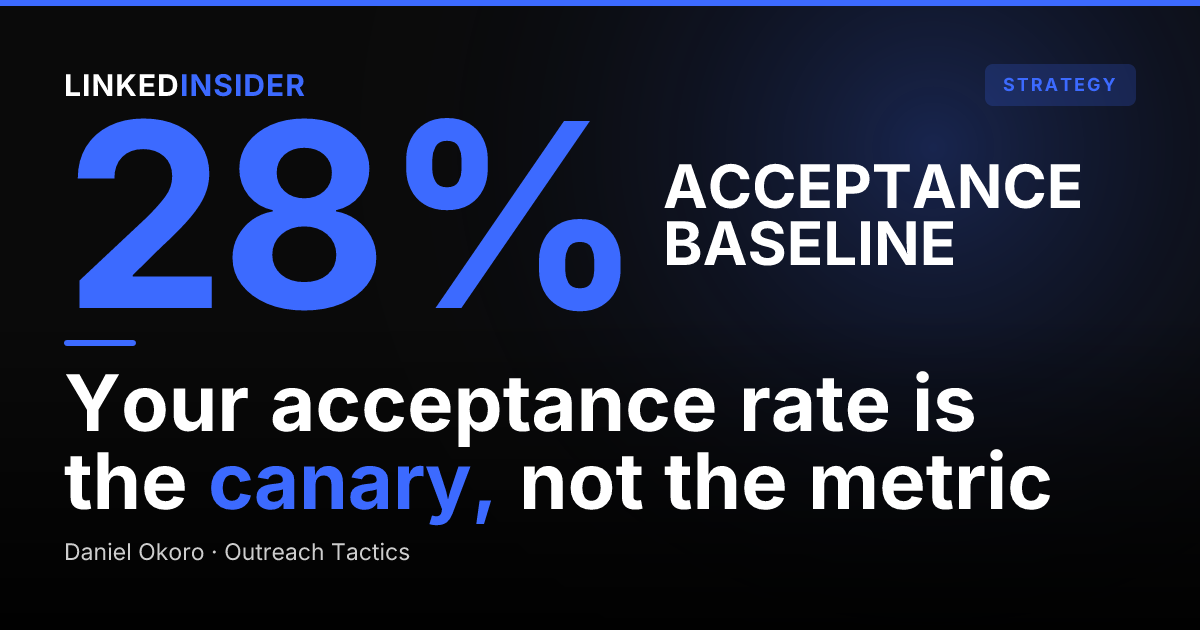
Around 28% on cold outreach to a reasonably targeted B2B list, based on Reachium's analysis of 441,965 verified-API sequences. Measure your own number against your trailing average and your list quality, not a single universal threshold.
Why did my LinkedIn acceptance rate suddenly drop?
Check the four causes in order: a recent profile edit, a drifting target list, a spike in daily invites, or a broad reach collapse that suggests throttling. The cause that started the same week your number fell is usually the real one, and it is rarely the message.
Does sending more connection requests lower acceptance?
Often, yes. Reachium's platform data found acceptance peaked at 32.01% in the 10-19 invites-per-day band and fell to 26.65% at 20-29 a day, so once you are past the peak, more volume lowers your hit rate and raises account risk.
Is a low acceptance rate a throttling warning?
It can be when acceptance, reach, and search visibility all fall together across every segment. That broad pattern points at shadow throttling, which browser-automation tools trigger by spiking volume, whereas a verified-API motion paces under the limit and caps the worst case at a recoverable rate-limit.