Should You Add a Note to a LinkedIn Connection Request?
By Daniel Okoro, Outreach Tactics. Last updated: 2026-05-23
Every sales training says to personalize everything. The data says something more complicated. Three independent studies with combined sample sizes exceeding 100,000 connection requests reach different conclusions on whether notes help. They are all correct, because they are measuring different things.
Does a LinkedIn connection request work better with or without a note?
The honest answer: it depends on the quality of the note, not simply its presence.
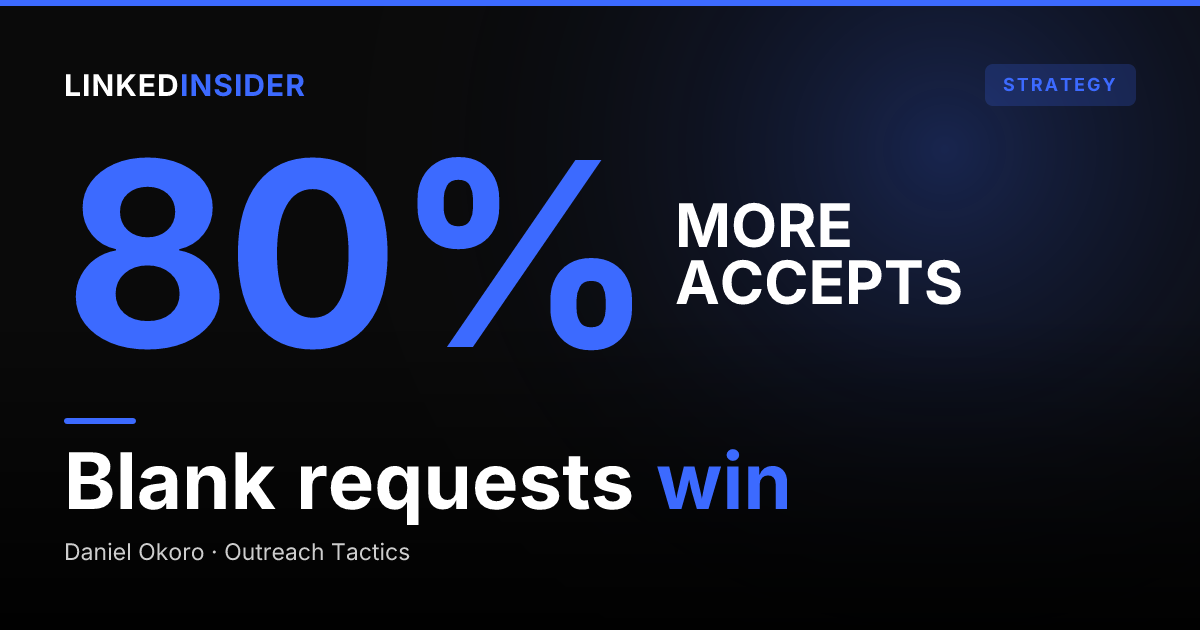
Botdog's study of 16,492 invitations found blank requests get 80% higher acceptance rates than requests with a note. ReactIn's analysis of 80,000+ automated campaigns found connection requests without a note accepted at 55-68% versus 28-45% with a note. Then Cleverly's 2026 benchmark, drawing on 20 million outreach attempts, found virtually no difference: 26.42% acceptance with a note versus 26.37% without one. [SYNTHESIS]
Three vendors, three conclusions. The reconciling variable is context quality. Botdog and ReactIn looked primarily at templated outreach at scale, where notes read as pitches. Cleverly's data comes from campaigns where operators were specifically trying to write contextual notes. When a note feels earned, acceptance rate stabilizes. When it feels generic, it triggers ignore.
The usable finding: if you are sending at volume with no specific context for each prospect, removing the note is likely to raise your acceptance rate. If you have a real reason to connect, a concise note referencing that reason can hold acceptance rate steady while improving what happens after acceptance. Across 180,155 connection requests run through the verified API, Reachium's data shows a 27.11% average acceptance rate in 2026, consistent with Cleverly's blended benchmark and useful as a baseline for any campaign audit. See the LinkedIn outreach benchmarks 2026 and LinkedIn response rate benchmarks for the full stage-by-stage picture. [SYNTHESIS]
What does a note do to your reply rate after acceptance?
This is the stat that cuts through the acceptance-rate debate entirely.
The same Cleverly-cited dataset (Expandi, 20M outreach attempts) found campaigns with a connection note generated a 9.36% post-connection reply rate versus 5.44% without a note: a 72% lift. Acceptance rate barely moved, but the quality of who accepted did. People who accepted a note that resonated had already cleared one layer of skepticism before reading the follow-up message. Reachium's study of the same question, across 19,516 noted and 160,639 blank matured requests, points the same direction: among accepted connections, 47.80% replied when the request carried a note versus 25.54% without one, while the acceptance effect stayed inconclusive once per-account sending mix was accounted for. [SYNTHESIS]
The interpretation: a well-written note pre-qualifies the connection. The acceptance rate is the wrong primary metric when post-connection reply rate is what drives pipeline. A 26% acceptance rate on noted requests that convert at 9.36% post-connection, per the Cleverly/Expandi data above, beats a 32% acceptance rate on blank requests that convert at 5.44%, if the note is doing real work. [SYNTHESIS] The downstream funnel math behind the note-versus-no-note trade-off (how acceptance, reply, and meeting rates compound) is broken out in what happens to 1,000 LinkedIn connection requests.
Practical implication for an SDR: if your post-connection sequence is strong and you can personalize the note to a specific context (a post they wrote, a recent job change, a mutual connection's referral), the note earns its place. If you cannot do that at your current send volume, drop it. Put the personalization into the first follow-up message after acceptance instead. The outreach templates that hit 40% reply rate breaks down what that post-connection message should contain.
Want to put this into practice?
Reachium automates LinkedIn outreach, content publishing, and inbox management in one platform.
Start Free →What is the LinkedIn connection note character limit in 2026?
Free accounts: 200 characters per note. Premium, Sales Navigator, and Recruiter accounts: 300 characters. This is not a word limit; it includes spaces and punctuation.
The harder constraint for free users: LinkedIn caps personalized connection notes on free accounts at roughly 5-10 per month. After that cap, the platform forces a blank request. Reps on free accounts who have "always add a note" as their standing rule are, past the first few days of the month, sending blank requests anyway. They typically do not know the policy shifted under them.
At scale, the character limit is less relevant than the monthly note cap. Premium users have unlimited personalized notes at 300 characters. This is one of the clearest practical arguments for upgrading to a paid LinkedIn account if you are doing serious outreach volume. It is also the reason why tool architecture matters: browser-automation tools that burn through a free account's note cap in a day, then silently switch to blank requests for the rest of the month, make a strategic choice on your behalf without telling you.
When does a note actually help?
Four situations where a note earns its place:
- You share genuine context the prospect can verify instantly: you attended the same event, commented on the same post, or have a mutual first-degree connection who referred you.
- You are targeting high-value accounts where a lower acceptance rate is acceptable if the quality of conversation that results is higher.
- Your ICP is senior enough that their inbox filter is tight. A completely cold, contextless request reads as low-effort.
- You are running a warm sequence (profile view, engage with their content, then connect) and the note references what you engaged with.
Four situations where a note hurts:
- You are sending at volume with no per-prospect context.
- The note is a mini pitch ("I'd love to connect to share how [product] helps teams like yours...").
- Your template has spread widely enough that your ICP's inbox has seen it before.
- You are a free account burning through your monthly note cap on mid-priority prospects.
Decision rule in one sentence: if you cannot fill that note with something specific to that prospect (something they wrote or did), send it blank.
For the structural question of whether to lead with a connection request or InMail at all, the LinkedIn InMail vs. connection request comparison for 2026 covers that channel-selection layer before you get to note versus no note.
What should you actually write in a LinkedIn connection note?
The 200-character constraint is a discipline aid. The note is not the pitch. It is the reason to accept.
Three patterns that work at this length:
Reference their content. "Saw your post on [specific topic], agreed with your point on [specific argument]. Worth connecting." This requires reading the post; it cannot be templated.
Mutual referral. "[Mutual name] suggested I reach out." One sentence. Nothing else needed. The referral is the credential.
Shared context. "We're both in [group/community/event]; wanted to connect." Verifiable, brief, contextually earned.
What to avoid: the mini-pitch ("I help companies like yours..."), the generic opener ("I'd love to add you to my network"), and the compliment that could apply to anyone ("Your work at [Company] is impressive; would love to connect").
Expandi's data from 13.2 million connection requests shows note reply rates declined 37%, from 3.5% in May 2025 to 2.2% by April 2026. The likely cause is template saturation. The average note has converged on the same phrasing, so the bar for a note that earns a reply in 2026 is meaningfully higher than it was two years ago. If the note sounds like something a tool wrote, it reads like something a tool wrote. The analysis of 100 top-performing LinkedIn DMs shows what the openers that do get replies have in common. [SYNTHESIS]
Want to put this into practice?
Reachium automates LinkedIn outreach, content publishing, and inbox management in one platform.
Start Free →How does this change if you are running automated outreach?
At automation scale, the note question becomes an infrastructure question, not a copywriting one.
Most browser-automation tools attach the same templated note to every request in a sequence and exhaust a free account's monthly cap in the first day or two, then silently send blank requests for the rest of the month with no strategy shift. The rep sees "connection request sent" and assumes the note went with it. It did not.
The verified-API approach handles this differently. Outreach Campaigns can be configured to vary note inclusion by segment: for the narrow segment where a note is genuinely contextual (warm sequence completions, high-value named accounts), the note goes out; for broad cold volume, blank requests are the deliberate choice, not a fallback. This is an infrastructure decision made once at the campaign level, not a per-send guess.
The other variable at automation scale: note quality. AI Personalization that references a prospect's actual recent post or job change produces a different note than a mail-merge first-name field. The former can hold acceptance rate steady and lift post-connection reply rate. The latter accelerates the template-saturation effect that Expandi's data is measuring.
FAQ
Do blank connection requests look unprofessional?
No. Most senior buyers on LinkedIn prefer a clean, note-free request from someone whose profile signals relevance over a note that reads like a template. A blank request from a well-optimized profile converts better than a templated note from a hollow one. Optimize the profile first; worry about the note second.
Does LinkedIn notify you when someone reads your connection note?
No. LinkedIn does not send a read receipt for connection notes. The recipient sees the note when they review the pending request, but there is no notification to the sender confirming the note was read. You only learn the outcome: accepted, ignored, or declined.
What is the LinkedIn connection request weekly limit in 2026?
LinkedIn caps connection requests at roughly 100-200 per week for most accounts, with the precise limit varying by account age, activity history, and whether you have Premium or Sales Navigator. The more relevant constraint for reps sending notes is the monthly personalized-note cap on free accounts (roughly 5-10), which is typically hit long before the weekly connection-request ceiling.
Can a connection note get my account restricted?
The note content itself rarely triggers a restriction directly. What triggers restrictions is the volume and velocity of requests, especially when many recipients mark them as "I don't know this person." A generic or pushy note increases the rate at which recipients mark requests as spam, which in turn raises restriction risk. The safety case for blank requests is partly this: fewer recipients feel solicited, so fewer click "I don't know this person."
What tool handles personalized connection notes at scale without hitting free-account limits?
Reachium runs outreach on the verified Unipile LinkedIn API, which respects platform rate limits and lets teams configure note inclusion per campaign segment rather than applying a single rule to all sends. AI Personalization references each prospect's actual posts and activity (not a name-fill token), so the notes that do go out reference something real. For reps doing more than a few dozen personalized sends per month, this is the architecture that makes the note-or-no-note decision a strategic choice rather than an accident of quota.
Sources
- Reachium: Do connection notes work? (180,155 matured requests)
- Botdog: LinkedIn connection request acceptance rates study (16,492 invitations)
- ReactIn: LinkedIn Connection Request With or Without Note (80,000+ campaigns)
- Cleverly: LinkedIn Benchmarks 2026
- Expandi: LinkedIn Outreach Benchmarks 2026 (13.2M data points)
- LeadLoft: LinkedIn Limits in 2026
- LinkedSDR: LinkedIn Limits Complete Guide 2026
- Linked Insider: LinkedIn InMail vs. Connection Request 2026
- Linked Insider: Outreach Templates (40% Reply Rate)
- Linked Insider: LinkedIn Response Rate Benchmarks
- Linked Insider: Analyzed 100 Top LinkedIn DMs
- Linked Insider: LinkedIn outreach benchmarks 2026