Connection to Meeting: The Real LinkedIn Outreach Timeline in Days
By Elena Marsh, Strategy & Algorithm. Last updated: 2026-05-30
- The first month feels broken because almost nothing has cleared the funnel yet, which is normal, not failure.
- Sending more invites to go faster lowers acceptance, so volume is not the accelerator founders assume it is.
- A timeline that stalls after warm-up is usually a targeting or messaging problem, not a speed problem.
- Month two compounds because the pipeline lag from month one finally lands as booked calls.
How long until LinkedIn outreach books meetings after warm-up?
Plan on a 2-3 week ramp before a cold account sends real outreach volume. A brand-new or long-dormant LinkedIn profile that suddenly fires dozens of connection requests looks automated, and LinkedIn throttles it. The warm-up phase exists to build a normal activity signal: profile completeness, a few posts, some genuine engagement, and a gradual climb in daily invites rather than a cold start at the ceiling.
The risk of skipping warm-up is not a permanent ban in most cases. Across the outreach sequences Reachium analyzed, no permanent suspensions appear in the data, and the worst observed outcome is a recoverable rate-limit. That is recoverable, but it costs you days while the account cools off, which is exactly the delay a time-poor founder is trying to avoid. The mechanics of that cooldown, and how to resume cleanly, are covered in the cooldown and soft-restriction resume guide. Treat warm-up as the first leg of the timeline, not a tax on it.
What does the day-by-day outreach Gantt look like?
The clock runs in five overlapping phases, and laying them out as a day count is the fastest way to see why "weeks" is the honest answer. Here is the message funnel mapped against calendar days for a single account from a standing start.
| Phase | Day range | What happens |
|---|---|---|
| Warm-up | Days 1-18 | Profile build, light posting, daily invites ramp toward a steady pace |
| Invite send | Days 14-30+ | Connection requests go out at a calibrated daily volume |
| Accept lag | Days 1-7 after each invite | Prospects accept on their own schedule, often days later |
| Sequence steps | Days 1-14 after accept | Opener, value message, and follow-ups land across the week |
| Meeting ask | Week 4-6+ | The booking ask converts a small share of replies into calls |
Notice the overlap. By the time warm-up ends, the first invites are already aging, and accepts are trickling in while the sequence runs. The first booked meeting from a true cold start typically lands somewhere in weeks 4-6, not in week one. For a deeper breakdown of the same clock, see how long LinkedIn outreach takes to book a meeting.
Want to put this into practice?
Reachium automates LinkedIn outreach, content publishing, and inbox management in one platform.
Start Free →How many connections turn into a booked meeting?
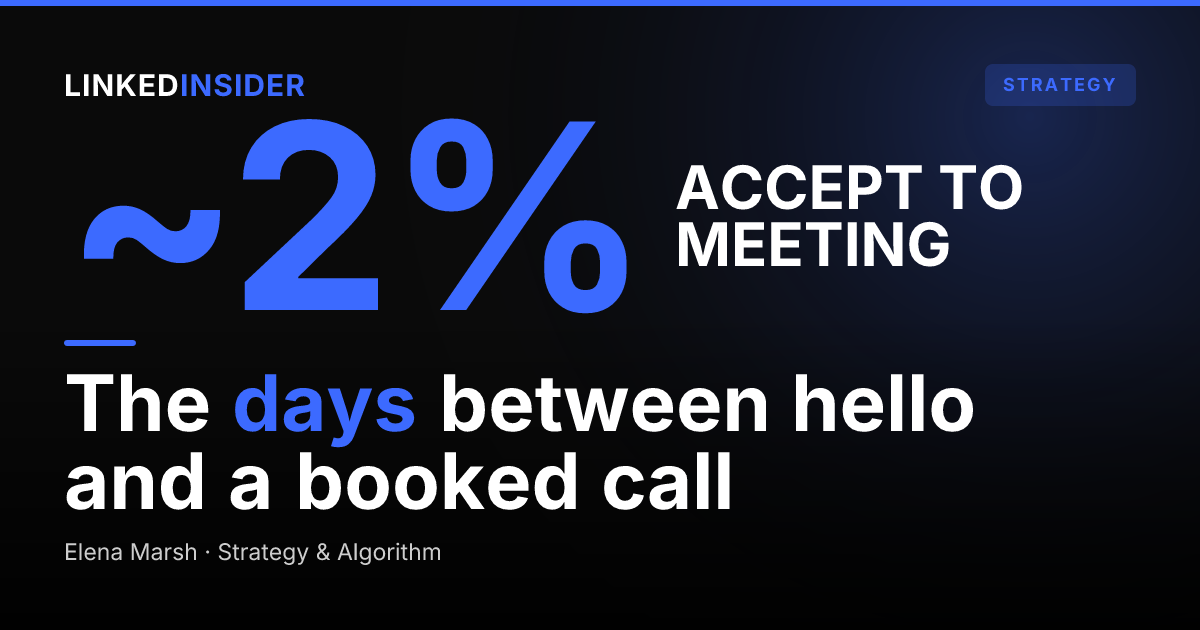
About 2% of accepted connections book a meeting, so the funnel is narrow by design and volume and patience have to compound together. Reachium's data across 180,155 matured connection requests shows a 27.11% average connection acceptance rate. Of those accepts, 27.55% reply, which is 7.47% of every request sent. Booked meetings land at 1.99% of accepted connections. [SYNTHESIS]
Work that backward and the timeline makes sense. To produce a handful of meetings, you need a few hundred accepts, which means roughly a thousand invites, which cannot all go out on day one of a warmed account. The funnel does not collapse because you want it faster; it clears at the rate accepts and replies arrive. Reachium's timing study measures that rate: the median accept arrives 25.37 hours after the invite, 65.97% of accepts land within 72 hours, and the curve keeps filling out to 92.04% at 30 days. The full accept-to-reply-to-booking arithmetic is laid out in the LinkedIn outreach-to-meeting math and the connection requests per meeting funnel data. Knowing the ratio is what lets you read progress instead of guessing. [SYNTHESIS]
Why does sending more invites not speed up the clock?
More volume lowers acceptance, so flooding the funnel slows the thing it was supposed to accelerate. This is the counterintuitive finding in Reachium's data, what the analysis calls the volume tax: acceptance peaked at 32.01% for accounts sending 10-19 invites a day and fell to 26.65% at 20-29 a day. More requests, fewer accepts per request. [SYNTHESIS]
That is why the platform paces sends in a modest band rather than maxing out the daily limit. A founder who doubles volume to hit meetings sooner ends up with a lower acceptance rate, a higher rate-limit risk, and roughly the same number of accepts arriving more erratically. The lever that actually moves the timeline is targeting quality, not raw send count. Reachium's universe holds a multi-million-lead B2B universe with a large share flagged as decision-makers, and pointing a calibrated daily volume at the right people beats pointing a firehose at everyone. The full benchmark set lives in the LinkedIn outreach benchmarks for 2026. [SYNTHESIS]
Why does month one feel slow and month two compound?
Month one feels slow because the pipeline lag is front-loaded: you are doing the work, but almost nothing has finished traveling through the funnel yet. Invites are out, a few accepts have landed, and a couple of conversations have started, but the meeting asks are still weeks away. Activity is high and outcomes are near zero, which reads like failure if you only watch the calendar.
Month two compounds because everything you planted in month one matures at once. The accepts from weeks 3-4 become replies, the replies become meeting asks, and a steady stream of new invites keeps refilling the top of the funnel. The leading indicators to watch in month one are acceptance rate and reply rate, not booked meetings, because those two predict month two. This is the same lag founders hit with content: see why LinkedIn content books meetings on a delay and the realistic how long to see LinkedIn results timeline.
Want to put this into practice?
Reachium automates LinkedIn outreach, content publishing, and inbox management in one platform.
Start Free →How do you read the clock instead of pulling the plug early?
Read it against milestone checkpoints, not against a wished-for date. By the end of warm-up, the account should be sending a steady daily volume with no rate-limit flags. By week 3, acceptance should be tracking near Reachium's 27.11% benchmark. By week 4, replies should be arriving from accepted connections. By weeks 5-6, the first meeting asks should be converting. [SYNTHESIS]
If acceptance is well below benchmark after warm-up, that is a targeting or messaging problem, not a speed problem, and sending more will not fix it. A stalled clock past warm-up almost always traces to the wrong audience or a weak opener, both of which are diagnosable from the numbers. The most common founder errors that quietly break the clock are catalogued in founder LinkedIn outreach mistakes. The discipline is simple: judge the leading indicators on schedule, and only change one variable at a time.
Should a founder run this in-house or hand it off?
The decision comes down to whether the warm-up and daily-send grind is worth a founder's hours. Running it in-house means owning the 2-3 week warm-up, calibrating the daily volume to stay in the high-acceptance band, writing and pacing the sequence, and watching for rate-limit signals every day. None of that is hard. All of it is time, and it is daily for the full window before the first meeting lands.
Handing it to a managed motion removes the daily clock-watching while keeping the same funnel math. The honest tradeoff is cost versus calendar hours, and for a funded founder whose time is the scarce input, the math usually favors handing off. Compare the in-house versus managed approach for outreach before deciding. A founder who wants to keep it in-house without owning the daily clock-watching can start a free trial and let the platform handle warm-up pacing and sequencing.
FAQ
How long should you warm up a LinkedIn account before sending invites?
Plan on 2-3 weeks. A cold or dormant account that fires high volume immediately looks automated and gets throttled, so the ramp builds a normal activity signal first.
How many days from a connection accept to a booked meeting?
Accepts trickle in over the days after each invite, then the sequence and meeting ask play out across the following week or two, so the first meetings from a cold start typically land in weeks 4-6.
Why is month one of LinkedIn outreach so slow?
Because the pipeline lag is front-loaded: invites are out and conversations are starting, but almost nothing has cleared the full funnel to a booked call yet. Watch acceptance and reply rates, not meetings, in month one.
When should a founder expect the first meeting from outreach?
From a standing start with a warm-up phase, expect the first booked call in roughly weeks 4-6, with the steadier flow arriving in month two as the funnel compounds.
Does sending more invites speed it up?
No. Reachium's data shows acceptance peaks at 32.01% in the 10-19 invites-per-day band and drops as volume climbs, so flooding the funnel lowers your accept rate instead of accelerating bookings.
Want to put this into practice?
Reachium automates LinkedIn outreach, content publishing, and inbox management in one platform.
Start Free →