The Acquisition-Trigger LinkedIn Message: How to Reach a Newly-Acquired Company Before Reps Pile In
By Daniel Okoro, Outreach Tactics. Last updated: 2026-05-30
- Most reps send "Congrats on the acquisition!" on day one, which reads as a template and gets archived.
- The buyer is not celebrating. They are absorbing two stacks, two teams, and a board asking what gets cut.
- The real window is integration chaos, usually weeks two through six, not the press-release day.
- The decision-maker you want changed too: titles, reporting lines, and budget owners all moved.
Why is an acquisition the most under-used sales trigger?
An acquisition is the trigger most reps ignore because they crowd the obvious ones, job changes, funding rounds, and promotions, while M&A sits quieter and creates sharper pain. When two companies merge, duplicate tools collide, contracts come up for consolidation, and a finance team starts hunting for overlap to cut. A contract that was "fine" becomes "why are we paying for two of these."
The research on trigger-based selling is consistent on one point: relevance beats volume. Outreach tied to a specific, recent event in the prospect's world earns a reply because it proves you are paying attention, not blasting a list. An acquisition is one of the strongest triggers available because it touches budget, headcount, and tooling at once. The catch is timing. By the time the deal hits the press, your competitors have the same alert, so the edge is in how fast and how specifically you move. For the broader playbook, see trigger-based LinkedIn outreach.
What pain does a newly-acquired company actually feel?
A newly-acquired company feels three pains at once: tool overlap, broken process, and uncertainty about who decides anything. Two CRMs, two outreach tools, and two reporting setups now have to become one, and someone has to choose what survives. That is the moment a buyer is most receptive to a clear thesis about what to keep and what to cut.
The buyer is not in a celebratory mood, which is the part most reps miss. The operational team absorbing the merger is bracing for system migrations, data cleanups, and a board asking what to consolidate. A message that assumes celebration shows you do not understand their week. A message that names the duplicate-tooling problem, by contrast, lands as a peer who has seen this before. That distinction is what separates a trigger-event icebreaker from a generic congratulations note.
Want to put this into practice?
Reachium automates LinkedIn outreach, content publishing, and inbox management in one platform.
Start Free →When should you actually send the message?
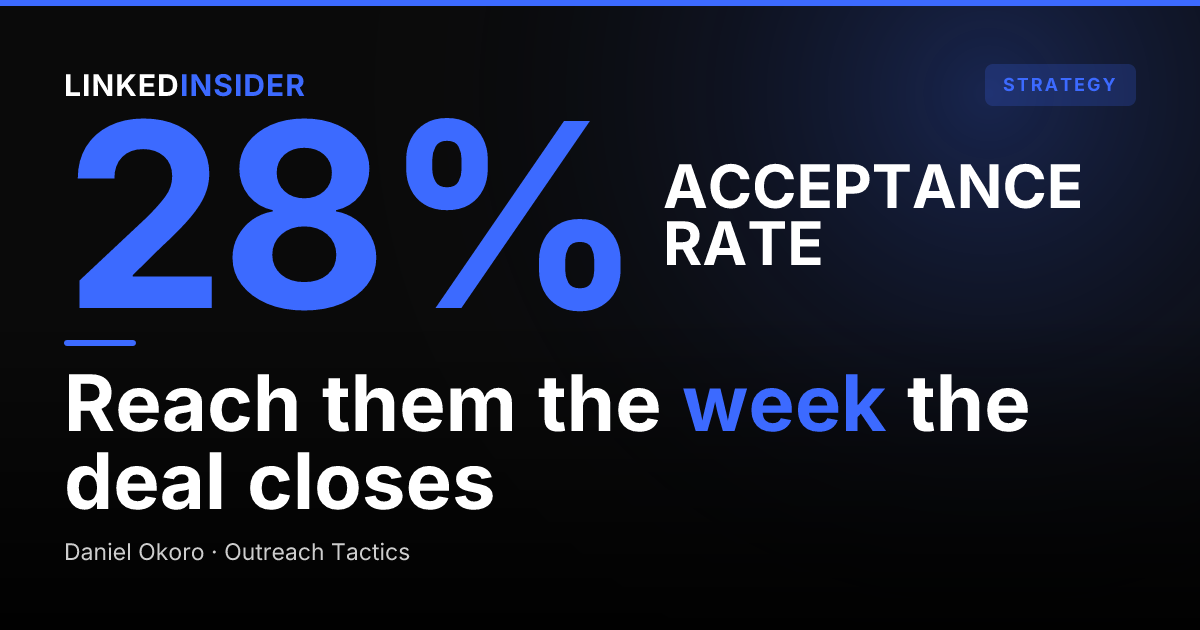
Send it in the integration window, roughly weeks two through six after the close, not on announcement day. Day one is the worst time: the inbox is buried in congratulations, the buyer is in all-hands meetings, and nobody has authority to buy anything yet because the new org chart is not set.
The pattern across deals is predictable. Week one is announcement and shock. Weeks two to six are integration, where operational pain is sharpest and the buyer is actively looking for ways to simplify. Weeks six to twelve is when consolidation decisions get formalized and budgets get reallocated. The sweet spot is the integration window, when the problem is acute and the contract review has not closed. If you missed the announcement, a message in week four often lands better than one in week one because the pain is concrete by then. Reachium's data backs the relevance premium: across 180,155 matured connection requests, its data shows a 27.11% average connection acceptance rate, and a real reason to reach out is what carries that number. See the full study in the 2026 LinkedIn outreach benchmarks. [SYNTHESIS]
Who gets the LinkedIn message after a company acquisition?
Message the operational owner of the problem you solve, and verify their title changed, because acquisitions reshuffle everyone. The VP of Marketing at the acquired company may now report to the acquirer's CMO, or may be on the way out. Sending to a title that no longer holds budget wastes the trigger.
Reachium's data underlines why precision matters here. Of the a multi-million-lead B2B universe in Reachium's universe, a large share flagged as decision-makers, which means roughly four in five contacts on any list cannot sign off on a purchase. After an acquisition, that ratio gets worse before it gets better, because authority is in flux. Check the person's recent activity and current title before you send, and when you are unsure whether to connect first or open with a note, the answer usually depends on mutual context, which we cover in connect or message first on LinkedIn. [SYNTHESIS]
What does the acquisition-trigger message actually say?
The message names the operational change, ties it to one problem you solve, and asks a low-friction question, in that order. It never opens with "congratulations." Here are three scripts you can adapt by situation.
Script 1: The integration-pain opener (acquired-side operational lead)
Hi [Name], saw [Company] is now part of [Acquirer]. Integrations like this usually mean two of everything for a while, including [tool category]. When [similar company] went through the same thing, the duplicate-tooling cleanup is where the timeline slipped. Happy to share the two-step process they used to consolidate without breaking reporting, if that is on your plate. No pitch.
Why it works: it acknowledges the real situation (two of everything), anchors to a peer's experience instead of your product, and offers a process, not a demo.
Script 2: The new-budget-owner note (acquirer-side leader inheriting a stack)
Hi [Name], with [Acquired Company] folding into your team, you are probably inheriting a [tool category] stack you did not pick. Most leaders in that spot spend the first quarter figuring out what to keep. I put together a one-page comparison of the two most common setups for teams your size. Want me to send it over?
Why it works: it speaks to the inherited-decision problem the acquirer's leader actually owns, and the lead magnet (a one-pager) is lower friction than a meeting ask.
Script 3: The light follow-up (no reply after 5-7 days)
Hi [Name], no need to reply if the timing is off. The one thing worth flagging during a merger: vendor contracts often auto-renew mid-integration, so it is worth checking [tool category] dates before anyone is watching them. That alone has saved teams a renewal cycle. Closing the loop here either way.
Why it works: it adds a genuinely useful fact (auto-renewal risk), removes pressure, and gives a clean reason to reply without restating the original ask. For a graceful exit when there is still no response, the LinkedIn breakup message keeps the door open.
Want to put this into practice?
Reachium automates LinkedIn outreach, content publishing, and inbox management in one platform.
Start Free →Why does the "congratulations" message fail?
It fails because everyone sends it, so it signals automation rather than attention. On announcement day the buyer's inbox fills with near-identical congratulations from reps who set an alert and fired a template. A message that opens the same way gets pattern-matched to spam in under a second.
Worse, "congrats" misreads the emotional state. The team absorbing the merger is bracing for layoffs, migrations, and a board asking what to cut, not celebrating. The fix is to lead with the operational reality. If you are warming up the relationship through engagement before the DM, our guide on how to AI-draft LinkedIn comments that get noticed shows how to earn recognition before you ever land in the inbox. And when you do open the conversation, connection request message examples keep the first line tight.
How do you reach the buyer before competing reps pile in?
Speed and account safety together: you need to move within days of the trigger, at enough volume to cover the buying committee, without tripping LinkedIn's limits. That second half is where most acquisition plays quietly die. When a deal breaks, reps spike their send volume to hit the new company fast, and that volume spike is exactly what gets accounts restricted.
Reachium's data shows the counterintuitive part. Across its sequences, acceptance peaked at 32.01% for accounts sending 10-19 invites a day and fell to 26.65% at 20-29 a day, so cranking volume to chase a fresh trigger actually lowers your accept rate. The platform caps sends near 25 a day by design for this reason. On safety, no client account has been suspended to date on the verified-API approach, with the only failure mode being recoverable rate-limiting. Compare that to browser-automation tools, where the publicly reported HeyReach ban in March 2026 wiped out connected accounts at once. When you are sprinting on a time-boxed trigger, an account ban does not slow you down, it removes you from the race. [SYNTHESIS]
What if the acquisition was a layoff or a leadership change instead?
Treat each sub-trigger as its own message, because the pain and the buyer differ. An acquisition rarely arrives alone. It often comes with layoffs, a new executive, or a champion leaving for a new company, and each of those is a distinct opening that needs its own framing rather than a recycled merger note.
If the deal triggered cuts, the angle is doing more with less, which we script in the layoff-trigger LinkedIn message. If a new executive came in to run the combined org, lead with their first-90-days agenda, covered in the new-leadership-hire outreach script. And if your internal champion left the acquired company for a new role, that is a warm reopen, not a cold trigger, and it follows a different sequence in the champion-left-company reopen script. Map the sub-trigger first, then pick the message.
Want to put this into practice?
Reachium automates LinkedIn outreach, content publishing, and inbox management in one platform.
Start Free →FAQ
When is the best time to send a LinkedIn message after a company acquisition?
Send it in the integration window, roughly two to six weeks after the deal closes. Announcement day is the worst time because the buyer's inbox is flooded with congratulations and the new org chart, including who controls budget, is not yet settled.
Should I congratulate someone on their company's acquisition?
No. The "congrats on the acquisition" opener is the single most common message after a deal, so it reads as automated, and it misreads the buyer's reality, which is usually stress about integration and cuts rather than celebration. Lead with the operational change instead.
Who should I message at a newly acquired company?
Message the operational owner of the problem you solve, and verify their title after the deal, since acquisitions reshuffle reporting lines and budget authority. Sending to a person who no longer holds the budget wastes the trigger entirely.
How do I reach a newly acquired company fast without getting my LinkedIn account restricted?
Move within days but keep daily invites in a safe range rather than spiking volume. Reachium's data shows acceptance actually drops above 20 invites a day, and tools on LinkedIn's verified API report no account suspensions, unlike browser-automation tools that have faced mass bans.
What is an acquisition trigger in B2B outreach?
An acquisition trigger is using a recent merger or acquisition as the reason for a timely, relevant outreach message. It works because the event creates immediate pain around duplicate tools, contract consolidation, and budget review, which makes the buyer more open to switching vendors.