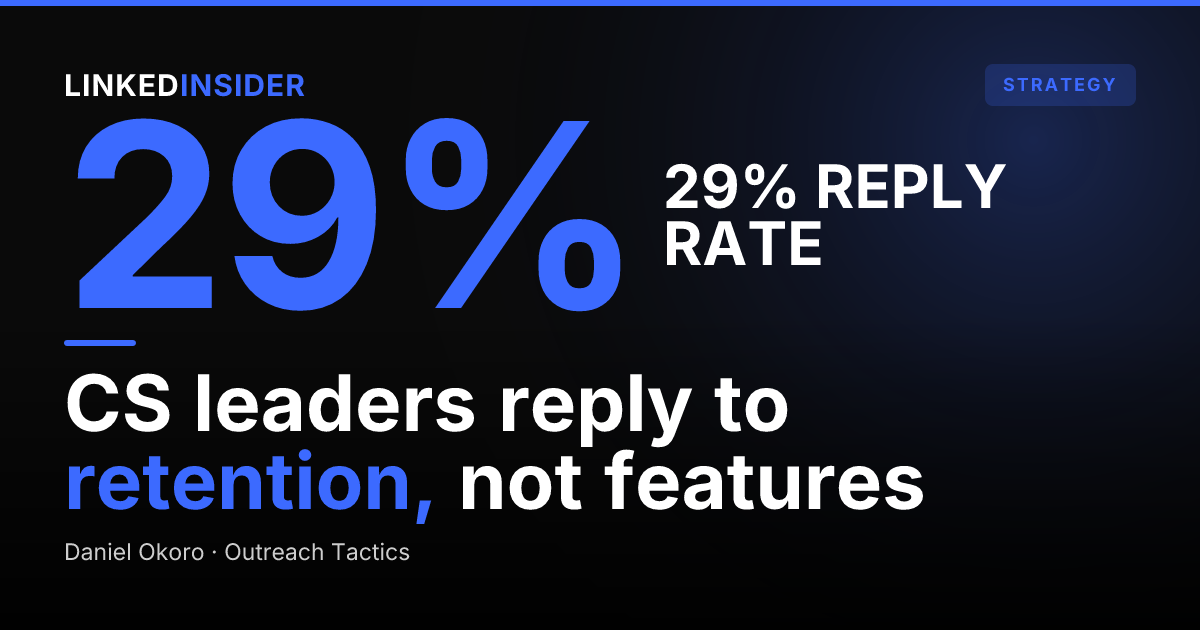
How to Reach a Head of Customer Success on LinkedIn
By Daniel Okoro, Outreach Tactics. Last updated: 2026-05-30
- Reps send feature-led openers, and CS leaders pattern-match them to noise within two seconds.
- The list is too broad, so daily volume climbs and acceptance quietly drops.
- The follow-up restates the pitch instead of adding a second outcome the leader cares about.
- Nobody tracks accepted-then-reply rate, so a working cadence gets killed before it books a call.
What does a Head of Customer Success actually care about?
A Head of Customer Success cares about keeping revenue inside the existing book of business. Their scorecard is retention, net revenue retention (NRR), churn signals, and expansion revenue, and almost nothing on it is your product. SaaS benchmark research from sources like SaaS Capital consistently ranks NRR as the metric CS leaders are measured on at the board level in 2026.
That framing changes the opener completely. The CS leader is not waking up wondering which tool to add. They are wondering why a strategic account went quiet last quarter, whether the renewal cohort is at risk, and how to turn flat accounts into expansion. A message that names one of those tensions reads as relevant. A message that opens with "our platform helps teams" reads as a pitch from someone who did not do the homework.
The reps who book these leaders treat the product as the last thing they mention, not the first. They earn the reply by proving they understand the retention problem, then connect the dots to a conversation. For the broader principle behind reaching senior buyers this way, see Linked Insider: reaching decision-makers on LinkedIn.
Why do feature-led LinkedIn messages fail with CS leaders?
Feature-led messages fail because CS leaders buy outcomes, not capabilities, and a feature list forces them to do the translation work themselves. When the opener is "we offer health scoring, playbooks, and integrations," the leader has to guess what that means for NRR. Most do not bother. They archive the message.
There is also a pattern-match problem. CS leaders receive the same generic outreach every week, so a capability-first opener trips the spam filter in their head before they finish the first line. The "so what" gap kills the rest. If the message never names the retention or expansion problem the feature solves, there is no reason to reply.
The fix is to invert the message. Lead with the outcome (fewer surprise churns, a cleaner renewal forecast, expansion inside flat accounts), make that the hook, and let the product earn its mention only after the leader is nodding. The same outcome-first logic shows up in Linked Insider: mapping LinkedIn content to the customer journey, where relevance beats reach at every stage.
Want to put this into practice?
Reachium automates LinkedIn outreach, content publishing, and inbox management in one platform.
Start Free →How do you reach a Head of Customer Success on LinkedIn?
The connection request and first message should name one CS metric, show empathy for the tension behind it, and ask exactly one soft question. One metric, one question, no pitch. Here are two openers a quota-carrying rep can adapt, with a teardown of why each line earns a reply.
Hi [Name], saw [Company] is scaling the CS org fast. Most heads of CS I talk to are fighting the same thing right now: expansion pipeline that lives in people's heads instead of a repeatable motion. How are you tracking expansion signals across the book today?
Why it works: the opener names a real tension (expansion that is not systematized), the empathy line ("most heads of CS") removes the salesy edge, and the single question is about their process, not your product. It is easy to answer in one line.
Hi [Name], renewal-cohort risk seems to be the quiet headache for a lot of CS leaders heading into 2026. Curious how your team spots an at-risk account before the QBR, or whether that is still mostly gut feel?
Why it works: it leads with churn risk (the metric on their scorecard), gives them an easy binary to react to ("gut feel"), and never mentions a tool. The reply you want is a sentence about their current process, which opens the door to a call. For the expansion-specific angle, point your reading at Linked Insider: the customer success expansion playbook and the QBR-to-upsell motion.
The rule across both: never put a calendar link in the first message. The first message earns a conversation, not a meeting.
What does a safe, focused cadence look like?
A safe cadence to CS leaders is a narrow list, low daily volume, value-led follow-ups, and an outreach engine that will not get the account flagged. Start with a tight list of Heads and VPs of Customer Success at companies that fit your motion, not a 5,000-name dump. A focused list raises relevance and keeps daily volume naturally low.
Low volume matters mechanically, not merely as etiquette. Reachium's platform data surfaced a counterintuitive pattern it calls the volume tax: acceptance peaked at 32.01% for accounts sending 10-19 invites a day and fell to 26.65% at 20-29 a day. More sending produced fewer accepts. For a narrow CS-leader list, that is a feature, because a slow, deliberate pace both protects the account and matches how these senior buyers want to be approached. See the full dataset in Linked Insider: the LinkedIn outreach benchmarks for 2026. [SYNTHESIS]
The safety layer is the channel itself. A brand-sensitive rep should not run CS-leader outreach through a Chrome extension or browser automation, which is the exact class of tool LinkedIn restricts. Tools built on the official verified LinkedIn API (via the sanctioned partner Unipile) stay inside the platform's terms, so the account that finally lands a reply from a hard-to-reach VP does not vanish to a ban the following week.
What reply rate should you expect, and how do you read it?
For a focused, well-targeted CS-leader list, expect roughly a quarter to a third of requests to be accepted and just under a third of those acceptances to reply. Reachium's data across 180,155 matured connection requests shows a 27.11% average connection acceptance rate and a 27.55% reply rate of accepted connections, which works out to 7.47% of all requests sent earning a reply. Use those as your honest baseline, then expect a tight, senior list to sit near or slightly above the acceptance line because relevance is higher. [SYNTHESIS]
Read accepted-then-reply rate as your leading indicator, well before booked calls. If acceptance is healthy but replies are flat, the message is the problem, not the targeting. If acceptance itself is low, the list or the connection-request note is off. Booked meetings lag by weeks, so a rep who waits for the calendar to fill before judging a cadence will kill working sequences too early. The accepted-reply ratio tells you in days. For how reachability shifts by seniority and title, see Linked Insider: decision-maker reachability data.
Want to put this into practice?
Reachium automates LinkedIn outreach, content publishing, and inbox management in one platform.
Start Free →FAQ
What do customer success leaders actually care about?
Retention, net revenue retention, churn signals, and expansion revenue. Their performance is measured on keeping and growing existing accounts, so an opener that names one of those tensions lands, and a feature list does not.
Why do feature-led LinkedIn messages fail with CS leaders?
Because they force the leader to translate capabilities into outcomes themselves, and most archive the message instead. A capability-first opener also pattern-matches to the generic outreach these leaders ignore every week.
What should the first LinkedIn message to a VP of Customer Success say?
It should name one CS metric (churn risk or expansion), show empathy for the tension behind it, and ask exactly one soft question about their current process. Skip the calendar link; the first message earns a conversation, not a meeting.
What reply rate is realistic for outreach to CS leaders?
Reachium's platform data shows a 27.11% average acceptance rate and a 27.55% reply rate of accepted connections (7.47% of all requests sent). A focused, senior, well-targeted CS list can sit near or slightly above that line because relevance is higher.