The Customer Success Expansion Playbook: Using LinkedIn to Trigger Upsell and Renewal Conversations
By Elena Marsh, Strategy & Algorithm. Last updated: 2026-05-30
- Most expansion still waits for the quarterly business review, by which point the renewal is already shaky.
- The champion who bought your product quietly changed jobs two months ago, and nobody on the account team noticed.
- A new VP arrived, owns the budget now, and has never heard of you.
- The team using your product doubled headcount, and that seat expansion is sitting unbilled.
Why is LinkedIn good for customer success expansion?
Customer success should live on LinkedIn because net revenue retention is won in the gaps between scheduled touchpoints, and LinkedIn is where those gaps show up first. A QBR happens once a quarter. A champion changes jobs, a buyer joins the committee, or a team triples in size on a random Tuesday, and the platform surfaces all three the day they happen.
Net revenue retention is the metric a revenue leader is judged on, and most of it is decided post-sale. The accounts that expand are the ones where someone noticed a buying signal early and acted on it with the right tone. The accounts that churn are usually the ones where a relationship quietly decayed and no one was watching. For a CS team, LinkedIn is the cheapest monitoring layer available: it costs nothing to follow the accounts you already own and watch for movement.
The discipline that makes this work is the same one that makes content across the customer journey work. You are not prospecting. You are staying present in the feed of people who already chose you, so that when the renewal conversation arrives you are a familiar name rather than a calendar invite from a vendor they forgot about.
What LinkedIn signals predict churn and expansion?
The four signals worth tracking are champion job changes, new buying-committee hires, role-title shifts, and hiring sprees inside an account. Each one is both a risk and an opening, depending on how fast CS responds.
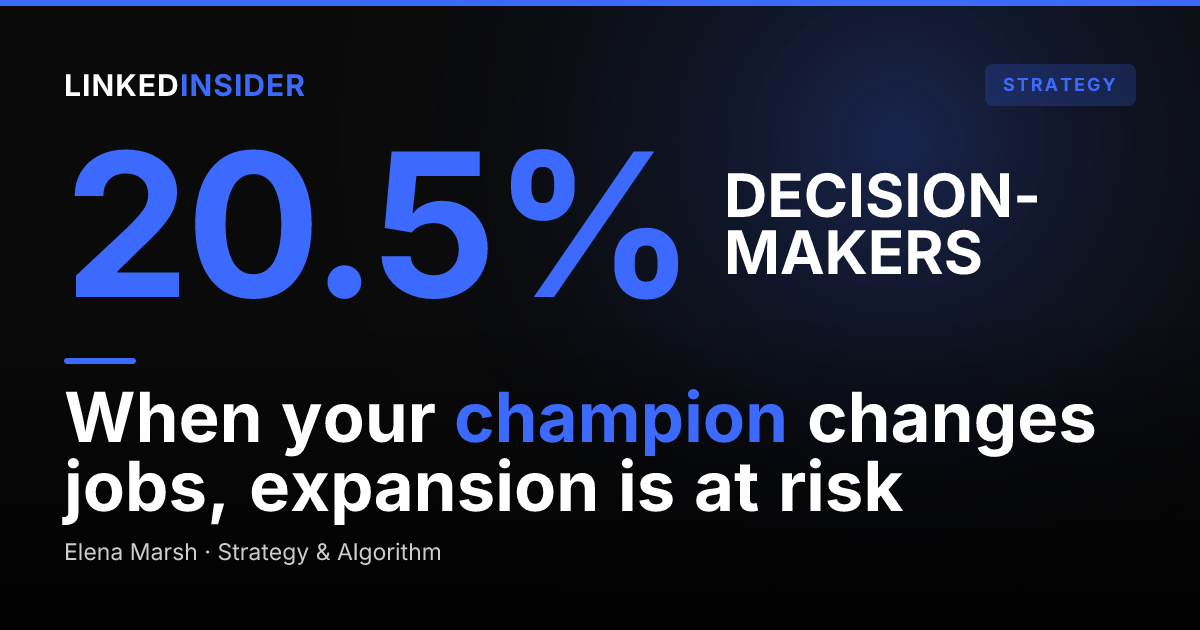
A champion changing jobs is the single most dangerous signal. Industry retention research consistently finds that buyer and decision-maker turnover is among the leading drivers of churn, because the person who internally defended your renewal is gone. The same signal is also the strongest expansion lead you will get all year: that champion just landed somewhere new with a budget and a problem you already solved for them.
New buying-committee hires matter because the people who sign the renewal in twelve months may not be in the account today. B2B purchases run through committees, and a new VP of the function you serve is a stakeholder you have to earn before the renewal, not during it. Role-title shifts inside the account (a manager promoted to director, a director to VP) tell you who is gaining budget authority. Hiring sprees on a team that uses your product are the clearest seat-expansion signal there is: more people doing the job your tool supports usually means more seats are justified.
Want to put this into practice?
Reachium automates LinkedIn outreach, content publishing, and inbox management in one platform.
Start Free →How do you re-anchor when a champion leaves?
You re-anchor by mapping the new internal stakeholder before you say a word, then running a warm reintroduction that protects the renewal first and pitches nothing. Speed matters here. The window where a champion's departure is still recoverable is short.
The sequence is three moves. First, identify who inherited the relationship. The departing champion's replacement, their former manager, or the most engaged power user are your candidates. Second, reach out to the departed champion to congratulate them and keep that relationship alive, because they are now a warm lead at a new company. Third, get a warm reintroduction into the account through anyone who still vouches for you, rather than cold-opening the new stakeholder. A relationship that already exists at the account level is leverage that net-new outreach never has, a point we cover in depth in the QBR and expansion upsell playbook.
The tone is everything. This is an account that pays you. A message that reads like a prospecting blast tells the new stakeholder you were never really a partner. The goal of the reintroduction is to be useful, not to be transactional.
How do CSMs reach new buying-committee members without selling too soon?
CSMs reach new committee members with value-first reconnection, which means the first touch offers something relevant and asks for nothing. The difference from cold outreach is that you have a legitimate, current reason to be in this person's network: they just joined a company you actively serve.
Lead with that context. A connection note that references the account and offers a genuinely useful resource (the rollout playbook their team already uses, a benchmark relevant to their new role, an intro to their internal power users) lands very differently from a generic vendor pitch. You are not asking for a meeting. You are establishing that you are the person who already makes their team successful.
The cadence should be slow. One thoughtful touch, then patience, then a second touch tied to a real event. Timing helps: research on when LinkedIn messages get read shows mid-week business hours outperform, and for a relationship-sensitive audience, being read matters more than being fast. Avoid the classic outreach mistakes of volume and immediacy. With an existing account, those mistakes do not just underperform. They actively burn trust you already paid to build.
What does a safe, relationship-respecting motion look like?
A safe motion is low-volume, runs on the verified LinkedIn API, and targets only the decision-makers already connected to the account. The principle is that brand-sensitive, post-sale outreach has zero tolerance for the things that get acquisition outreach away with: high volume, scraping tools, and an account suspension that takes your real name offline.
This is where the channel mechanics matter more than most CS teams realize. Reachium's data across more than 316,000 outreach sequences found a counterintuitive volume tax: acceptance peaked at 32.01% for accounts sending 10-19 invites a day and fell to 26.65% at 20-29 a day. More volume produced fewer accepts. For a CS team running a few high-stakes touches a week, that finding is reassuring. Restraint is not just safer, it performs better. The flagship benchmark study breaks the full curve down. [SYNTHESIS]
Safety also means the tooling cannot get your personal profile restricted. Browser automation and scraping extensions carry that risk, and a public ban (a competitor tool was reported banned in March 2026) takes the human relationship down with it. A verified-API approach avoids that failure mode entirely, which is exactly the property a relationship-first motion requires. If you are moving off a riskier stack, the outreach stack migration playbook covers the transition.
Want to put this into practice?
Reachium automates LinkedIn outreach, content publishing, and inbox management in one platform.
Start Free →How do you measure CS-led expansion?
You measure CS-led expansion with leading indicators first, then attributed outcomes. The leading indicators are signals caught and acted on, warm reconnections made with new committee members, and champion departures flagged within a week. The lagging outcomes are expansion pipeline sourced by CS, renewal saves attributed to early intervention, and net revenue retention lift.
The reason to start with leading indicators is that expansion and renewals have long cycles, and you cannot manage a number that only resolves quarters later. Tracking how many signals your team catches and converts into a conversation tells you whether the motion is working long before NRR moves. Reachium's analytics dashboard gives a CS team that visibility per account: who was reached, who accepted, who replied, mapped against the accounts you care about. Targeting is the foundation here, and Reachium's lead universe flags decision-makers directly, which is precisely the population a CS-led expansion motion needs to find inside existing accounts.
FAQ
How do CSMs spot upsell signals on LinkedIn?
They watch the accounts they own for four movements: champion job changes, new buying-committee hires, role-title promotions that shift budget authority, and hiring sprees on teams that use the product. Each one signals either expansion potential or renewal risk, and the platform surfaces them before any QBR does.
What happens to a renewal when the champion changes jobs?
The renewal becomes immediately at risk because the person who internally defended it is gone, and the same departure is also a fresh expansion lead at the champion's new company. The fastest CS teams map the new internal stakeholder and run a warm reintroduction within days.
Should customer success do outreach, or only the sales team?
Customer success should own the relationship-first, low-volume motion because the relationship already exists and a sales-style approach to an existing account can damage it. Sales owns net-new acquisition. CS owns the in-account expansion and renewal conversation.
How is CS expansion outreach different from cold outreach?
It is different because you have a current, legitimate reason to connect (you already serve the account) and because the wrong tone has real downside: it tells a paying customer you were never a true partner. The cadence is slower, the volume is far lower, and the first touch offers value rather than asking for a meeting.
Sources
- Reachium
- LinkedIn Outreach Benchmarks 2026 (Reachium's published platform data on acceptance, reply rates, and the volume tax)
- LinkedIn Help: connection requests and messaging (official guidance on connections and outreach limits)
- Customer success QBR and expansion upsell playbook
- LinkedIn Sales Solutions