The CS Expansion Playbook: Turning QBRs Into LinkedIn Upsell Conversations
By Elena Marsh, Strategy & Algorithm. Last updated: 2026-05-30
- The champion who loves you is often the only person in the account who knows you exist.
- Expansion outreach that reads as a renewal nudge gets ignored, because the buyer already bought.
- Most CS teams start multi-threading after the renewal forecast locks, which is too late.
- A templated touch inside a paying account reads as a downgrade in the relationship.
How does customer success run LinkedIn upsell expansion from a QBR?
The QBR is the highest-leverage trigger because it is the only recurring moment that exposes the entire buying center at once. A renewal forces the account to assemble its stakeholders: the day-to-day champion, the new VP who inherited the budget, the procurement lead, sometimes a director from an adjacent team curious about the same outcome. For one meeting, the org chart is visible. Then it closes again.
Champion-only relationships cap net revenue retention by design. When a single contact carries the entire account, you have a single point of failure and a single point of growth. If that person leaves, you churn. If that person never expands their own remit, you flatline. Expansion lives in the people the champion reports to and the teams sitting next to the use case you already proved.
Timing matters as much as access. The expansion motion has to start before the renewal forecast locks, so the new conversations are already warm when commercial discussions begin. CS leaders thinking about how the broader LinkedIn buying committee shapes deal velocity tend to start sourcing the moment a QBR is scheduled, not the week renewal paperwork goes out.
How do you map the buying-center white space a renewal exposes?
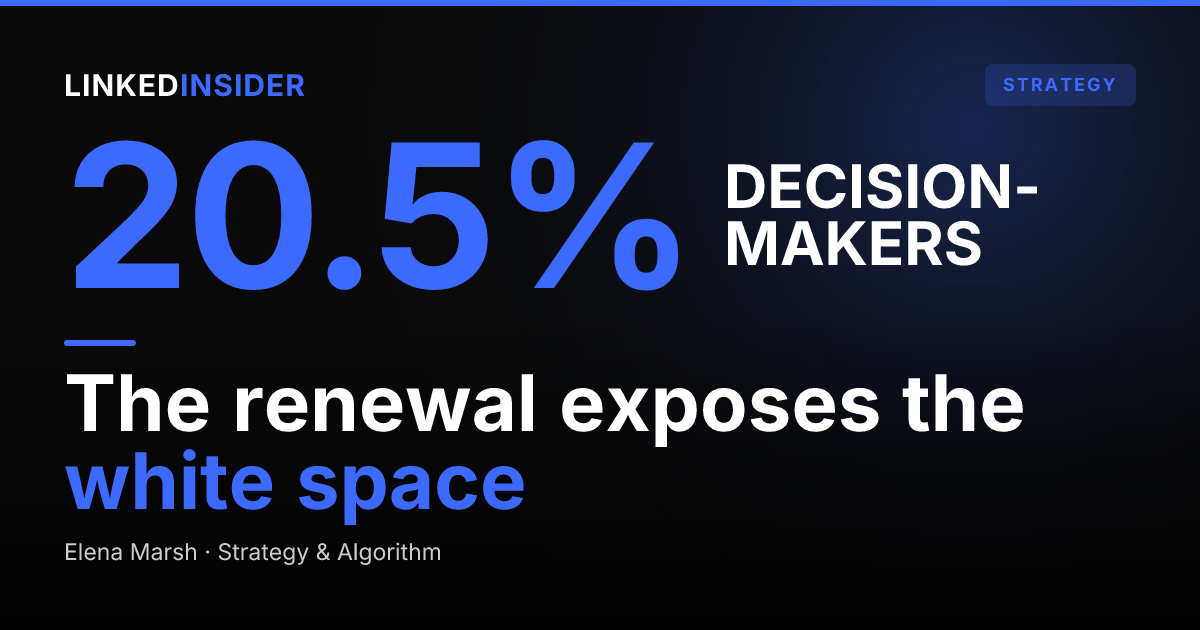
You map the white space by listing three roles the renewal makes visible: the champion's manager, the adjacent team with the same pain, and the economic buyer who never logs in. Each is a thread the account is not yet running, and each is the difference between a flat renewal and a 120% net revenue retention number.
Start with the champion's manager. They own the budget line, they sit in the QBR to judge ROI, and they almost never appear in your product analytics. Then map adjacent teams: if marketing proved the outcome, the same outcome likely lands with revenue operations or sales enablement next door. Finally, the economic buyer who signs but never uses the product. These three roles are where expansion actually closes, and a strong LinkedIn buying-committee view makes them findable.
Reachium's data underscores why this mapping is worth the effort: across its universe of a multi-million-lead B2B universe, a large share flagged as decision-makers, per the 2026 LinkedIn outreach benchmarks. The white space a renewal exposes is disproportionately senior, which is exactly why the champion-only relationship leaves so much expansion on the table. [SYNTHESIS]
Want to put this into practice?
Reachium automates LinkedIn outreach, content publishing, and inbox management in one platform.
Start Free →What does a value-first expansion DM sequence look like?
A value-first expansion sequence leads with the outcome the account already proved, never the upsell. The new VP does not care about your second product line. They care that the team they inherited hit a number, and that there is an adjacent way to hit another one. The opener references the QBR result and offers the enablement, not the SKU.
Here is a three-touch sequence a CSM can adapt. Each message is observable and sent by hand to a senior stakeholder, not blasted.
Touch 1 (to the champion's manager, warm via the QBR): "Saw the Q2 numbers ahead of the review. [Champion] hit a 22% lift on the onboarding workflow. There is an adjacent play for the [adjacent team] that uses the same setup. Want me to walk you through the one-pager before we meet?"
Why it works: it opens on proven ROI the manager already owns, not a pitch, so it reads as a CSM doing their job rather than a rep prospecting.
Touch 2 (to an adjacent-team leader): "[Champion]'s team used [outcome] to fix [pain]. Your team flagged the same pain in the last review. Happy to share what worked so you can decide if it is worth a look. No pitch."
Why it works: it borrows the social proof of a colleague's win inside the same company, which is the warmest signal a buyer can get.
Touch 3 (follow-up, value-add only): "Putting the QBR benchmark together for next week. Dropping the expansion section here in case it is useful for your planning, whether or not we ever talk product."
Why it works: it earns the next reply with a useful asset and removes the commercial pressure, so the thread stays open. For more reusable structures, see LinkedIn upsell and expansion DM scripts.
The warm intro from the champion beats a cold message to the VP every time. A CSM who asks the champion to forward a value asset to their manager converts at a far higher rate than one who messages the VP cold, which is why the sequence sources warmth before it sources volume.
How do you trigger Lead Magnet auto-DMs off CS content?
You trigger Lead Magnet auto-DMs by publishing the QBR-ready asset, then letting the content do the sourcing while you keep the conversation human. A CSM posts the expansion benchmark or the playbook, asks engaged readers to comment for the file, and an automated comment-to-DM flow delivers it. The asset surfaces the adjacent contacts who self-identify as interested.
This is where content earns its keep. Reachium's analysis found lead-magnet posts (comment-to-DM) drew many times the impressions and engagement of regular posts in Reachium's earlier internal analysis. A CS enablement asset published as a lead magnet does the prospecting a CSM does not have time to do by hand, and it pulls in exactly the adjacent-team contacts you want to multi-thread into. See how this fits a LinkedIn content customer journey for the full motion.
The auto-DM delivers the asset. A human takes the next step. The automation routes an engaged director into the sequence above, then steps aside so the CSM owns the relationship from the first real reply onward.
Where should automation stop in a CS expansion motion?
Automation stops the instant the renewal conversation begins. Source automatically, follow up automatically, but never automate a touch inside the live commercial relationship. A paying customer mid-renewal who receives a templated message reads it as a downgrade, and you risk the relationship you spent a year earning. This is the credibility line, and it is not negotiable.
The safe zone is sourcing and follow-up cadence: finding the adjacent contacts, delivering the asset, nudging a non-reply once. The human-only zone is everything that touches the renewal itself. Observability is what keeps the line clean. A CSM should see every thread before it sends and be able to pause a sequence the moment an account goes into active negotiation.
The infrastructure matters more here than anywhere, because the accounts at risk are paying customers. Browser-automation tools that scrape or simulate clicks put those accounts in the blast radius of a platform crackdown. The publicly reported HeyReach action in March 2026 is the cautionary case: a tool built on automation, not the sanctioned API, is a tool that can take a renewal account down with it. Safety-conscious teams treat LinkedIn connection limits and rate behavior as a renewal-protection issue, not just a deliverability one.
Want to put this into practice?
Reachium automates LinkedIn outreach, content publishing, and inbox management in one platform.
Start Free →How do you measure expansion outreach without gaming the renewal?
You measure expansion by leading indicators that cannot be faked by a renewal that was always going to happen. Count new threads opened, multi-thread depth per account, and booked expansion calls, not closed-won dollars that the renewal would have produced anyway. Those upstream metrics tell you whether the motion is actually widening the account.
Watch the warm-versus-cold reply gap. Threads sourced from CS content convert far better than cold first touches, and tracking that gap tells you whether your sourcing is genuinely warm or just volume in disguise. Reachium's data shows acceptance peaked at 32.01% for accounts sending 10-19 invites a day and fell as volume rose, a reminder that more outreach is not more expansion. The number that matters is multi-thread depth: how many real conversations exist in an account beyond the champion. CS leaders who borrow discipline from founder outreach mistakes tend to instrument depth before they instrument volume. [SYNTHESIS]
FAQ
How should a CSM multi-thread beyond the champion?
Start at the QBR, where the buying center is visible, and map three roles: the champion's manager, an adjacent team with the same pain, and the economic buyer who never logs in. Reach the manager and adjacent team through a warm intro or a shared QBR result, not a cold pitch.
What is the best LinkedIn message for an account expansion?
The best opener references the outcome the account already proved and offers enablement, not a new SKU. Lead with "your colleague's team hit this result and yours flagged the same pain" rather than "here is our second product," because borrowed social proof inside the same company is the warmest signal a buyer gets.
When in the renewal cycle should expansion outreach start?
It should start the moment a QBR is scheduled, well before the renewal forecast locks, so new conversations are already warm when commercial discussions begin. Starting after the renewal closes means the white space the QBR exposed has usually closed with it.
Should customer success outreach be automated?
Sourcing and follow-up cadence can be automated; the renewal conversation itself never should be. A paying customer who receives a templated touch mid-renewal reads it as a relationship downgrade, so the right setup automates discovery and delivery while keeping every live commercial thread human and observable.