Can You Actually Reach Decision-Makers on LinkedIn?
By Priya Nair, Data & Trends. Last updated: 2026-05-28
A few things sales leaders actually run into when chasing senior buyers on LinkedIn:
- The team's activity number keeps climbing while the meetings-with-real-buyers number does not.
- A "decision-maker list" pulled from Sales Navigator turns out to be diluted with junior contacts and stale titles.
- Reps assume C-suite contacts will ignore them because of rank, and quietly defocus on the accounts that actually own the budget.
Can you actually reach decision-makers on LinkedIn?
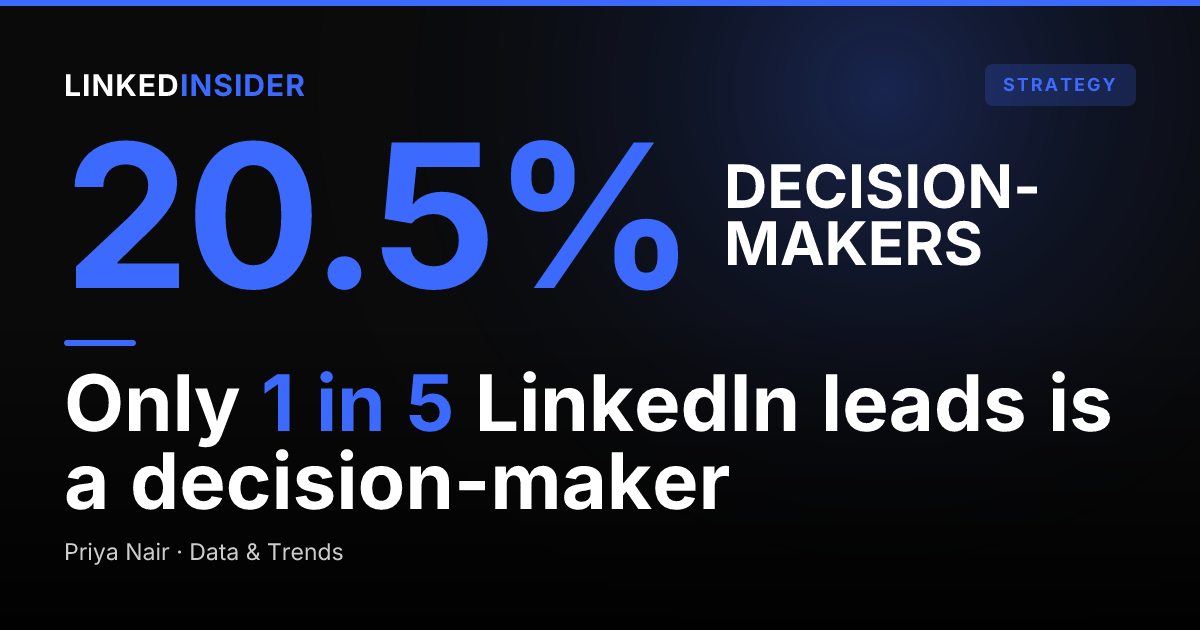
Yes, but they are a minority of any raw B2B lead universe. In Reachium's lead universe, only a fraction of profiles carry the decision-maker flag. LinkedIn reaches buyers at volume. The challenge for a sales leader is that most of a typical list are not the people who can sign, which is why low reply rates from "decision-makers" almost always trace back to who is on the list, not what the message said.
The reframe matters because it changes where a leader spends effort. The conversation usually starts as "how do we get C-suite to reply?" and ends in copy iteration. The data points the other direction: targeting is upstream of messaging, and once the list is genuinely filtered, the same copy starts to perform. The flagship LinkedIn outreach benchmarks 2026 post covers the full funnel; this analysis is the targeting cut of the same dataset.
The quotable version, which is what most strategic queries want as a one-liner: most raw B2B leads are not decision-makers. LinkedIn reaches buyers, but only if the list is filtered for them.
What share of B2B leads are actually decision-makers?
A minority, with named seniority segments large enough to source from. The decision-maker view of Reachium's lead universe looks like this:
| Segment | What the data shows |
|---|---|
| Decision-makers (platform flag) | A minority of the universe; the layer campaigns should filter to |
| C-Suite profiles | The largest known seniority segment |
| Founder profiles | A substantial named segment |
| Lead data-quality score | Scored per record; part of the signal is always soft |
A note on how to read this: the "decision-maker" figure is the platform's classification flag, while C-Suite and Founder are profile-reported seniority segments. They are separate cuts of the same universe and not designed to sum cleanly. The point is density and named-segment scale, not a partition.
Two takeaways follow. First, senior buyers exist in real volume: deep C-suite coverage in a single B2B universe is not a scarcity problem, it is a filtering problem. Second, data-quality scoring exists because part of the signal is soft, so titles and seniority flags belong on a verification step, not on a trust step.
Want to put this into practice?
Reachium automates LinkedIn outreach, content publishing, and inbox management in one platform.
Start Free →How do you filter a lead list down to real decision-makers?
Four practical levers, applied in order. Each one cuts the noise the next one inherits.
- Filter by seniority. C-suite, VP, founder, head, and director levels are where budget authority concentrates. The crude version of this filter (a title contains "VP") catches the obvious cases and misses the ones with off-pattern titles, so combine with a function filter.
- Filter by function. A senior person who does not own the buying decision for your product is not the buyer. A CFO is a decision-maker for finance tooling and a champion at best for an outbound platform. Function alignment is what turns "decision-maker" into "decision-maker for this purchase."
- Filter by company size. Below a certain headcount the founder is the buyer; above it the VP is. The same title means different things at 25, 250, and 2,500 employees, and the role split affects who needs to be reached.
- Filter by activity signals. Recently active profiles accept more, reply more, and are more likely to be in-role. A senior title attached to a profile that has not posted, commented, or updated in twelve months is a probabilistic dead lead.
The data-quality score is the honest caveat here. A meaningful share of any pulled segment will include stale or mis-classified profiles. Verifying titles against a current source before a campaign launches catches the bulk of those errors and is the difference between a list that looks like decision-makers and a list that is decision-makers. The mechanism is the same one covered in how to personalize LinkedIn outreach at scale: personalization can only do its job on a list that is already correct.
The honest reframe for a sales leader: most teams' "low reply rate from executives" is a list-composition problem (the list was mostly non-decision-makers) presented as a messaging problem.
Do senior decision-makers actually accept connection requests?
Yes, and the data on sender rank is the part that surprises most leaders. Acceptance rate barely moves based on who is sending the request. Across the connection-request dataset, the gap between C-level senders and manager-level senders is roughly two percentage points, which means the recipient's decision is driven by targeting and profile quality, not by whether the message came from an SDR or a VP. The detail on this is in LinkedIn acceptance rate benchmarks.
For a team motion, that implication is large. A well-targeted, well-profiled rep can reach a decision-maker about as effectively as an executive can. The barrier is list quality and approach, not rank, which means the playbook generalizes across the team rather than depending on the leader's own outbox.
What does change with senior recipients is the relevance bar. Decision-makers get more outreach than the median user, so the message has to clear a higher signal threshold to earn a reply. Tight targeting plus genuine personalization clears it. Volume-blasting a broad list does not, which is also why a system that prevents the team from defaulting to volume tends to outperform one that hopes reps will personalize on their own. The mechanics of why volume crowds out signal are covered in the LinkedIn volume tax.
Is LinkedIn better than email for reaching decision-makers?
For senior buyers, LinkedIn has two real channel advantages that are worth naming honestly, plus one disadvantage.
The advantages. First, the surface is warm. A connection request lands next to mutual connections, content activity, and a visible profile, all of which raise the trust signal a guarded inbox does not get. Second, inbox saturation is lower for the LinkedIn DM than for a cold email to a C-level address protected by an assistant, a filter, and a corporate firewall. The data anchor: LinkedIn places a deep C-suite population within reach of a connection request, and acceptance does not penalize the sender's rank. That is a material channel advantage for senior reach.
The disadvantage. Per-account volume on LinkedIn is capped by the platform (approximately 100 connection requests per week on standard accounts), which means raw send capacity is lower than cold email's. Teams that need to address tens of thousands of leads per month run LinkedIn alongside email rather than instead of it; LinkedIn and email as a multi-channel stack covers that integration.
The fair statement, neither overclaim nor underclaim: LinkedIn is a strong channel for decision-maker access, especially for the warm surface and lower inbox saturation. It is not the only one, and the right architecture for most B2B teams is LinkedIn-led with email as the parallel and follow-up channel.
Want to put this into practice?
Reachium automates LinkedIn outreach, content publishing, and inbox management in one platform.
Start Free →How do you build a repeatable decision-maker outreach motion for a team?
A sales leader managing 10 to 20 reps needs four components running together, not a deck on personalization. Each one solves a failure mode the previous component cannot.
- A verified, filtered lead source. Seniority plus function plus company size plus activity signals, pulled into segmented lists per rep so no two reps work the same contact. The lead universe's decision-maker flag defines the upstream sourcing problem: the list has to be filtered to that minority, not pulled raw.
- Standardized targeting templates. Every rep uses the same filter logic for the same segment, which makes the motion reproducible across the team and makes the leader's reporting comparable across reps. Without this, "decision-maker outreach" means whatever each rep decided yesterday.
- Personalization that clears the higher relevance bar. Senior buyers see more outreach, so the contextual signal in the first message has to be real. The execution detail and tier mapping is in personalize LinkedIn outreach at scale. The principle is that targeting tightness plus genuine personalization clears the bar; volume plus tokens does not.
- Per-rep, per-campaign visibility into who is actually being reached. A sales leader who cannot see the decision-maker share of who their team contacted last week cannot diagnose the targeting problem when it appears. The metric to track is not messages sent, it is decision-makers contacted and decision-makers replied. Building a sales pipeline on LinkedIn covers the broader pipeline view.
The pattern that breaks teams here is solving for messaging in isolation. Sharper copy on a list that is 80% non-decision-makers raises the overall reply rate slightly and does not move the meetings-with-real-buyers number, which is the only number the leader is measured on. Fixing the list composition is what moves it.
FAQ
How do you find decision-makers on LinkedIn?
Combine four filters: seniority (C-suite, VP, founder, head, director), function (the actual buyer for your product, not just any senior person), company size (the segment with the budget and the right role split for the title), and activity signals (recently active profiles are more likely to be in-role). Sales Navigator gives the filters; the verification step is what turns the output into a real decision-maker list rather than a title list. Reachium's targeting templates run that filter logic across its lead universe so the team applies the same definition every time.
What percentage of B2B leads are actually decision-makers?
A minority, based on Reachium's lead-universe classification flag; named seniority segments inside the same universe include deep C-suite and founder cuts. A reasonable working assumption for a sales leader: most of a raw list cannot sign, so a campaign of 1,000 unfiltered contacts is targeting only a fraction of real buyers unless the list was pre-filtered.
Do C-suite contacts accept connection requests from sales reps?
Yes, and the sender's rank barely changes the outcome. Across the dataset, the gap between C-level senders and manager-level senders on acceptance is about two percentage points, which means recipient behavior is driven by targeting and profile quality rather than by whether the message came from a VP or an SDR. The relevance bar is higher for senior recipients because they see more outreach, so tight targeting plus genuine personalization is the requirement, not seniority on the sender side.
Is LinkedIn or email better for reaching executives?
LinkedIn has two advantages for senior buyers: a warm surface (mutual connections, content activity, a visible profile) and lower inbox saturation than a guarded executive email address. The disadvantage is per-account volume caps. For most B2B teams the right architecture is LinkedIn-led for senior reach with email as the parallel and follow-up channel rather than a choice between the two. The multi-channel pattern is covered in LinkedIn and email as a multi-channel stack.
How do I make sure my team is reaching decision-makers, not gatekeepers?
Three steps. First, standardize the targeting filter (seniority plus function plus company size plus activity) so every rep applies the same definition. Second, verify titles against a current source before launch, because no lead database is perfectly current and part of the signal is always soft. Third, report the decision-maker share of who was actually reached per rep and per campaign, not just messages sent. Without that visibility, a leader cannot diagnose the targeting problem when it shows up in the meetings number.
Sources
- Linked Insider, LinkedIn outreach benchmarks 2026: full funnel benchmark and the parent dataset.
- Linked Insider, LinkedIn acceptance rate benchmark: sender-rank effect on acceptance and targeting tightness.
- Linked Insider, personalize LinkedIn outreach at scale: personalization tier mapping for senior buyers.
- Reachium: platform behind the lead universe and decision-maker filter.
- LinkedIn Sales Navigator: seniority, function, and company-size filters used to build a decision-maker list.
- LinkedIn Professional Community Policies: platform rules that frame the per-account volume context.
- Expandi, LinkedIn Outreach Benchmarks 2026: industry corroboration on acceptance and reply trends.