LinkedIn for Market-Research and Insights Firms: Reaching Brand, Product, and Strategy Buyers
By Elena Marsh, Strategy & Algorithm. Last updated: 2026-05-30
- The partners who close are too busy delivering studies to prospect, so pipeline stalls between projects.
- The buyer is a specific role, which makes spray-and-pray both wasteful and reputationally risky.
- A research firm's brand is its asset, so it cannot afford outreach that looks like spam.
- Budget opens on triggers (a launch, a rebrand, a new CMO), and timing beats volume.
How does market research firm lead generation work on LinkedIn?
The buyer is a small, named committee, not a broad audience. Insights, CX-research, brand, pricing, and segmentation work is bought by CMOs, brand and marketing directors, product and category leads, and corporate strategy teams. These are the people who own the budget line for understanding a market before they bet on it.
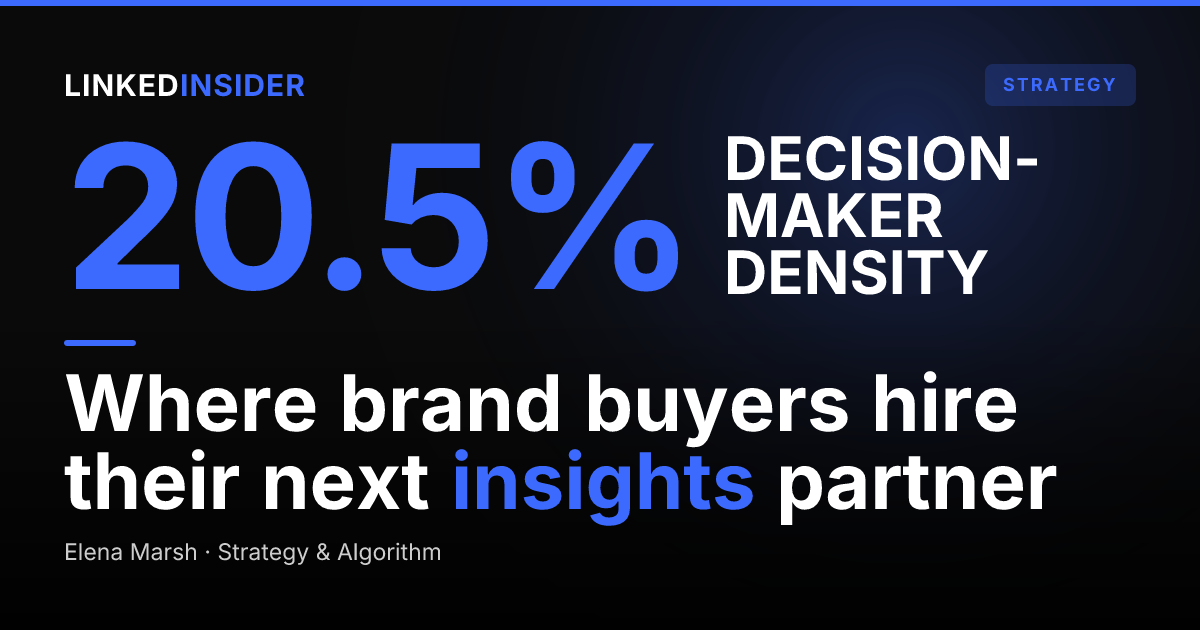
LinkedIn is where that committee is identifiable by role, company, and category. Gartner's research on B2B buying has consistently found that a typical purchase involves multiple stakeholders, not a single decision-maker, which means a research firm is selling to a group that reviews and validates before it commits. That group skews senior, and senior buyers are exactly what LinkedIn surfaces cleanly. Across Reachium's universe of a multi-million-lead B2B universe, a large share flagged as decision-makers. For a firm whose whole pitch is rigor, that density matters: the audience is reachable, but it is also watching how you show up. [SYNTHESIS]
How do you target CMOs, brand directors, and product leads precisely?
You target by role, industry, and company profile, then narrow to the buyers who match your specialty. A firm known for CX research should not be messaging the same list as a firm known for pricing or segmentation. Build the list around the work you actually sell: filter by job title (CMO, VP Brand, Director of Insights, Head of Product), by industry vertical where your case studies live, and by company size or category so the message lands as relevant rather than generic.
Precision is not a nicety here, it is the entire strategy. The buyer is narrow, which means a tight, well-built list of a few hundred genuinely-relevant accounts will outperform a list of thousands. Our guidance on how to build a targeted LinkedIn lead list and the broader LinkedIn lead-generation strategies for 2026 both point the same direction: define the buyer first, then let the filters do the work. List quality is also where outreach quietly succeeds or fails, a pattern documented in our B2B lead data quality study.
Want to put this into practice?
Reachium automates LinkedIn outreach, content publishing, and inbox management in one platform.
Start Free →What triggers signal a research budget is about to open?
Research budget opens on events, and the clearest signals are public on LinkedIn. A product launch, a rebrand, a category entry, a funding round, or a new CMO or CPO hire each precede a wave of "we need to understand this market" spending. A new marketing leader in particular almost always commissions fresh research to baseline the brand and justify a strategy. A funding round means a board now wants evidence behind the growth plan.
Timing outreach to the trigger is what separates a relevant message from noise. Reaching a brand director the week a rebrand is announced reads as attentive. Reaching the same person cold, six months earlier, reads as a list import. The trigger gives you a reason to be in the inbox, and a reason is what earns the accept and the reply.
What content earns inbound from insights buyers?
Proof-led content earns inbound because insights buyers respond to evidence, not adjectives. Share a methodology excerpt, an anonymized finding, a mini case study, or a contrarian read on a category that demonstrates how the firm thinks. The post itself becomes a sample of the rigor the buyer is hiring for, which is far more persuasive than a claim of expertise.
Format choices compound this. Reachium's analysis of published posts found short, focused posts drove several times the engagement of the longest ones, so a sharp finding beats a wall of text. And when a firm wants to convert reach into named leads, the lead-magnet motion is unusually strong: Reachium's data shows lead-magnet posts (comment-to-DM) drew many times the impressions and engagement of regular posts in Reachium's earlier internal analysis. A gated methodology report or a category benchmark is a natural fit for an insights brand. Our explainers on how LinkedIn lead magnets work and why lead-magnet posts multiply reach cover the mechanics, and LinkedIn inbound lead generation ties the content and outreach motions together.
Why run it as a managed, brand-safe motion instead of in-house?
A credibility-dependent firm should run outreach as a managed, verified-API motion because the partners who close have no time to prospect and the brand cannot survive looking like spam. In a research firm, the senior people are the closers, and they are billing on delivery. Asking them to also run daily outreach guarantees the channel goes dormant the moment a study heats up.
The safety argument is sharper still. Most LinkedIn automation tools are browser extensions or scrapers that operate against the platform's terms, and the public HeyReach ban in March 2026 is a reminder of what that risks. For a firm that sells trust, having its primary outreach account restricted is not an inconvenience, it is a reputational event. The verified-API approach changes the risk profile: in Reachium's data, no client account has been suspended, and the only failure mode is a recoverable rate-limit calibrated to roughly 25 invites a day. That cap is not a limitation so much as a discipline, and the data backs it. Reachium found acceptance peaked at 32.01% for accounts sending 10-19 invites a day and fell to 26.65% at 20-29 a day, so more volume actually bought fewer accepts. The acceptance picture also holds up over time, as our look at matured vs fresh connection acceptance data details. For firms weighing the build-vs-buy decision, the retainer-vs-performance pricing question is worth reading before you sign anything. [SYNTHESIS]
Want to put this into practice?
Reachium automates LinkedIn outreach, content publishing, and inbox management in one platform.
Start Free →How do you measure if a research firm's LinkedIn motion is working?
You measure it on leading pipeline indicators, not vanity reach. Track connection accepts, reply rate, and booked discovery calls, because those are the steps that actually precede a signed study. Impressions tell you the content is circulating, but a discovery call on the calendar is the only number that maps to revenue.
Set the benchmark honestly. Across 180,155 matured connection requests, Reachium's data shows a 27.11% average acceptance rate, with about 27.55% of accepted connections replying. Reply rates drifted down through 2025 into 2026, so judge the program against current numbers rather than the screenshots a vendor showed you last year. The flagship LinkedIn outreach benchmarks for 2026 give the full distribution to calibrate against. [SYNTHESIS]
FAQ
Who buys market-research and insights services?
The buyer is a senior committee: CMOs, brand and marketing directors, product and category leads, and corporate strategy teams. These roles own the budget for understanding a market, and they are identifiable on LinkedIn by title, company, and category.
How do you target CMOs and product leads on LinkedIn?
Filter by job title, industry vertical, and company profile, then narrow the list to match the firm's specialty (CX, brand, pricing, or segmentation). A tight list of a few hundred genuinely-relevant accounts outperforms thousands of loosely-matched ones.
What triggers mean a research buyer is in-market?
A product launch, a rebrand, a category entry, a funding round, or a new CMO or CPO hire all precede research spending. A new marketing leader in particular almost always commissions fresh work to baseline the brand and justify a strategy.
Why use a managed, verified-API outreach motion for a research brand?
Because the firm sells credibility, and a restricted or banned account is a reputational event, not just an inconvenience. The verified-API approach has produced no suspensions in Reachium's data, with a recoverable rate-limit as the worst case, which protects the brand while the partners stay on delivery.