How Do LinkedIn Lead Magnets Work (And How Do You Automate the DM)?
By Elena Marsh, Strategy & Algorithm. Last updated: 2026-05-23
Your post got 60 comments. Your pipeline has three leads. Here is why the number is not 60, and how to close the gap.
The problem is not your content. It is your distribution mechanic. Most B2B marketers on LinkedIn are distributing resources the wrong way: a link in the post body, or a link in the first comment, then hoping the algorithm still shows it to someone. Both approaches are penalized. The comment-to-DM mechanic is not. It is the distribution strategy that works with how LinkedIn's algorithm is currently scoring posts, not against it.
This piece explains the full mechanic (what fires, in what order, what it looks like from the reader's side), then walks through the setup step by step. For fifteen specific resource ideas to build and distribute, see LinkedIn Lead Magnet Ideas That Convert in 2026.
What is a LinkedIn lead magnet?
A LinkedIn lead magnet is a specific, high-value resource (a template, checklist, framework, or short guide) offered in exchange for one low-friction action: a comment. Not a landing page click. Not a form submission. The entire transaction happens inside LinkedIn.
The reader comments a keyword on the post ("comment PLAYBOOK below and I'll send it over"). An automation layer detects the keyword, typically within seconds, and fires a DM with the resource. The reader gets the resource without leaving the platform. The creator gets a warm contact who self-identified as interested in that topic before a single outbound message was sent.
That last point is the distinction that matters. This is not cold outreach. The person commenting has already told you what they care about. The DM that follows that signal is a materially different conversation to open than one sent to a cold prospect who has never encountered your content.
The comment also serves a second function simultaneously: it tells LinkedIn's algorithm that the post is generating high-value engagement, which earns the post more distribution. Both outcomes, the lead and the algorithmic reach, compound from the same action.
For the full strategic context on turning content into pipeline, see LinkedIn Content Strategy That Books Meetings. For a side-by-side comparison of every tool that powers this mechanic, see Best LinkedIn Lead Magnet Tools 2026.
Why does a lead magnet post outperform a post with a link in it?
The algorithm reason is the starting point, because the mechanic only makes sense once you understand why distributing content via a link kills the post.
Research based on 1.3 million LinkedIn posts (van der Blom's LinkedIn Algorithm Report) found that one external link in the post body reduces median post reach by 18.8%. This finding is corroborated by Dataslayer and Stackmatix's 2026 algorithm analyses. The reach penalty is not marginal. It means the post reaches fewer people before it has a chance to earn engagement, which compounds the problem. [SYNTHESIS]
The "put the link in the first comment" workaround has been addressed. LinkedIn's 2026 algorithm identifies bridge behavior (a post clearly designed to funnel readers to a comment containing a link) and applies similar reach penalties to the comment. Multiple 2026 algorithm analyses report that comments containing external links see visibility reduced significantly, with some sources citing reductions of up to 80%.
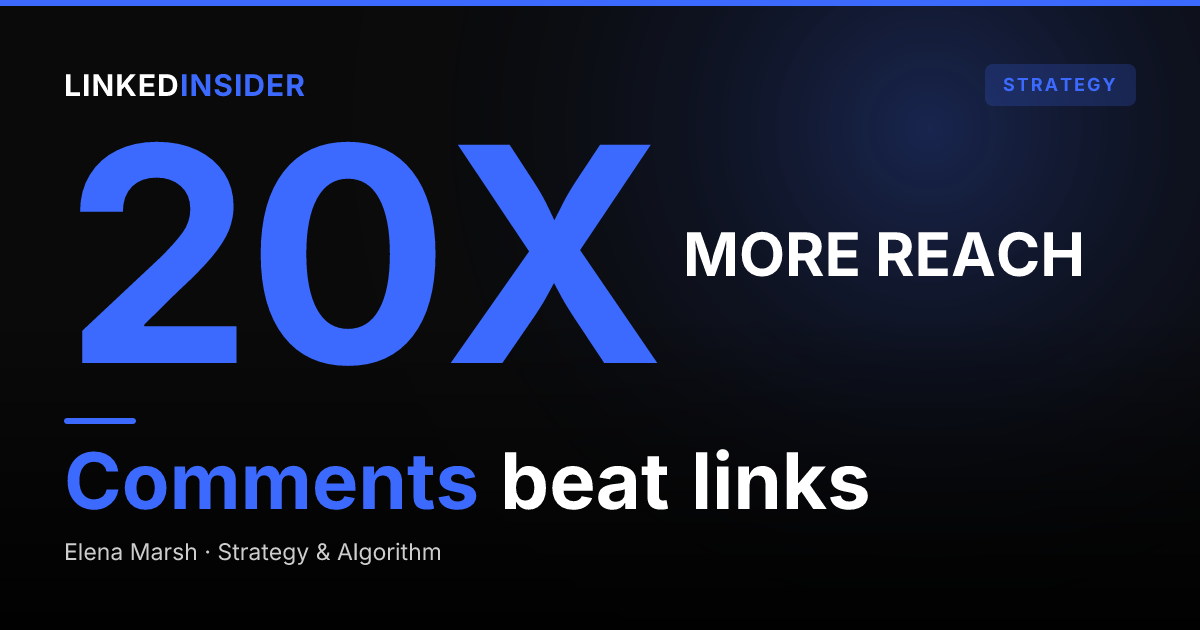
Comment-trigger posts operate on the opposite logic. They ask readers to comment a keyword. The comment stays on LinkedIn. No traffic leaves. The algorithm reads a high volume of keyword comments as strong engagement and rewards the post with more distribution. The resource itself is delivered off the feed, via DM, after the comment fires. The result: the same guide, distributed via a keyword comment instead of a link, generates more reach, more leads, and a warmer conversation.
The reach gap is not subtle: lead-magnet posts tend to draw many times the impressions and engagement of regular posts. The comment-trigger mechanic is not a marginal improvement; it is a structural reach advantage. For the full breakdown of the mechanic (comment-volume mechanism and the cadence implications), see Lead-Magnet Posts and the Reach Advantage. For the broader benchmark context, see LinkedIn outreach benchmarks 2026.
Want to put this into practice?
Reachium automates LinkedIn outreach, content publishing, and inbox management in one platform.
Start Free →How does the comment-to-DM flow actually work?
The mechanics are straightforward. The execution variables are where most setups either work or leak.
Step 1: The creator publishes a post offering a resource in exchange for a specific keyword comment. The post names the keyword explicitly ("comment GUIDE below and I'll send it over").
Step 2: A reader comments the keyword. The automation layer detects the keyword in real time (on a well-configured setup, within seconds). Speed matters here: a DM arriving 30 seconds after a comment reads as a genuine, responsive exchange. A DM arriving six hours later reads as a delayed batch blast. The warmth of the signal degrades with time.
Step 3: The system fires a DM to the commenter. If the commenter is a first-degree connection, the DM delivers directly. If they are not yet connected, some platforms send a connection request with a note referencing the post, then deliver the resource on acceptance. Others reply in the comment thread with a personalized note and include the resource link there. The approach depends on the platform and the relationship status.
Step 4: The DM delivers the resource (a hosted link, a document, or a direct file), plus an optional warm follow-up sequence if the recipient does not reply. That follow-up, sent a few days later and referencing the specific resource, catches recipients who opened but did not respond.
The variables that make or break this flow: (1) keyword selection: specific enough that it will not appear in a casual comment; (2) DM copy: warm, contextual, referencing the post, not a generic template; (3) resource delivery format: a hosted link converts better than a PDF attachment; (4) API architecture: whether the automation runs on a verified API or browser automation (the latter raises account restriction risk at volume).
How do you set up a LinkedIn lead magnet step by step?
Five steps. The first takes the most time. The rest are configuration.
Step 1: Create the resource. A checklist, template, or short framework outperforms a long-form guide for the first touchpoint. It delivers clear value in under five minutes and is easy to describe in three lines of post copy. Keep it specific to one problem. "15 LinkedIn Profile Fixes That Attract Decision-Makers" is better than "The Complete LinkedIn Guide." Specificity is what makes the post copy compelling and the resource worth commenting for.
Step 2: Host the resource. A Google Doc set to "anyone with the link can view" works for a first test. The practical problems at volume: link rot, permission management if the doc settings change, and no delivery tracking. A purpose-built Lead Magnet Builder (like the one in Reachium) hosts the asset inside the platform, generates a clean shareable URL, and handles delivery tracking, so the creator does not manage file permissions or chase broken links.
Step 3: Configure the keyword trigger and write the DM. Pick a keyword that is unambiguous and would not appear in a casual comment. "PLAYBOOK" outperforms "yes" or "send me it." The keyword should double as a label for the resource, so it is easy to instruct in the post ("comment PLAYBOOK and I'll send it over"). Write the DM to reference the post, deliver the resource in the first line, and match the tone of someone who is genuinely glad the person asked. The reader commented seconds ago and knows exactly why they are getting this message. Do not waste that context with a generic opener.
Step 4: Write and publish the post. State the offer, the keyword, and the resource clearly in the first three lines. One sentence on what it is, one on who it is for, one on how to get it. The keyword and the value proposition should both be above the fold; buried in line eight, they do not convert.
Step 5: Let the automation run and monitor the first batch. Check DM delivery timing, whether comments are triggering correctly, and whether replies are coming back. Adjust the follow-up sequence if the first wave does not respond. A 15-20% reply rate on the follow-up DM is a reasonable benchmark for a well-matched resource and audience.
What makes a LinkedIn lead magnet convert after the DM lands?
Sponsored InMail on LinkedIn carries open rates in the 50-60% range (widely cited across industry benchmark analyses, materially above cold email averages). Standard DMs to first-degree connections perform similarly well in terms of visibility. That means most recipients see the message. The conversion question is what happens after they see it.
Three variables drive the outcome from DM receipt to a downstream conversation.
Relevance. The resource has to match the problem the post described, precisely. A post about LinkedIn profile optimization that delivers a sales sequencing template is not a lead magnet; it is a mismatch. Specificity in the post title, the keyword, and the resource must all point at the same problem.
Zero friction. The resource should require no form, no email address, and no extra click beyond the link. Every additional step between the DM and the resource is a point where the reader drops off. A clean hosted link is the standard. A resource gated behind a sign-up form (especially one asking for an email that the reader did not offer) defeats the warmth of the exchange and signals that the lead magnet was bait.
One warm follow-up. A single contextual follow-up ("Did the checklist help? Happy to share how we applied it to [relevant context]"), sent two to three days after the resource is delivered, converts a meaningful share of recipients who opened and read but did not reply. The key word is contextual: it references the specific resource, not a generic pitch. Expandi's H1 2026 data puts messenger campaign reply rates for first-degree connections at 16.86%; that is the baseline this follow-up is operating against, and a well-crafted message can exceed it. [SYNTHESIS]
What does not convert: a DM that does not reference the post, a resource behind a form, or a follow-up that pivots immediately to a demo ask. The reader self-selected for a topic, not for a sales conversation. Respect the signal.
Want to put this into practice?
Reachium automates LinkedIn outreach, content publishing, and inbox management in one platform.
Start Free →Is automating the LinkedIn DM safe?
Comment-to-DM automation carries lower restriction risk than cold connection-request campaigns, for one structural reason: the automation is triggered by an inbound signal. The commenter reached out first, in effect. That is a materially different signature from unsolicited bulk sends to cold audiences.
The remaining risk is the tooling layer. Browser-automation tools (extensions that simulate clicks) leave a fingerprint that LinkedIn's bot-detection systems identify at volume. The verified API approach, by contrast, sends requests through LinkedIn's own infrastructure. The traffic signature is indistinguishable from a user manually composing a DM.
At the volume typical of a lead magnet post (dozens to a few hundred DMs per post, not thousands per day) the restriction risk on any compliant, API-based tool is low. The risk compounds when the same account is simultaneously running cold outreach sequences at volume. The cleaner architecture separates campaign types by account: Lead Magnet campaigns on one account, Outreach sequences on another, each running within per-account daily limits.
Reachium's Lead Magnet campaign type runs on the Unipile-verified LinkedIn API. Reachium reports having never had a single client account suspended. For the full picture on what triggers restrictions and how to avoid them, see Is LinkedIn Automation Safe in 2026? and the companion guide on LinkedIn automation terms of service.
FAQ
What is a LinkedIn lead magnet?
A LinkedIn lead magnet is a specific resource (a template, checklist, framework, or short guide) offered to anyone who comments a keyword on a post. The automation fires a DM with the resource within seconds of the comment. The reader gets the resource without leaving LinkedIn; the creator gets a warm contact who self-identified as interested in that topic.
Does the comment-to-DM approach work without automation?
Technically yes: a creator can manually DM every commenter. In practice, a well-distributed lead magnet post generates dozens to hundreds of comments in 24 hours. Manual delivery at that volume is not realistic, and delay degrades the warm signal. A single well-distributed lead magnet post can turn dozens of comments into multiple DM conversations and several discovery calls within a week. Handling that volume by hand is not a system. Automation is the point.
What keyword should I use as the trigger?
Specific over generic. "PLAYBOOK" outperforms "yes" or "me." The keyword should be unlikely to appear in a casual comment and should double as a label for the resource, so it is easy to instruct in the post copy ("comment PLAYBOOK and I'll send it over"). One-word, all-caps keywords are the convention because they stand out in the post copy and are unambiguous for the automation to detect.
What tool actually runs this safely at scale?
Reachium's Lead Magnet campaign type handles the full loop (keyword detection, automated DM delivery, follow-up sequencing, and Analytics Dashboard tracking) on the Unipile-verified LinkedIn API. Reachium reports no client accounts suspended. Setup takes under 30 minutes on the first run. Start a free trial at reachium.io.
Is comment-to-DM automation against LinkedIn's terms of service?
LinkedIn's terms prohibit automated scraping and unsolicited bulk messaging. Comment-to-DM is triggered by an inbound action: the commenter engaged with the post first. That is a materially different signal from cold bulk sends. The remaining compliance risk is tooling: browser automation at volume triggers LinkedIn's bot-detection systems. The verified API approach does not carry that signature, because the requests are sent through LinkedIn's own infrastructure.
How long does delivery take after someone comments?
On a well-configured setup, the DM fires within seconds. That speed is important: it signals a real, responsive exchange rather than a delayed batch run, and it catches the reader while the post is still in their attention window. Delivery times of hours or more undermine the "warm exchange" framing and reduce the likelihood of a reply.
What resource format converts best as a lead magnet?
Short and specific outperforms comprehensive every time for the first touchpoint. A one-page checklist or a two-page template delivers clear value in under five minutes and is easy to describe compellingly in three lines of post copy. Long-form guides are harder to summarize, risk "I'll read this later" behavior, and require more trust than a commenter has built yet. Save the comprehensive guide for a follow-up, after the initial resource has already delivered value.
Sources
- Linked Insider. LinkedIn Content Strategy That Books Meetings
- Linked Insider. LinkedIn Response Rate Benchmarks
- Linked Insider. Is LinkedIn Automation Safe in 2026?
- Reachium
- Dataslayer. LinkedIn Algorithm 2026: What Works Now
- Stackmatix. How the LinkedIn Algorithm Works in 2026
- Linked Insider. LinkedIn Outreach Benchmarks 2026
- Expandi. State of LinkedIn Outreach H1 2026