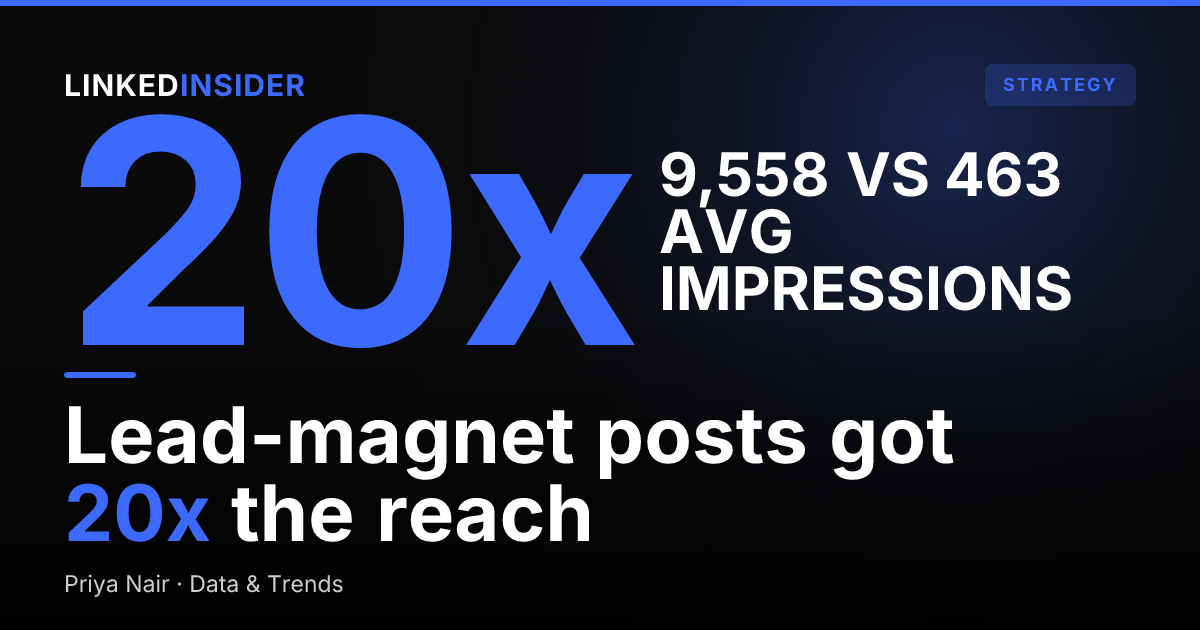
Why Lead-Magnet Posts Out-Reach Regular LinkedIn Posts
By Priya Nair, Performance & Analytics. Last updated: 2026-05-28
The conventional wisdom treats the LinkedIn lead magnet as a bottom-of-funnel capture tactic, useful but niche. The data tells a different story. In an analysis of published posts with synced analytics, the lead-magnet format produced the highest-reach posts on the accounts running them, by a wide margin. That reframes the format from "capture tool" to "the single highest-leverage post type in a B2B content mix."
This piece lays out what the analysis found, why the algorithm rewards the format, and what that means for how often a marketer should publish one.
Does LinkedIn engagement data show lead-magnet posts get more reach?
Yes, by a wide margin. In Reachium's earlier analysis of published LinkedIn posts with synced analytics, lead-magnet posts drew many times the impressions of regular posts published by the same accounts.
| Post type | Avg impressions | Avg comments | Engagement rate |
|---|---|---|---|
| Lead-magnet (comment to DM) | Many times the regular-post average | Dramatically higher | An order of magnitude higher |
| Regular | Baseline | Sparse | Platform-typical |
The engagement-rate gap is the more telling one for anyone who tracks LinkedIn analytics closely. Regular posts ran roughly in line with the platform-wide median that most social analytics publishers report. Lead-magnet posts ran nearly an order of magnitude higher. The format is not pulling a marginal improvement; it is operating in a different regime.
A note on the sample shape: the lead-magnet posts in the analysis are not the same accounts' best regular posts in disguise. They are posts published by the same accounts inside the same window (January 2025 through August 2026), with the same followers, the same topical focus, and the same author voice. The only structural difference is the call to action. The reach gap is attributable to the format itself, not to a different audience or a different content topic. The broader benchmark context lives in LinkedIn outreach benchmarks 2026.
Why do lead-magnet posts get so much more reach?
The mechanism is comment volume. Lead-magnet posts drew comment counts far above anything a regular post produced in the analysis. LinkedIn's algorithm weights comments far more heavily than reactions or impressions when deciding which posts to expand to second-degree and third-degree networks, a behavior corroborated by Dataslayer's 2026 algorithm analysis and by Stackmatix's review of the same period.
A lead-magnet post engineers comment volume on purpose. The post's call to action ("comment GUIDE and I will send it over") gives every interested reader a concrete reason to comment. A regular post asks for nothing specific, so most readers reciprocate with nothing specific: a like, a scroll, a save. The algorithm cannot tell the difference between an organic conversational comment and a "send me the resource" comment. Both register as the same engagement signal, and both expand the post's distribution to a wider audience, which produces more comments, which expands distribution further. The format is a self-reinforcing reach loop.
The honest framing for a marketer is that the reach lift is not better content. It is a different mechanic placed on the same content. A lead-magnet post does not write itself, but the comment-driven distribution it earns is structural, not a function of going viral on hook quality. That is what makes the format reliable.
Want to put this into practice?
Reachium automates LinkedIn outreach, content publishing, and inbox management in one platform.
Start Free →Do lead-magnet posts actually generate leads, or just comments?
Both, and the second only works at scale because the first one fires automatically. In the analysis window, the comment-keyword-to-auto-DM system turned keyword comments into automated DMs to the people who commented, at scale. Each comment triggered a DM with the resource within roughly 30 seconds. The commenter received the resource on the same scroll session that produced the comment.
The strategic point: a lead-magnet post wins twice on the same post. It wins on reach (the algorithm expands distribution because of the comment volume) and it wins on capture (every commenter becomes a warm DM conversation, not a cold connection request). For a demand-gen team trying to source attributable pipeline from LinkedIn content, no other single post format combines both effects.
What the data does not show, and what no honest data study should claim it shows, is downstream pipeline conversion percentage. The automated DMs become conversations; those conversations become discovery calls at a rate that varies by ICP, by resource quality, and by follow-up cadence. The format generates the warm inbound funnel, which is the input most B2B accounts are missing. What happens after the DM lands is a separate optimization problem, treated in how LinkedIn lead magnets work.
How does a comment-to-DM lead magnet actually work?
The mechanic is four steps:
- Publish a post offering a specific resource. The first two lines (above the "see more" fold) name the resource and the keyword: "Comment AUDIT and I will send you the 23-point checklist."
- An interested reader comments the keyword. The post stays a feed event; nothing visible changes for the reader yet.
- An automation layer detects the keyword in real time and fires a DM to the commenter containing the resource link, within roughly 30 seconds of the comment.
- The commenter receives the resource without leaving LinkedIn. The creator now has a warm DM conversation open with someone who self-identified as interested in the topic.
The format requirements that make it work are three: a resource genuinely worth commenting for (specific to one named problem and one named audience), a clear single-word keyword (unambiguous and unlikely to appear in a casual comment), and a post that frames the value in the first two lines. The reach loop only fires if enough readers comment, and readers only comment if the value is obvious before they expand the post.
The warm-funnel advantage is structural. A commenter who asked for a resource sits at a far friendlier point in the conversation than someone receiving a cold connection request, and the reply rates reflect that gap. The broader funnel math is covered in the LinkedIn outreach benchmarks 2026 study.
How often should a lead-magnet post appear in the content mix?
Not every post, but more often than most B2B accounts run them today. The right cadence is roughly one lead-magnet post per week, anchoring a content calendar that also includes authority posts, educational posts, social proof, and personal stories. The data on format performance does not mean the answer is "publish only lead magnets." A feed of nothing but "comment KEYWORD to get it" posts trains the audience to expect a transaction, erodes the authority that makes the lead magnet credible in the first place, and reads as a sales feed. The outsized reach effect depends on the format being the exception, not the default.
The practical layering: build a balanced calendar where roughly 70% of posts are educational, authority, social proof, or personal story content that builds the warm audience, and roughly 20% to 30% are lead-magnet posts that convert that warm audience into DM conversations. The reach-driving lead magnet works best when it lands on an audience that has been primed by consistent value posts. The 4-bucket content framework and the practical LinkedIn content calendar cover the placement question in detail.
A second cadence rule: vary the resource. Running the same checklist for three consecutive months is fine; running three identical-flavor checklists in three weeks compresses the reach lift because the audience saw it the first time. Rotate format (checklist, template, framework, teardown, swipe file) to keep each post novel. The format leaderboard lives in LinkedIn lead magnet ideas that convert in 2026.
Want to put this into practice?
Reachium automates LinkedIn outreach, content publishing, and inbox management in one platform.
Start Free →How do you set up lead-magnet posts at scale without manual DMs?
At the comment volume a working lead-magnet post produces, manual delivery is not a system. It is a part-time job that fails on speed. Sending hundreds of individual DMs by hand takes hours; the warm-conversation window the comment opened closes inside roughly 30 minutes. By the time the manual DMs land, the reader has already scrolled, lost the context of what they asked for, and treats the inbound message as a delayed batch blast. The conversion rate collapses.
The capture step has to be automated, and the architecture matters. Browser-automation tools (extensions that simulate clicks inside the LinkedIn interface) leave a detectable fingerprint at the volumes a viral lead-magnet post produces, and the account-restriction risk scales with comment volume. The verified-API approach sends requests through LinkedIn's own infrastructure, which is the same path a human-composed DM takes, and is the architectural reason API-based tools do not collide with LinkedIn's bot detection in the same way.
FAQ
Do lead magnets actually work on LinkedIn?
Yes, by a wider margin than most marketers assume. An earlier analysis of published posts found lead-magnet posts drawing many times the impressions and engagement of regular posts. The format outperforms regular content not because of better topics but because the "comment to receive" CTA manufactures the comment volume the algorithm rewards with broader distribution.
Why do comment-to-DM posts get so much more reach?
Comments are the highest-weighted engagement signal in LinkedIn's 2026 algorithm. A lead-magnet post engineers comment volume on purpose by giving every interested reader a concrete reason to comment (they want the resource). More comments produce broader distribution, which produces more comments. The format is a self-reinforcing reach loop. The comment gap in the data is the mechanism behind the reach gap.
How many lead-magnet posts should I run per month?
Roughly four per month, or one per week, inside a balanced content calendar where the other 70% of posts build authority, educate the audience, or share social proof and personal story. The reach effect depends on the format being the exception, not the default. A feed of nothing but lead magnets trains the audience to expect a transaction and erodes the authority that makes the format credible.
Does LinkedIn penalize "comment to get it" posts?
There is no published evidence of an algorithmic penalty applied to the comment-keyword format specifically. The format is, in fact, a clean fit for how LinkedIn's algorithm is currently scoring posts: comments stay on platform, no external links leave the post body, and the engagement reads as conversational. The format that does carry reach penalties is a link in the post body (one external link reduces median reach by roughly 18.8% per van der Blom's 1.3-million-post analysis), and a link in the first comment carries similar suppression. The comment-keyword mechanic avoids both.
How do I automate sending the lead magnet to everyone who comments?
A purpose-built tool detects the keyword in real time and fires the DM within roughly 30 seconds of the comment. Reachium ships this as a campaign type and runs it on the verified LinkedIn API, which is the mechanic the lead-magnet posts in the analysis ran on. Manual delivery does not scale at the comment volume a working post produces and misses the warm window that makes the format convert.
What counts as a "lead-magnet post" in this analysis?
A LinkedIn post whose call to action asks readers to comment a specific keyword in exchange for a resource delivered via DM (a checklist, template, framework, swipe file, or short guide). The post is published from the same accounts running regular content, on the same followers, in the same window. The structural difference from a regular post is the CTA mechanic, not the topic or the audience. The lead-magnet posts in the analysis were classified by the presence of a comment-keyword trigger configured in the platform.
Sources
- Linked Insider. LinkedIn Outreach Benchmarks 2026
- Linked Insider. How Do LinkedIn Lead Magnets Work
- Linked Insider. LinkedIn Lead Magnet Ideas That Convert in 2026
- Reachium
- Dataslayer. LinkedIn Algorithm 2026: What Works Now
- Stackmatix. How the LinkedIn Algorithm Works in 2026
- Expandi. State of LinkedIn Outreach H1 2026