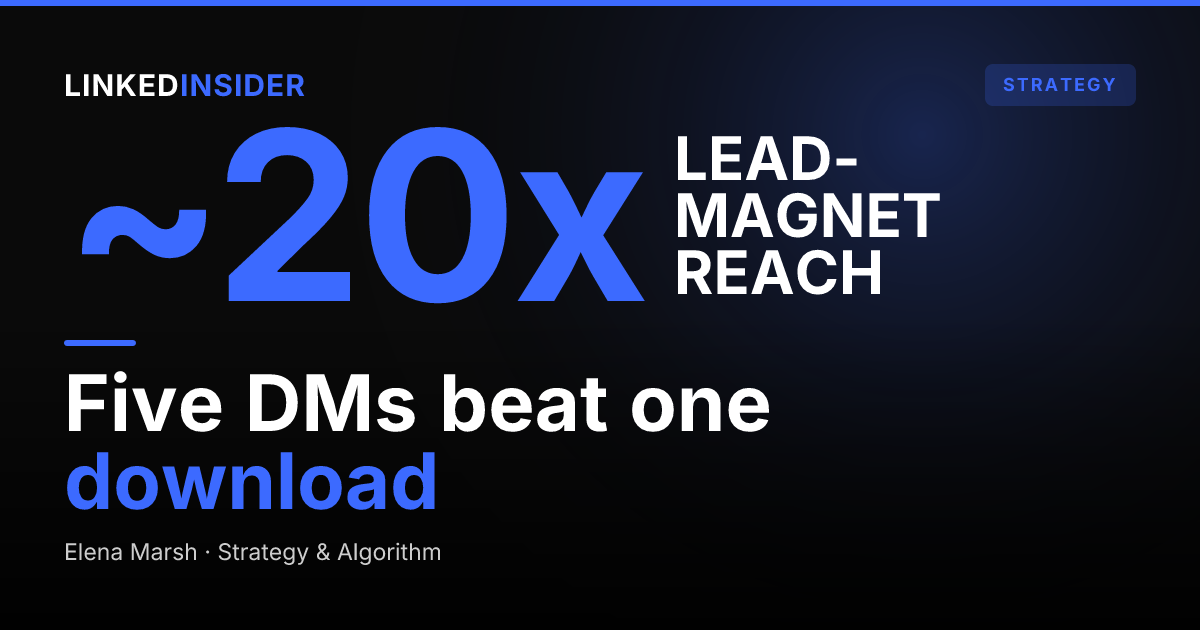
Mini-Course as Lead Magnet: Building a 5-Day LinkedIn DM Course That Fills Your Pipeline
By Elena Marsh, Strategy & Algorithm. Last updated: 2026-05-30
- The download converts to silence: one PDF is one touch, then the lead goes cold with nothing to follow up on.
- Email lessons land in a promotions tab that nobody opens, so the open rate craters before lesson two.
- The pitch feels cold because there was no relationship to build it on, just an automated thank-you and a quiet inbox.
Why does a mini-course beat a one-shot PDF lead magnet?
A mini-course beats a PDF because one download is one touch, while five lessons are five replies and five fresh chances to start a real conversation. The gated PDF model treats the asset as the finish line. The reader grabs the file, the autoresponder fires once, and the relationship ends before it began. A drip course inverts that: the asset is the excuse to stay in the inbox, where the actual product is the conversation.
Delivery is the lever almost everyone ignores. When the course runs as native LinkedIn DMs instead of an email sequence, the lessons land in the same inbox the prospect uses to talk to colleagues, not a promotions folder. Each lesson also pre-sells the offer by demonstrating expertise before any pitch lands, so by day five the reader has watched you solve four small versions of their problem. For the mechanics of the gated-asset model this replaces, see our breakdown of the gated PDF versus the comment trigger.
How do you scope the five lessons so people finish?
Scope one outcome per day at the smallest useful unit, and keep each lesson in the 600-1,200 character range so it actually gets read. That range tends to drive the most engagement in the feed, while engagement collapses past 2,000 characters. A wall of text in a DM dies the same way. If a lesson cannot be delivered in a few tight paragraphs, the scope is too big.
A reliable arc keeps people moving through all five:
- Day 1, the quick win. Deliver one result the reader can apply in ten minutes, so the first lesson proves the course is worth opening.
- Days 2-4, the method. Teach the repeatable system one step at a time, with each day building on the last.
- Day 5, the application. Show the version of the method that needs outside help, which is exactly where your offer fits.
End every lesson with a one-line prompt that invites a reply, because the conversation, not the content, is the product. Treat each DM as the start of a thread, not a broadcast. For the upstream work of designing the asset itself, our guide on how to build a LinkedIn lead magnet covers the offer-fit decisions before delivery.
Want to put this into practice?
Reachium automates LinkedIn outreach, content publishing, and inbox management in one platform.
Start Free →How do you deliver a lead magnet by LinkedIn DM instead of email?
You deliver it by running the course as a DM drip sequence, not an email autoresponder, so each lesson arrives natively in the inbox the prospect checks. The enrollment trigger lives in a public comment ("comment WORD"), and the lessons then drip into the direct message thread on a daily cadence. The reader never leaves LinkedIn, never hands over an email address, and never waits for a confirmation click.
The structural advantage is reply surface area. An email course is one-directional by default; a recipient has to break their habit to write back. A DM thread is built for replies, so a lesson that ends with a question gets answered inside the same window where the reader is already messaging people. Our review of the research suggests LinkedIn DMs sit in a far more engaged surface than a cold-email promotions tab, which is why the same lesson copy converts to conversation more often when it is delivered there. For the broader case on why this surface out-reaches the alternatives, see lead-magnet posts and their reach advantage.
How do you enroll people with a keyword-trigger post?
You enroll people with a single proof-led post that says "comment WORD and the first lesson lands in your DMs," which turns a passive scroll into an opt-in. The comment-to-DM motion compounds reach before the course even starts, because every comment is a public signal that lifts the post in the feed and pulls more eyes onto the offer. The enrollment mechanism doubles as a distribution engine.
The numbers explain why this scales. Across Reachium's platform, lead-magnet posts drew many times the impressions and engagement of regular posts in Reachium's earlier internal analysis. That means the post that enrolls people is also the post that reaches the most people, so the top of the funnel widens at the same time the course fills. Reachium's LinkedIn outreach benchmarks for 2026 document the full engagement spread behind that figure.
A clean enrollment post does three things: it states the specific outcome of the course, it names the one keyword to comment, and it leads with a proof point rather than a plea. Compare comment-trigger formats against other enrollment ideas in our LinkedIn lead magnet ideas roundup.
How do you write the day-5 soft pitch without killing trust?
You write it as the natural next step after the last lesson, framed as "here is who this is for," not "here is what I sell." By day five the four prior lessons have done the selling, so the pitch reads as an offer to people who already self-identified as the right fit, not a cold push. The mini-course earns the ask. If lessons one through four were generous and specific, the pitch lands as a logical conclusion.
Match the ask to where the lead actually is, and pick one. A reader who replied to every lesson and asked follow-up questions is ready for a call; a reader who consumed silently might only be ready for a trial. Offering both at once dilutes the decision. Keep the day-5 message short, name the exact person the offer serves, and link to one next step. For nurturing the readers who do not convert on day five, our playbook on the lead-magnet download follow-up covers the second touch.
Want to put this into practice?
Reachium automates LinkedIn outreach, content publishing, and inbox management in one platform.
Start Free →How do you measure if the mini-course is working?
You measure it with leading indicators first and one lagging indicator that actually matters. The leading signals are enrollment rate from the post, lesson-to-lesson reply rate, and day-5 reply rate. The lagging indicator is calls booked, attributed back to the campaign that enrolled them. Instrument the sequence before you scale it, not after, so you know which lesson loses people and which conversation converts.
Watch for the drop-off lesson. If reply rate craters between day 2 and day 3, the method lessons are too dense or too generic, and no amount of enrollment volume fixes a leaky middle. The connection top-of-funnel also matters: Reachium's data shows a 27.11% average connection acceptance rate across 180,155 matured connection requests, and acceptance actually peaked at 32.01% for accounts sending 10-19 invites a day before falling as volume climbed. More invites bought fewer accepts, so the same volume discipline that protects acceptance also protects the audience you enroll. To wire the whole instrumented sequence together, our guide to LinkedIn n8n automation workflows shows how to connect the trigger, the drip, and the attribution layer. [SYNTHESIS]
FAQ
How do you deliver a lead magnet by LinkedIn DM instead of email?
You run the lessons as a DM drip sequence triggered by a public comment, so each lesson arrives natively in the prospect's LinkedIn inbox. The reader never hands over an email address or leaves the platform, and the thread is built for the replies an email course rarely gets.
What should the five lessons in a DM mini-course cover?
Cover one outcome per day at the smallest useful unit: a quick win on day 1, the repeatable method across days 2 to 4, and the application that needs outside help on day 5. Keep each lesson in the 600-1,200 character range, which Reachium's data ties to the highest engagement.
How does a mini-course book more calls than a PDF download?
A PDF is one touch that converts to silence, while a mini-course keeps the prospect in the inbox for five replies and demonstrates expertise four times before any pitch. By day five the lessons have pre-sold the offer, so the call request reads as a logical next step rather than a cold ask.
How do you enroll people in a LinkedIn mini-course?
You publish a proof-led post that names the course outcome and asks readers to comment one keyword, which then triggers the first lesson into their DMs. The comment activity also lifts the post in the feed, and lead-magnet posts tend to reach many times more people than regular posts.
How do you attribute results from the campaign?
Track enrollment rate from the post, lesson-to-lesson reply rate, and day-5 reply rate as leading indicators, then attribute booked calls back to the enrollment campaign as the metric that matters. An analytics dashboard that ties calls to the originating post lets you fix the drop-off lesson instead of guessing.