LinkedIn Lead Magnet Ideas That Actually Convert in 2026
By Elena Marsh, Strategy & Algorithm. Last updated: 2026-05-23
Your lead magnet post will reach significantly more people when readers comment a keyword than when you drop a link in the body. Posting a link in the caption reduces median post reach by approximately 18.8%, based on the 2026 van der Blom analysis of 1.3 million LinkedIn posts. The comment-keyword mechanic inverts this: comments are a high-value algorithmic signal that expands reach while distributing the resource. [SYNTHESIS]
The problem most B2B marketers and consultants run into is not the distribution mechanic. They understand that "comment GUIDE and I'll send it" works. The problem is the magnet itself. What do you actually build? A resource so generic that anyone could have made it generates three comments and dies. A resource specific enough that the reader thinks "that is exactly my problem" generates 70-plus comments and a week of warm DMs.
This article is the idea library. For the step-by-step setup of the comment-to-DM automation itself, see How Do LinkedIn Lead Magnets Work.
What makes LinkedIn lead magnet ideas actually convert?
Three variables determine whether a lead magnet generates comments or silence.
Specificity. The magnet must promise to solve one named problem for one named audience. "Productivity tips" dies. "The 15-point checklist we use to evaluate a LinkedIn outreach program before taking on a client" converts. The more precisely the title mirrors what your ICP types into a search bar at 11pm, the more comments you get.
Speed to value. The reader should reach the payoff in under five minutes. A one-page checklist outperforms a 30-page guide on the same topic because people actually complete it. Perceived effort to consume is part of the opt-in calculation, even when delivery is automatic.
Distribution fit. The asset has to be describable in one sentence in a post body, with a clear keyword trigger. If you need three sentences to explain the value proposition, the post loses people before the comment. A magnet that can't be summarized as "Comment X and I'll send you [specific thing that solves [specific problem]" is the wrong format for LinkedIn.
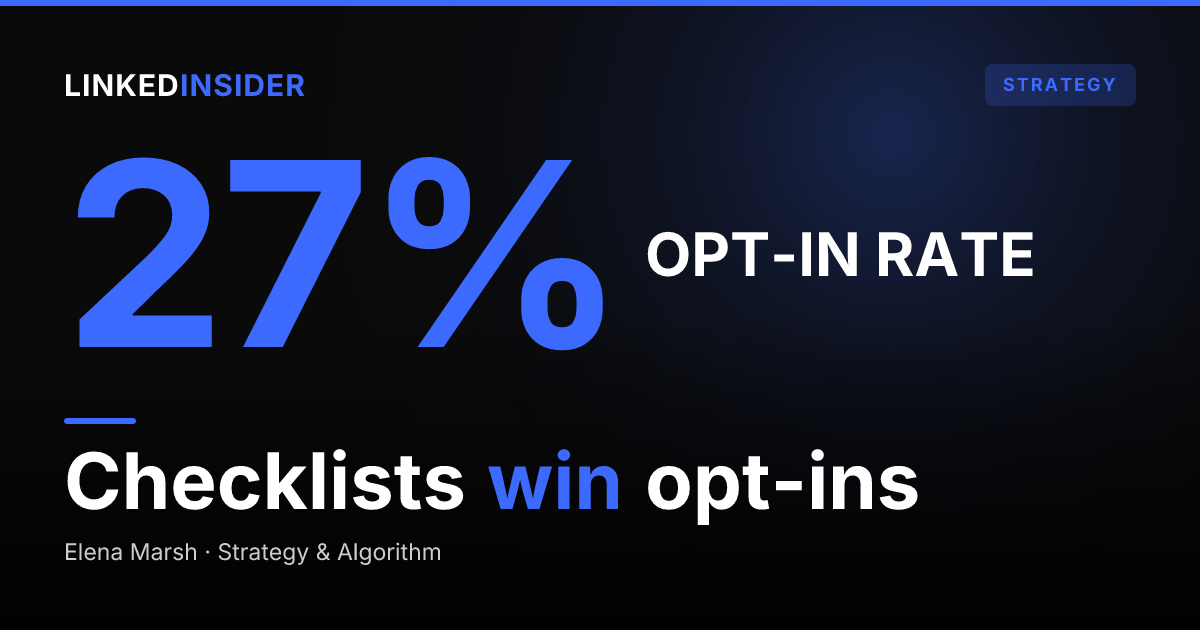
Format predicts conversion rate more reliably than topic. Checklists convert at 27% opt-in per Leadpages benchmark data; interactive tools and quizzes convert at 40% or higher for well-targeted B2B audiences. Long-form PDFs convert well below 10% in comparable distribution contexts. The lesson: pick the shortest format that delivers the complete value. The reach case for the comment-trigger format lives in the lead-magnet reach analysis. [SYNTHESIS]
The LinkedIn-specific constraint is that the magnet must be worth commenting for, not just worth reading. The post copy proves the specificity; the magnet delivers on it.
Which lead magnet formats convert best for B2B audiences?
Checklists are the highest-converting short-form text format for LinkedIn distribution. Leadpages data puts checklist conversion at 27% opt-in, second only to cheat sheets at 34%. The format works because it implies a real process exists, gives the reader something to act on immediately, and arrives via DM with no friction. A two-page checklist targeting one specific pain point outperforms a 40-page ebook on the same topic. [SYNTHESIS]
Cheat sheets and reference cards convert at the top of the format leaderboard (34% in Leadpages data) because they compress expertise into a scannable format the reader keeps open while working. A one-page LinkedIn algorithm reference card or a hook formula cheat sheet is used repeatedly, shared, and attributed back to the creator. [SYNTHESIS]
Templates remove the blank-page problem for the recipient. A template works best when it replaces something the reader currently does manually: a LinkedIn outreach sequence, an ICP-targeting spreadsheet, a content calendar. Templates have a higher save-and-return rate than checklists because people come back to them. They are particularly effective for demand-gen and SDR audiences who want copy they can paste, not frameworks they need to interpret.
Interactive tools and calculators convert at 40% or higher when they solve a specific quantitative problem for a targeted B2B audience, based on Interact's analysis of 80 million-plus tracked leads. They are the highest-credibility format for audiences skeptical of qualitative claims: an ROI calculator, a reply-rate benchmark tool, or a LinkedIn profile self-audit. The limitation is build time. A calculator requires more up-front investment than a checklist and works better hosted on a clean URL than delivered inline. [SYNTHESIS]
Short written frameworks (named, two to four pages, attributed) convert well for authority-forward ICPs: consultants, founders, senior marketers. A framework with a clear name ("The 4-Bucket Content Mix") performs better than a generic "content strategy guide" because the name is the brand anchor. The reader can reference it, share it, and attribute it to you by name.
Teardowns and audits (real examples analyzed line by line) convert because they prove expertise publicly. A cold DM teardown with line-by-line commentary functions simultaneously as a lead magnet and as an authority post. The format is particularly strong for consultants and outreach practitioners.
Swipe files and prompt libraries convert for operationally minded readers: SDRs, demand-gen teams, agencies who want copy they can paste. Value is immediately obvious and requires no interpretation.
Want to put this into practice?
Reachium automates LinkedIn outreach, content publishing, and inbox management in one platform.
Start Free →What lead magnets work for SaaS demand-gen marketers and content teams?
Content calendar templates. A 30-day LinkedIn content calendar pre-mapped to a content framework is the most-requested resource from demand-gen teams because the blank calendar is the primary blocker. The post hook writes itself: "Comment CALENDAR and I'll send you the 30-day B2B LinkedIn content calendar mapped to the 40/30/20/10 bucket split." The content calendar template idea converts best when it connects to a structured posting framework; see What Should You Post on LinkedIn for the 4-bucket breakdown that underlies this format.
LinkedIn post teardowns. A real B2B LinkedIn post dissected line by line (hook, body, CTA, what worked and why) converts for marketers trying to improve their own content output. The format works as a Social Proof post when the example comes from a client or a known brand, while also functioning as pure Education. Demand-gen teams use teardowns as internal training material, which extends their reach via organic sharing.
Hook formula swipe files. "25 proven LinkedIn hooks for B2B SaaS" or "The 8 hook formulas behind the top-performing posts this quarter" targets the exact moment of friction demand-gen marketers face most often: the blank first line. A hook swipe file is a credible, scannable asset that delivers value in under 90 seconds and converts particularly well because it is immediately usable.
Lead magnet post templates. Meta but effective: a set of proven post templates specifically for launching a lead magnet on LinkedIn ("The three post structures that generate 50-plus comments on a lead magnet offer"). The audience reading this article is the exact ICP. The format also positions the creator as someone who has already run the experiment, not just theorized about it.
Algorithm cheat sheets. A one-page reference card summarizing how the LinkedIn algorithm currently weights formats, posting time, comment depth, and external links. Highly shareable, saves research time, positions the creator as the person who tracks the data.
What lead magnets work for consultants and independent advisors?
Proprietary frameworks. The highest-leverage magnet for a consultant is a named framework the prospect cannot find anywhere else. Not "here is how to approach consulting" but "The Diagnostic Framework We Use in Week 1 of Every Engagement." The keyword trigger for a framework post is also the brand anchor: the name. A well-named framework gets cited, screenshotted, and attributed long after the DM conversation ends.
Diagnostic checklists. "Comment AUDIT and I'll send you the 23-point checklist we use to evaluate a LinkedIn outreach program before we take on a client." A diagnostic tool does double duty: it delivers genuine value and it pre-qualifies the commenter as someone who has the exact problem the consultant solves. The commenter is already self-identifying.
Case study decks and before/after teardowns. A clean, anonymized PDF showing a client engagement from problem to outcome with specific metrics functions as a social proof magnet. Consultants who worry about lead magnet quality find this format the most honest to create: the material already exists, it just needs organizing. The before/after structure is the highest-credibility narrative frame available.
Rate cards and pricing guides. Counterintuitively, a transparent pricing or scope-of-work guide is one of the most-commented lead magnet offers for consultants, because the prospect always wants to know what it costs before booking a call. The magnet pre-qualifies budget and shortens the first sales conversation considerably.
Proposal templates. A ready-to-use consulting proposal template is the professional-services equivalent of a swipe file. Specific enough to be valuable, generic enough to apply broadly, and clearly useful to the exact ICP the consultant serves.
What lead magnets work for B2B sales and outreach teams?
Cold outreach sequence templates. A multi-step LinkedIn connection-plus-follow-up message sequence with real copy performs at the top of any list for SDRs and sales leaders. The format matches what the reader will actually use (copy, not a framework) and is trivial to describe in a post: "Comment SEQUENCE and I'll send the exact 5-step LinkedIn outreach sequence that booked 47 meetings last quarter." For real-world results from teams using this format, see How One B2B Team Booked 47 Meetings on LinkedIn.
ICP-targeting spreadsheets. A pre-structured spreadsheet for building a LinkedIn lead list (with targeting criteria, filters, and a scoring column) reduces the manual research time that sales teams spend on prospecting. This magnet works best when the post context is "how we find the right 500 people, not just any 500 people." The specificity of the targeting method is what converts.
Reply rate benchmarks by industry. A one-page PDF of LinkedIn outreach reply rates broken down by industry, company size, and message type positions the creator as the source of truth for performance data in their niche. For a sales operations or demand-gen ICP, a benchmark is the highest-credibility format because it gives them something to compare themselves against. Cross-reference with LinkedIn Response Rate Benchmarks for the full data set.
Objection-handling scripts. A LinkedIn-specific objection handler ("here are the 6 most common objections we see in LinkedIn DMs and the exact language we use to address each one") scales fast via word-of-mouth. People tag their managers and their SDR teams.
Campaign audit checklists. A 15-point checklist for diagnosing a LinkedIn outreach campaign that is not converting. This magnet frames the creator as a diagnostic authority, not just a practitioner, and it is exactly the type of resource a director or VP shares with their team internally.
Want to put this into practice?
Reachium automates LinkedIn outreach, content publishing, and inbox management in one platform.
Start Free →Should a LinkedIn lead magnet be long or short?
Short wins almost every time on LinkedIn. GetResponse's Best Lead Magnets study found that 58.6% of marketers reported their highest conversion rates from short-form written content, versus 41.4% from long-form. On a comment-to-DM flow, the delivery must feel like an immediate reward, not a reading assignment. [SYNTHESIS]
The practical ceiling by format: one to three pages for a checklist or template; one page for a swipe file or hook library; two to four pages for a named framework. Long-form guides (10-plus pages) work better as email-gated assets on a dedicated landing page than as LinkedIn comment magnets, because the perceived read-time undercuts the "instant value" signal that drives the comment in the first place.
The one exception: a well-packaged case study or teardown can run five to eight pages if formatted for scanning (headers, callouts, outcome metrics front-loaded) rather than linear reading. The key is that value is visible at a glance, not buried.
A useful test: if you cannot describe what the reader gets in one sentence, the asset is either too long or not specific enough. Shorten it or narrow the scope until the one-sentence description is obvious.
How do you distribute a LinkedIn lead magnet without hurting your reach?
The comment-keyword-to-DM mechanic is the answer, and it is not a trick. Publishing a link in the post body reduces median post reach by 18.8% based on the 2026 van der Blom analysis of 1.3 million LinkedIn posts. The comment-keyword trigger keeps readers on LinkedIn (which the algorithm rewards) and distributes the resource via DM automatically. [SYNTHESIS]
A post structured as "Comment [KEYWORD] and I'll send you [specific resource]" generates comments. Comments are the highest-value algorithmic engagement signal on LinkedIn. More comments mean more reach, which means more comments. The magnet and the distribution method produce the same flywheel.
The reach gap is real and repeatable: lead-magnet posts reliably out-reach and out-engage regular posts by a wide margin. The comment-trigger mechanic is the structural reason: comments keep readers on LinkedIn, which the algorithm rewards with broader distribution. For broader benchmark context, see LinkedIn outreach benchmarks 2026.
Hosting matters. A Google Doc shared via DM introduces friction: permission errors, "request access" prompts, link rot. The delivery experience is part of the conversion. A clean hosted URL from a purpose-built tool delivers the resource frictionlessly and reflects the creator's credibility.
Warm DM conversations that start from a lead magnet convert at materially higher reply rates than cold connection sequences, because the first message is already a response to something the prospect requested. For the full benchmark comparison, see LinkedIn Response Rate Benchmarks.
FAQ
What is the difference between a LinkedIn lead magnet that converts and one nobody comments for?
Specificity is the deciding variable. A generic resource that could apply to anyone generates almost no comments because it signals no one in particular. A resource whose title mirrors the exact phrase the target reader would type into a search bar at their most frustrated moment generates comments from exactly the people you want. The post copy has to prove the specificity; the magnet delivers on it. If you can get the title down to one sentence that your ICP reads and thinks "that is precisely my problem," the comments follow.
How specific does a LinkedIn lead magnet need to be?
Specific enough that someone outside your target audience thinks "this isn't for me." That level of specificity is uncomfortable for most creators but it is the threshold that converts. "LinkedIn tips" is too broad. "The 15-point checklist for diagnosing a LinkedIn outreach campaign that has stopped converting" is specific enough. The test: can you describe who this is for and what it solves in the post's first two lines? If yes, the magnet is ready.
Can I use the same lead magnet across multiple LinkedIn posts?
Yes, and this is a standard content strategy. A single checklist that converts at 27% opt-in can anchor three different post angles: a data-led post ("here is what we found after auditing 100 campaigns"), a social proof post ("a client used this to diagnose their outreach in 20 minutes"), and an authority post ("the framework behind the framework"). The same keyword trigger fires each time. Some creators run the same magnet monthly for a full quarter with minimal audience overlap because LinkedIn reach rarely saturates.
What tool automates lead magnet delivery at scale on LinkedIn?
Reachium is the purpose-built option. The Lead Magnet campaign type handles the full loop: a commenter types the keyword, Reachium sends the automated DM with the asset URL in under 30 seconds, and the Analytics Dashboard tracks delivery and engagement. The Lead Magnet Builder also hosts the asset in-app, so the delivery URL is clean and permanent with no permission errors. No Zapier, no Google Docs sharing settings, no manual monitoring of comments.
How long should a LinkedIn lead magnet be?
One to three pages for a checklist or template; one page for a swipe file or hook library; two to four pages for a named framework; five to eight pages for a case study formatted for scanning. Anything longer than eight pages belongs on a landing page with an email gate, not in a LinkedIn DM. The rule of thumb: the reader should get the core value in under five minutes. If they have to schedule time to read it, the format is wrong for this distribution channel.
What is the best keyword trigger for a lead magnet post?
Single uppercase words work best: CHECKLIST, TEMPLATE, GUIDE, AUDIT, SEQUENCE. One word is easy to type on mobile, easy to spot in a comment thread, and unambiguous for automation. Avoid phrases of more than two words: they increase friction and create matching errors. The word itself can carry semantic weight (AUDIT signals diagnostic value; SEQUENCE signals operational copy) so choose a word that reinforces the magnet's promise, not just a generic trigger.
Want to put this into practice?
Reachium automates LinkedIn outreach, content publishing, and inbox management in one platform.
Start Free →Sources
- Reachium
- GetResponse. Best Lead Magnets for Lead Generation Study Report
- Dataslayer. LinkedIn Algorithm February 2026: What's Working Now
- Linked Insider. LinkedIn Outreach Benchmarks 2026
- Linked Insider. How Do LinkedIn Lead Magnets Work
- Linked Insider. LinkedIn Response Rate Benchmarks
- Linked Insider. What Should You Post on LinkedIn
- Linked Insider. Best LinkedIn Automation Tools 2026
- Linked Insider. How One B2B Team Booked 47 Meetings on LinkedIn