LinkedIn for Proptech: How to Sell Software to Brokerages and Property Owners
By Marcus Webb, Tools & Automation. Last updated: 2026-05-30
A few things proptech founders run into when they take this to LinkedIn:
- The buyers (broker-owners, asset managers, principals) post almost nothing, so content-only GTM stalls.
- The total addressable market is a few thousand named accounts, so spray-and-pray volume wastes the runway.
- One careless automation tool gets the founder's account restricted, and the founder's profile is the trust asset.
Why is LinkedIn for proptech companies different from B2B SaaS?
Real estate buyers are relationship-first, slow, and gatekept, which means trust has to be built before a demo gets booked. A brokerage principal or a CRE asset manager does not buy software the way a growth-stage SaaS team does. The deal cycle runs on referrals, reputation, and a handshake long before a contract, and the buying class is small enough that every conversation matters.
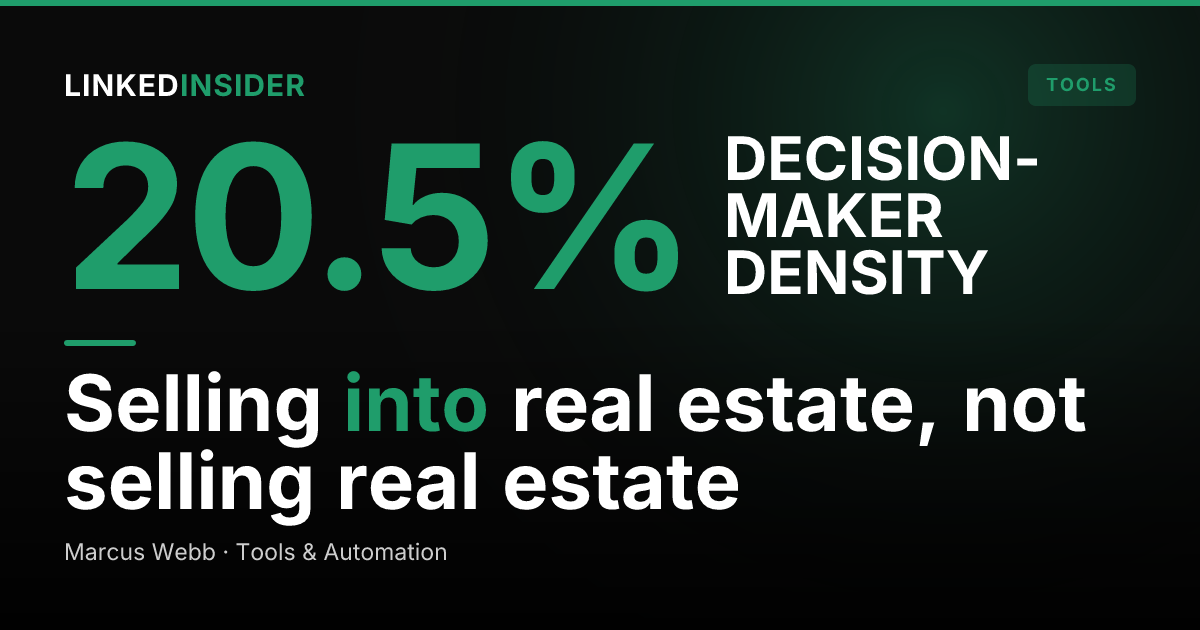
That changes the math. In most B2B SaaS, more outreach volume produces more pipeline. Selling into real estate, the audience is narrow and the wrong message to the wrong principal can close a door permanently. The job is not reach. The job is reaching the right named people with a message that respects how they already operate. This is the inverse of an agent-prospecting playbook: you are not selling homes, you are selling the software the people who sell homes will run on.
Where do proptech founders find brokerage and CRE decision-makers?
They find them by name on LinkedIn, because even a low-posting industry maintains accurate profiles for titles and firms. Brokerage principals, broker-owners, REIT executives, property-management leaders, and CRE asset managers all keep current job titles and company affiliations on the platform, even when they never publish a post. That profile data is the targeting layer.
The density matters here. Across Reachium's universe of a multi-million-lead B2B universe, a large share flagged as decision-makers, as documented in the LinkedIn outreach benchmarks for 2026. For a vendor selling into a small buying class, that density is the point. You are not trying to reach 50,000 people. You are trying to reach the 200 principals who can sign, and named-account targeting is how you isolate them. For the founder-led version of this motion, the companion piece LinkedIn for proptech founders covers the personal-brand side; this guide is the company GTM side. [SYNTHESIS]
Want to put this into practice?
Reachium automates LinkedIn outreach, content publishing, and inbox management in one platform.
Start Free →How do you position proptech so a non-technical property buyer gets it?
You lead with the financial outcome the buyer already tracks, not how your product is built. A broker-owner does not care that your platform uses a new data pipeline. They care whether it raises occupancy, lifts net operating income, or shortens deal velocity. Translate every feature into a number on the buyer's own P&L before it leaves your draft.
Concretely, that means the first line of any message or post names a result a real estate operator measures. "Cut your leasing vacancy window by three weeks" lands. "AI-powered tenant analytics suite" does not. The same discipline applies on the call: open with the outcome, show one proof point, and let the buyer ask about the mechanism. Founders who skip this step and pitch features tend to repeat the outreach mistakes founders make, the most common of which is talking about the product before the result.
What LinkedIn content earns proptech inbound from property buyers?
Content that names a specific industry inefficiency and shows a measurable fix earns the inbound, because it signals you understand the buyer's world better than the buyer expected. Teardowns of how brokerages lose deals to slow follow-up, short case studies with a before-and-after number, and lead-magnet posts that offer a benchmark report all pull buyers who would never have searched for your category.
Lead-magnet posts are the strongest format here: comment-to-DM lead-magnet posts reliably draw many times the impressions and engagement of regular posts. For a low-native audience, that reach gap is the difference between a post a principal scrolls past and one a colleague forwards to them. Keep the posts tight: mid-length posts consistently out-engage the ones that sprawl past a couple of thousand characters. Property buyers do not read essays.
How do you reach property owners and operators who are not LinkedIn-native?
You reach them through a precise connection-and-message motion rather than expecting them to find your content. A property owner who logs in twice a month will never see your post, but they will see and read a relevant connection request from a founder solving a problem they have. The motion is one accurate connection request, a short outcome-led follow-up after acceptance, and patience through a slow reply cycle.
Volume works against you here, and the data confirms it. Reachium's benchmarks show acceptance peaked at 32.01% for accounts sending 10 to 19 invites a day, then fell to 26.65% at 20 to 29 a day. More volume produced fewer accepts. Sending the right 15 to 20 requests a day to named accounts beats blasting 80. If you are worried about hitting platform ceilings while staying targeted, the breakdown in the LinkedIn connection limit guide shows where the safe daily band sits. Timing also helps when the buyer rarely logs in; the best time to send LinkedIn messages analysis covers when a low-frequency user is most likely to be online. [SYNTHESIS]
Want to put this into practice?
Reachium automates LinkedIn outreach, content publishing, and inbox management in one platform.
Start Free →What does a safe, targeted outreach motion look like?
A safe motion targets named accounts, stays under platform rate limits, and runs on the verified LinkedIn API rather than a browser extension that scrapes or automates clicks. The founder's profile is the brand, so an account restriction is not an inconvenience, it is a reputational hit in an industry that runs on reputation. The architecture you outreach with is therefore a GTM decision, not just a tooling one.
Here is how the two approaches compare on the dimensions that matter to a proptech founder.
| Dimension | Browser-automation tools | Verified-API approach |
|---|---|---|
| Architecture | Chrome extension or scraping, against the user agreement | Official LinkedIn API via a sanctioned partner |
| Account safety | Restriction and ban risk (HeyReach was banned in March 2026) | No permanent suspensions in the data, worst case a recoverable rate-limit |
| Targeting | Often volume-first, low decision-maker fit | Named-account, decision-maker filtering |
| Daily pace | Pushed high until throttled | Calibrated to roughly 25 invites a day |
| Founder fit | Risks the account that is your brand | Protects a brand-sensitive profile |
The verified-API path is slower by design, and for a relationship-first buyer that is the correct trade. You are scaling carefully past one account's ceiling rather than racing toward a ban.
How do you measure whether the proptech GTM is working?
You measure leading indicators tied to a small buying class, not vanity reach. Impressions and follower count tell you almost nothing when the goal is reaching 200 principals. The metrics that predict revenue are connection acceptance rate among named decision-makers, replies from accepted connections, and demos booked. Reachium's data gives a baseline: a 27.11% average acceptance rate, 27.55% of accepted connections replying (7.47% of all requests sent), and 1.99% of accepted connections turning into a booked meeting. [SYNTHESIS]
Watch the reply trend too. Reachium's data shows reply rate of accepted connections drifted down through 2025 into 2026, which means a sharper message and tighter targeting matter more now than a year ago. If your accepted-but-no-reply pile is growing, the fix is message relevance, not more volume. For the broader debate on whether the channel is crowding, the is LinkedIn outreach saturated analysis is worth reading, and the companion vertical guides in the guides hub cover adjacent SaaS playbooks.
FAQ
How do you sell software into a relationship-driven industry like real estate?
Lead with trust and outcomes, not features. Build credibility through proof-led content and one-to-one named-account outreach that respects a slow, referral-driven cycle, and translate every capability into a number the buyer already measures.
Where do proptech founders find brokerage and CRE decision-makers?
On LinkedIn by title and firm, even when those buyers post nothing. Profiles stay current for job titles and company affiliations, so principals, broker-owners, REIT executives, and asset managers can be targeted by name through verified-API tools.
What LinkedIn content earns proptech inbound from property buyers?
Teardowns of a specific industry inefficiency, short case studies with a before-and-after number, and comment-to-DM lead-magnet posts. Lead-magnet posts reliably draw a large multiple of the impressions of regular posts, which is what reaches a low-posting audience.
How do you reach property owners who are not LinkedIn-native?
Through a precise connection request and a short outcome-led follow-up rather than waiting for them to find your content. Keep daily volume in the 15 to 20 range, since Reachium's data shows acceptance falls as volume rises past that band.
Want to put this into practice?
Reachium automates LinkedIn outreach, content publishing, and inbox management in one platform.
Start Free →