LinkedIn Lead Generation for Healthtech Startups: Reaching Clinical and Admin Buyers
By Marcus Webb, Tools & Automation. Last updated: 2026-05-30
- The clinical demo goes great, then the deal vanishes into a procurement gauntlet the founder never mapped.
- The person who loves the product is almost never the person who signs the contract.
- One careless line about patient data can torch credibility before a reply ever lands.
- Volume tactics that work in other verticals get a founder rate-limited and burn a reputation health buyers actually check.
Who actually buys health software inside a hospital?
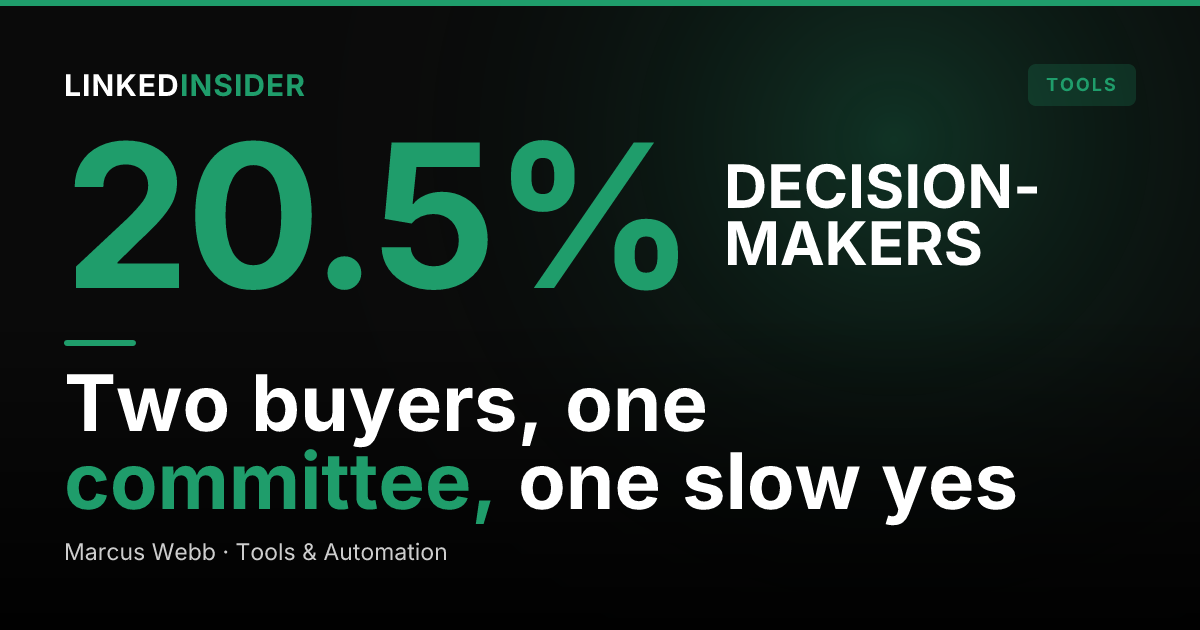
The buyer is a committee, not a person, and it splits into two distinct roles. The first is the clinical champion: a physician, nurse leader, care-team manager, or department head who feels the workflow pain your product fixes. The second is the economic and compliance signer: a revenue-cycle director, CFO, CIO, IT security lead, or compliance officer who controls budget, integration risk, and the security review. The clinical champion can open a door and rally internal demand. They almost never sign the contract.
Generic GTM advice stops at "find a champion." That is the trap. An enthusiastic clinician sends a deal upstream into a procurement and security process they do not control, and the founder who mapped only the clinician watches the deal stall for two quarters and die. Working a healthtech buying committee on LinkedIn means you reach both roles on purpose, with different messages, before the deal ever reaches procurement.
How do you reach clinical champions on LinkedIn?
Lead with workflow and patient outcomes, never features. A clinical champion does not care about your API or your dashboard. They care about the 40 minutes a shift they lose to a broken handoff, the documentation burden eating their evenings, or the safety gap that keeps them up at night. Your first touch should name a problem they recognize and offer proof, not a pitch.
Proof beats claims with this audience because clinicians are trained skeptics. A short connection note that references their specialty and a specific operational pain, followed by a value-first message (a relevant case outcome, a peer reference, a short clinical-workflow brief) outperforms any feature dump. A comment-to-DM lead magnet such as a workflow benchmark or a deidentified before-and-after case study gives a busy clinician a low-commitment reason to engage. Reachium's content data is blunt on this point: lead-magnet posts drew many times the impressions and engagement of regular posts in Reachium's earlier internal analysis. For a founder building clinical demand, that reach gap is the whole game.
Want to put this into practice?
Reachium automates LinkedIn outreach, content publishing, and inbox management in one platform.
Start Free →How do you reach the revenue-cycle and IT signer?
Switch the entire vocabulary to ROI, security posture, integration burden, and risk. The economic signer reads the same product through a different lens: what does this cost to implement, what does it break, what is our exposure if it fails a security review. Your message to a CIO or revenue-cycle director should quantify return (hours saved, reimbursement recovered, denials reduced) and preempt the integration and compliance questions they will ask anyway.
This is where founders lose deals by going silent. While the clinical champion is excited, the signer is doing math and risk assessment in parallel, and they have not heard from you. A separate, role-specific outreach track to the economic signer (referencing SOC 2 status, EHR integration approach, and a defensible ROI range) keeps the second half of the committee warm. Build the target list so it captures both roles inside the same accounts, then run two message tracks against one buying group.
What can you safely say in healthtech outreach?
Say nothing that references protected health information, and never imply you have seen a prospect's patient data. The hard do-nots: do not reference specific patients, do not name a prospect's clinical outcomes as if you have their PHI, do not claim regulatory clearance or HIPAA "compliance" you cannot defend, and do not make medical efficacy claims your product has not earned. One line that sounds like you mishandle data ends the conversation with a compliance-sensitive buyer.
Keep every claim defensible. Use aggregate, deidentified, or your-own-data framing ("clinics using the product recovered X in denials" rather than anything tied to a named patient). Frame security posture in terms a CIO recognizes (SOC 2, encryption, access controls) without overpromising. The safe posture is restraint: say less, prove more, and let the prospect's compliance instincts read you as a peer rather than a risk. This is also why a safe outreach approach matters more here than in almost any other vertical.
What does LinkedIn lead generation for healthtech look like?
It looks like precision targeting plus restraint, running on infrastructure that cannot get you banned. Healthtech buyers vet vendors, and a sloppy or risky outreach footprint is itself a negative signal. The motion is: tightly target decision-makers across both committee roles, send at a deliberate daily cadence, and run on the verified LinkedIn API rather than a Chrome extension or scraper that can get an account flagged.
Volume is the enemy here, and Reachium's data confirms it is also self-defeating. Acceptance peaked at 32.01% for accounts sending 10 to 19 invites a day and fell to 26.65% at 20 to 29 a day: more volume, fewer accepts. A restrained, brand-sensitive founder is not sacrificing results by going slow, they are optimizing for them. On the targeting side, of a multi-million-lead B2B universe in Reachium's universe, a large share flagged as decision-makers, which is the pool a healthtech founder actually needs to reach. The full numbers sit in the 2026 outreach benchmarks study. The same low-volume, verified-API logic applies to other regulated and committee-heavy verticals, including logistics and supply-chain tech. [SYNTHESIS]
Want to put this into practice?
Reachium automates LinkedIn outreach, content publishing, and inbox management in one platform.
Start Free →How do you know it is working before a deal closes?
Track committee coverage and booked discovery calls, not raw connection counts. Healthtech sales cycles are long, so closed deals are a lagging signal that arrives quarters late. The leading indicator that predicts closes is whether you have an active conversation with both the clinical champion and the economic signer inside the same account. A deal with only one half of the committee engaged is a deal at risk, no matter how excited that one contact is.
Watch three signals weekly: acceptance and reply rate by role (clinical messages and economic messages behave differently), the number of accounts where both roles are in motion, and discovery calls booked with a signer in the room. Reply rates have drifted down across LinkedIn through 2025 into 2026, so judge yourself against committee coverage rather than a single vanity metric. If clinical replies are strong but no signer is engaged, your motion is half-built, and the procurement gauntlet will expose it.
FAQ
Who is the real buyer for health software inside a hospital?
It is a buying committee, not one person. A clinical champion feels the workflow pain and rallies internal demand, but a separate revenue-cycle, IT, or compliance signer controls the budget and the risk and is the one who actually approves the contract.
How do you reach clinical champions and economic signers on LinkedIn?
Run two message tracks against the same accounts. Speak to clinical champions in the language of workflow and patient outcomes with proof, and speak to the economic signer in the language of ROI, security posture, and integration burden, so both halves of the committee stay warm at once.
What can you safely say in healthtech outreach without crossing HIPAA lines?
Never reference protected health information, never imply you have seen a prospect's patient data, and never make regulatory clearance or medical efficacy claims you cannot defend. Use aggregate, deidentified, or your-own-data framing and keep every claim provable.
Why do healthtech sales cycles stall, and how does outreach shorten them?
They stall when a founder works only the excited clinician and the economic signer never hears from them, so the deal dies in procurement. Working both roles in parallel from the first touch, on a safe and low-volume motion, keeps the full committee engaged and shortens the path to a signed deal.