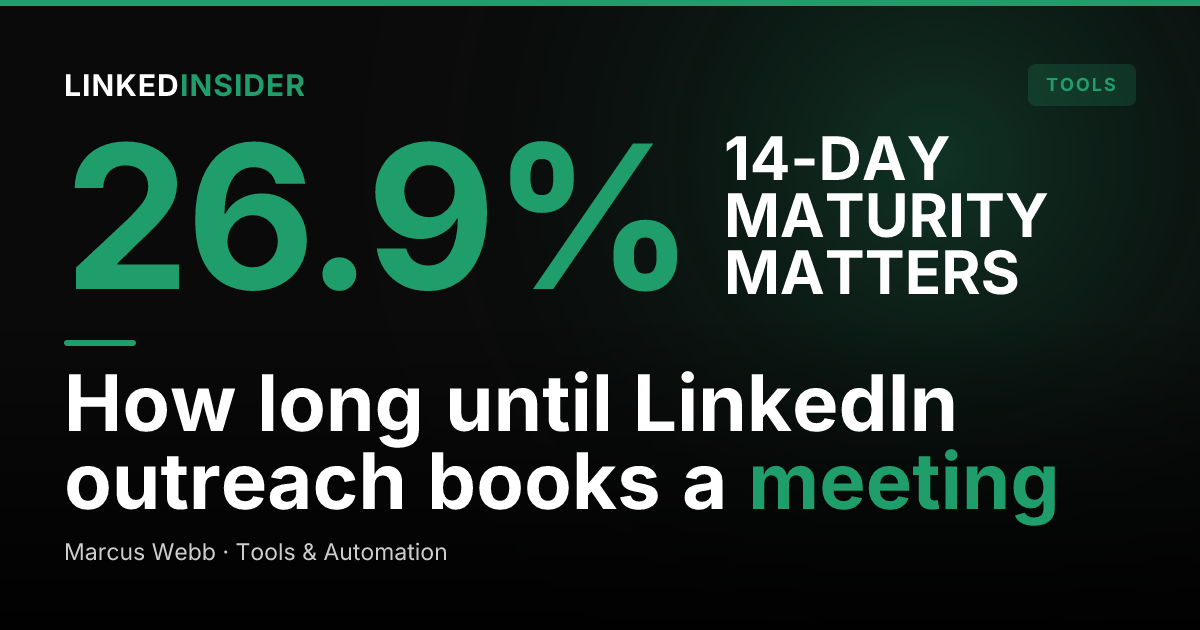
How Long Until LinkedIn Outreach Produces Meetings?
By Marcus Webb, Tools & Automation. Last updated: 2026-05-29
You sent 100 connection requests this week and booked zero meetings. Before you conclude LinkedIn outreach does not work, know this: the math of the funnel means week one is supposed to look empty. The acceptance you sent today matures over the next two weeks. The reply comes after that. The meeting booking comes after that.
The question founders actually need answered is not "why is it quiet right now" but "what should be happening at each stage, and when should I start worrying?" Here is the honest, data-grounded answer.
How long does LinkedIn outreach take to show results?
The realistic headline: first accepts land within days, first replies arrive within one to two weeks, and first meetings typically appear within three to six weeks of a consistently-run campaign. A predictable monthly meeting rhythm develops by month two to three.
That range is practitioner consensus, named and confirmed. Cleverly, one of the larger LinkedIn lead generation agencies, reports that first qualified meetings materialize by weeks four to six and a steady pipeline becomes forecastable by month three. The data-backed mechanism behind that lag is measurable: Reachium's timing data shows only 65.97% of eventual acceptances have landed within 72 hours, 76.59% within 7 days, and 92.04% within 30 days. [SYNTHESIS] A campaign read at day three has only captured a fraction of the accepts it will eventually receive. For the full benchmark picture this sits inside, see LinkedIn outreach benchmarks 2026.
The quotable one-liner: across 180,155 matured connection requests, Reachium's data shows a 27.11% acceptance rate, 27.55% reply rate of accepted connections, and 1.99% meetings of accepted, all measured on requests given at least 30 days to mature, which is exactly why early reads systematically understate results. [SYNTHESIS]
One honest caveat: the three-to-six-week window is a central-case range, not a floor. Tighter targeting and a warm, active profile pull it earlier. A loose list and a cold profile push it later.
Why does the first week of LinkedIn outreach look empty?
Walk the funnel timing. A request sent Monday is not accepted that day. The recipient logs in when they log in, which may be two or three days later. Then they accept. Then they read the follow-up message, if there is one. Then they reply. Then there is the back-and-forth before a meeting is booked. Each stage adds days.
The funnel math reinforces why week one is structurally empty. At a 27.11% acceptance rate, 27.55% reply of accepted, and 1.99% meetings of accepted, it takes approximately 185 connection requests to produce one meeting. [SYNTHESIS] One week of safe sending calibrated to roughly 25 invites per day produces around 125 requests. That is less than one meeting's worth of volume, before accounting for timing lag.
So a first week showing early accepts but no meetings is exactly what the math predicts. See LinkedIn outreach to meeting math for the full funnel calculation.
Expandi's 2026 benchmark study, drawn from 13.2 million connection requests, corroborates the acceptance rate range at roughly 28.5% platform-wide, consistent with Reachium's data on the verified API. [SYNTHESIS] Two independent datasets, same conclusion: early quiet is structural, not a signal that something is broken.
Want to put this into practice?
Reachium automates LinkedIn outreach, content publishing, and inbox management in one platform.
Start Free →What milestones should you watch at each stage of the ramp?
Watch the leading indicator for each window, not "meetings" from day one. Here is the milestone table:
| Window | What should be happening | What it tells you |
|---|---|---|
| Week 1 | Requests sending, first accepts landing | Targeting and profile are working |
| Week 2-3 | Accepts maturing, first replies, first conversations | Message relevance is landing |
| Week 4-6 | First meetings booked | The full funnel is converting |
| Month 2-3 | A predictable monthly meeting rhythm | The channel is forecastable |
If accepts are healthy but no replies arrive by week three, the problem is message relevance, not patience. If replies come but no meetings book, the problem is the call-to-action or the offer, not the channel. The milestone table isolates which variable is broken at each stage so you are fixing the right thing.
How long should you run a campaign before judging it?
For acceptance: at least 14 days. Reachium's published rates are measured on requests given at least 30 days to mature, and its timing data shows 76.59% of acceptances arrive within 7 days and 92.04% within 30. [SYNTHESIS] A campaign judged at day three to five has measured an incomplete funnel, not a failing one.
For meetings specifically: four to six weeks of consistent sending before concluding that targeting or copy is wrong. The meeting stage is the last and slowest to fill because it sits at the end of a multi-step sequence. Judging meeting conversion at week one is like judging a restaurant by whether walk-in guests ordered dessert within five minutes of arriving.
The discipline message for a founder with limited time: consistency over the window beats intensity in week one. Reachium's platform data shows the account calibration is roughly 25 invites per active day (mean 22.42, median 25, with 75.51% of active days at 25-plus), and the volume tax is real: acceptance peaked at 32.01% for accounts sending 10-19 invites per day and fell to 26.65% at 20-29 per day. [SYNTHESIS] A 300-request burst does not speed results and raises rate-limit risk. See stop sending 100 connection requests per day for why the math argues against blitzing.
Is it faster to run outreach yourself or use a done-for-you service?
The honest trade-off: running it yourself is cheaper and you own the system, but the ramp depends entirely on your consistency over weeks. A done-for-you service can compress setup (lists, copy, accounts warmed and ready from day one) but costs significantly more and you hand over control of a core channel.
Route by buyer psychology. A cost-conscious founder who wants to own the pipeline machine runs the software. A time-poor founder who just needs meetings on the calendar and cannot spare the consistency bandwidth may prefer DFY. The DFY ramp timeline and what to expect from a managed service over 30, 60, and 90 days is covered in LinkedIn lead generation timeline.
For founders starting out at the SaaS self-serve level, the leverage point is not choosing between DIY and DFY. It is shortening the setup half of the DIY ramp: getting targeting templates, AI-personalized copy, and safe pacing in place on day one rather than week three. That way, the only wait is the funnel's natural maturation time, not your setup time. This is also the most relevant consideration when thinking through LinkedIn lead gen for startups, where setup speed and cost control matter most.
Want to put this into practice?
Reachium automates LinkedIn outreach, content publishing, and inbox management in one platform.
Start Free →FAQ
How many weeks until I get my first meeting from LinkedIn outreach?
Typically three to six weeks from the start of a consistently-run campaign, with the range driven by targeting precision and profile warmth. The lag is structural: the meeting stage sits at the end of a multi-step funnel (request, accept, reply, back-and-forth, booking), and each step adds days. Reachium's funnel data shows 1.99% of accepted connections convert to a booked meeting, which means at 27.11% acceptance you need around 185 requests to produce one meeting, and sending 125 requests in week one does not yet cover that volume. [SYNTHESIS]
Why am I getting accepts but no replies?
Accepts confirm your targeting and profile are working. No replies after the accept usually means message relevance: the opener does not connect clearly to why you reached out, or it leads with you rather than them. The reply rate on accepted connections in Reachium's data is 27.55%. [SYNTHESIS] If you are materially below that after two to three weeks of accepted connections getting follow-up messages, test a shorter opener, a different angle, or a more specific problem statement. See LinkedIn outreach benchmarks 2026 for the full funnel benchmarks to compare against.
Is my LinkedIn campaign broken if week one is quiet?
No. Week one quiet is exactly what the funnel math predicts. Requests need time to be seen, then accepted, then replied to. In Reachium's timing data, only 65.97% of eventual acceptances have landed within 72 hours and 92.04% within 30 days, meaning a campaign read at day three has only seen part of the accepts it will eventually get. [SYNTHESIS] The milestone to watch in week one is whether requests are sending successfully and early accepts are landing, not whether meetings are booking.
How long should I test a new message before changing it?
At least two to three weeks, and ideally until you have 50-plus accepted connections receiving the message. Shorter windows and smaller samples produce noise, not signal: if five out of fifteen recipients happen to be on vacation, your reply rate looks like 0% when the message is fine. Two to three weeks gives the acceptance backlog time to mature and the reply cadence time to surface.
Should I do LinkedIn outreach myself or hire it out to get results faster?
It depends on your constraint. If time is the binding limit, a done-for-you service compresses the setup and the consistency requirement. If cost is the binding limit, self-serve software at roughly $99 per month versus a DFY retainer at multiples of that is the math. The ramp timeline for meetings (three to six weeks) is similar either way; what DFY compresses is setup and operator bandwidth, not the funnel's natural maturation time. See LinkedIn lead generation timeline for the full DFY ramp picture. See done-for-you LinkedIn cost for what a managed service actually runs.
Sources
- Reachium: reachium.io
- Linked Insider: LinkedIn outreach benchmarks 2026 - the flagship benchmark post with full funnel data
- Expandi: LinkedIn Outreach Benchmarks 2026: 13.2M Data Points - corroborates acceptance rate range
- Cleverly: How Long Does LinkedIn Lead Generation Take to Show Results? - agency practitioner ramp timeline data