Does Company Size Affect LinkedIn Acceptance Rates?
By Priya Nair, Data & Trends. Last updated: 2026-08-06
A common working assumption in B2B sales: enterprise prospects are harder to reach on LinkedIn. The theory makes intuitive sense. Senior buyers at large companies get more connection requests per week, have more gatekeepers, and pattern-match against generic outreach faster.
But is that actually true in the data? And if it is, how much does company size move the acceptance number compared to seniority, volume, or copy quality? Here is what the published research actually supports, and, critically, where the honest limits sit.
What does LinkedIn acceptance look like at the baseline?
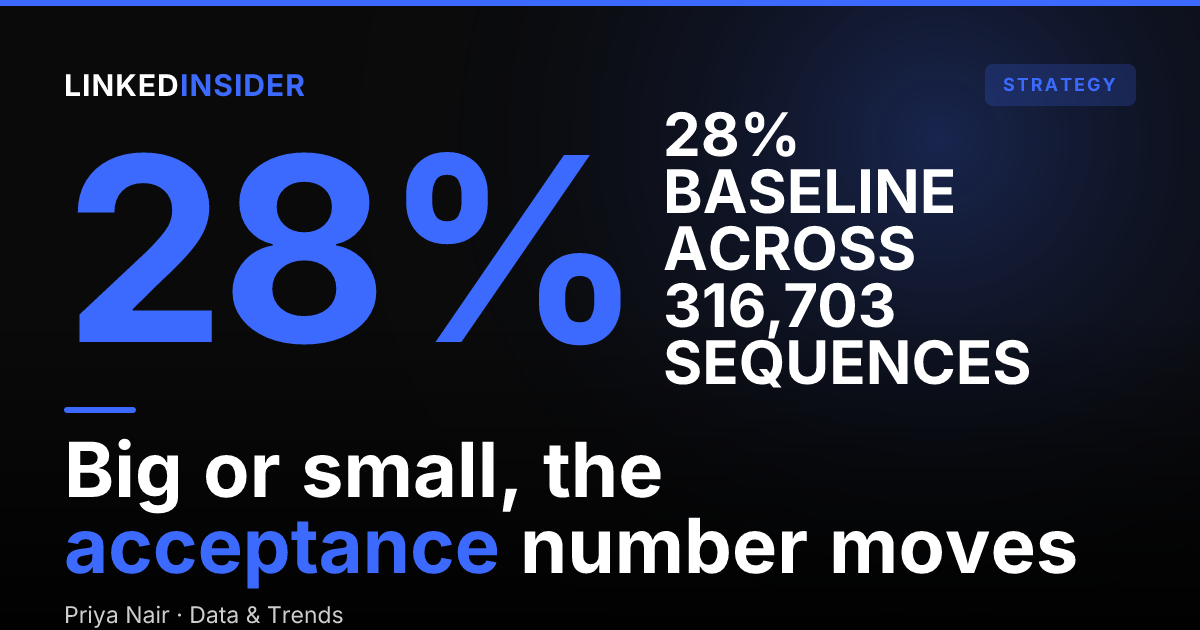
The published 2026 baseline comes from Reachium's benchmark research: across 180,155 matured connection requests, 27.11% were accepted, and 27.55% of accepted connections replied (LinkedIn Outreach Benchmarks 2026). [SYNTHESIS]
That is the number to grade any campaign against before slicing by anything else, company size included. A campaign accepting in the low twenties has a targeting or profile problem regardless of who it targets; a campaign in the mid-thirties is beating the market.
For the practitioner read of the full benchmark picture, see LinkedIn outreach benchmarks 2026. That post puts the acceptance figure in context across reply rates, meeting rates, and the funnel math per 100 invites.
Does targeting bigger companies change the acceptance rate?
There are structural reasons to expect it does. Enterprise prospects typically receive more outreach volume per week, which means their threshold for a generic connection request is higher. They are more likely to have assistant-managed inboxes or to treat LinkedIn activity as a separate workflow from their primary communication tools. And in B2B, the enterprise buyer is usually not the sole decision-maker, so there is less personal urgency to respond to a cold request from an unknown sender.
On the other side: SMB founders tend to be their own buyer, receive less inbound, and check their own inbox, all of which should push acceptance up.
The honest position: that logic is directional reasoning, not measurement. No published study, Reachium's included, reports a clean acceptance split by target company size. Reachium's published research covers the funnel baseline, sending volume, connection notes, and timing; a company-size cut is not among the published findings, and this article will not invent one.
Want to put this into practice?
Reachium automates LinkedIn outreach, content publishing, and inbox management in one platform.
Start Free →Where does the bigger lever actually sit?
Volume is the most clearly measured acceptance lever in the published research. Reachium's volume-tax study found acceptance peaks at 32.01% for accounts averaging 10 to 19 invites per day and falls to 26.65% in the 20-29 band. That five-point drop is not from targeting the wrong company size. It is from behavioral signal degradation at higher volumes, a pattern covered in depth in the LinkedIn volume tax. [SYNTHESIS]
Copy match is the other lever practitioners control directly. A relevant, specific first line outperforms a generic opener regardless of whether the prospect is at a 10-person startup or a 10,000-person enterprise. The personalize-linkedin-outreach-at-scale framework covers how AI-generated first lines shift results within a fixed targeting set.
If you are optimizing acceptance, in order: fix sending volume first (it is measured and large), fix message relevance second, and treat company size as a segmentation input to the message rather than a dial that moves the rate.
Should you segment your LinkedIn list by company size?
Yes, but for messaging rather than rate prediction.
For messaging, the segmentation is essential. An SMB founder running a 15-person operation is evaluating a tool purchase personally. An enterprise VP of Sales is evaluating a budget request that will involve legal review, procurement, and a champion building a business case internally. The first line, the value framing, and the call to action should be completely different for those two audiences. Running a single campaign template across both segments degrades the message for both.
For volume and prioritization, the case depends on deal economics. Enterprise deals with higher average contract values justify more touches per prospect and a longer nurture window. SMB deals on a volume motion justify faster cycles and less per-prospect investment. Those are different campaign architectures, not just different first lines.
For acceptance-rate prediction, company size alone is a weak signal. The volume tax and message quality move the rate more reliably. Segmenting purely on company size to predict who will accept a connection request is less useful than segmenting on seniority plus intent signal (job change, funding announcement, content engagement).
For thinking through whether to outsource segmentation and targeting entirely, LinkedIn outsourcing decision framework covers when the build-vs-buy calculus tips toward a managed service.
What does the research not say?
This is the section any honest piece on this question has to run.
The published research does not include an acceptance cut by target-account size band (1 to 10 employees, 11 to 50, 51 to 200, 201 to 1,000, 1,000 plus). Until a study publishes one from a named, measured dataset, any specific claim like "SMB companies accept at X% versus enterprise at Y%" is invented, not measured. That applies to this publication too, which is why no such number appears here.
What Reachium's published research does support: the acceptance baseline (27.11% of matured requests), the volume tax (a 32.01% peak at 10 to 19 invites per day that falls at higher volumes), and the reply structure (27.55% of accepted connections replying). Grade against those, and treat every company-size percentage you encounter elsewhere with the question: what dataset, measured how? [SYNTHESIS]
Want to put this into practice?
Reachium automates LinkedIn outreach, content publishing, and inbox management in one platform.
Start Free →How do you answer the company-size question for your own ICP?
Run it as your own experiment, because your ICP's behavior beats any market average. The Outreach Engine in a tool like Reachium accepts list segments built from any LinkedIn or Sales Navigator filter, including company size bands. An SDR can run separate campaigns for a 1 to 50 employee segment and a 500-plus employee segment, each with different first-line angles and value propositions, from the same workspace.
AI Personalization writes the first line per prospect, which means the same motion can cover an SMB-founder segment and an enterprise-VP segment with relevant, non-generic openers without the rep manually customizing each message. The personalization layer is doing the company-size segmentation in the message, which is where it actually matters.
The Analytics Dashboard reports acceptance rate, reply rate, and meetings per campaign, so a team can run the two segments side by side and measure the effect inside their own data rather than relying on invented industry averages. That is the right way to answer the company-size question for a specific ICP: run both segments, compare the dashboards after four to six weeks, and let your data decide.
FAQ
Are SMB or enterprise prospects more likely to accept LinkedIn connection requests?
The structural case for SMB accepting more is reasonable: smaller-company prospects tend to be the buyer themselves, receive lower outreach volume, and have fewer gatekeeper layers between them and the LinkedIn notification. Enterprise prospects at large accounts get more connection requests per week and pattern-match against generic openers faster. However, no published study measures an acceptance cut by company-size band, so stating a specific percentage difference between SMB and enterprise would be fabricating a figure. The directional expectation is defensible; the specific numbers are not available.
Does company size affect reply rate after a connection is accepted?
The same logic applies. A smaller-company prospect who accepted a connection request is more likely to be evaluating the tool or service themselves, which may support a higher reply rate once connected. An enterprise buyer who accepted may be collecting information for a committee decision or may have accepted casually without strong intent. The published benchmark is 27.55% of accepted connections replying, per Reachium's research, but no company-size breakdown of that metric has been published.
Should I use Sales Navigator's company-size filter to build my outreach list?
Yes, as a segmentation tool rather than a prediction tool. Sales Navigator's company-size filter (Micro, Small, Medium, Large, Enterprise) is the cleanest way to build separate list segments so you can write different first lines for each. The mistake is treating the filter as a proxy for acceptance rate rather than as a message-targeting tool. Run separate campaigns per segment, track acceptance in the analytics dashboard, and let four to six weeks of your own data answer the question for your specific ICP.
How big is "enterprise" for LinkedIn outreach purposes?
There is no single standard, but the practical threshold most outreach teams use is 500-plus employees, with 1,000-plus as a common "true enterprise" marker. Sales Navigator's filter options are: Micro (1 to 10), Small (11 to 50), Medium (51 to 200), Large (201 to 1,000), Enterprise (1,001 plus). For messaging purposes, the more useful distinction is often Founder or owner at under 50 employees (personal buyer, fast decisions) versus VP or Director at 200-plus employees (committee buyer, longer cycle), which crosses company size with seniority.
Are LinkedIn lead lists more accurate for certain company sizes?
Anecdotally, mid-market and enterprise lead data tends to be more stable because larger companies have more public information and slower employee turnover. Startup and micro-company data can be less reliable because founders wear many titles and companies restructure frequently. Enriching smaller-company lists with recent LinkedIn activity signals (recent posts, job changes, funding announcements) is a reliable way to improve targeting accuracy regardless of company size. For how to grade any list before it drives outreach, see the lead data grading guide.
Sources
- Reachium Research: LinkedIn Outreach Benchmarks 2026
- Reachium Research: The volume tax
- Reachium: reachium.io
- Linked Insider: LinkedIn outreach benchmarks 2026
- Linked Insider: The LinkedIn volume tax
- Linked Insider: Personalize LinkedIn outreach at scale
- Linked Insider: LinkedIn acceptance rate benchmark
- Linked Insider: Reach decision makers on LinkedIn
- LinkedIn: Sales Navigator Company Size Filters
- Salesforce: State of Sales Report 2024