LinkedIn Lead Generation for Commercial Cleaning and Facilities Firms: Reaching Facility Managers
By Daniel Okoro, Outreach Tactics. Last updated: 2026-05-30
- The person who signs the contract is the facility manager or office manager, not the front desk.
- Most firms hand outreach to a VA with a spreadsheet who burns the company name on careless messages.
- Bid portals and cold calls trap the firm in a price-only race.
- Recurring contracts are high-LTV, so a handful of booked walkthroughs a quarter pays for the channel.
Who do commercial cleaning LinkedIn lead generation campaigns target?
The buyer is the facility manager, office manager, building general manager, or property and operations lead, not the front desk and not a generic "info@" inbox. These are the people who own the cleaning budget, sign recurring service agreements, and decide whether to switch vendors. They are findable by name and city on LinkedIn, which is exactly what a regional cleaning or janitorial firm needs to build a target list instead of guessing.
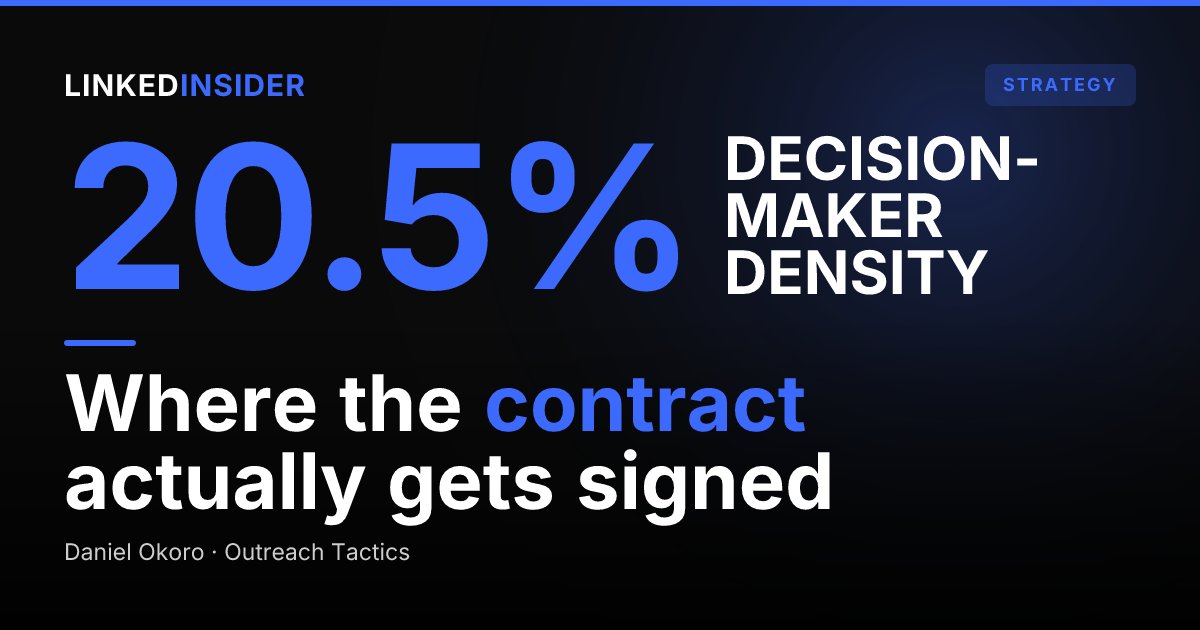
The density matters. Reachium's platform data shows that across its universe of a multi-million-lead B2B universe, a large share flagged as decision-makers. For a firm selling recurring contracts, that ratio is the difference between a list of gatekeepers and a list of signers. For the methodology behind these numbers, see the flagship LinkedIn outreach benchmarks. [SYNTHESIS]
Is LinkedIn worth it for a local cleaning or janitorial firm?
Yes, because it moves the firm out of the price-only race that bid portals and cold calls create. On a portal, the cleaning company is one anonymous number against ten others. On LinkedIn, the firm reaches a named facility manager and leads with reliability, retention, and references before price ever comes up. That reframes the conversation from "who is cheapest" to "who will not leave a building dirty on a Monday."
The economics fit a hands-on local business. Recurring janitorial and facilities contracts are high-LTV, so even a handful of booked walkthroughs per quarter covers the channel several times over. The volume needed is small, which is good news because the math compounds on a tight list: Reachium's data across 180,155 matured connection requests shows a 27.11% average connection acceptance rate, and 27.55% of accepted connections replied. A focused list of a few hundred local facility managers can produce a steady trickle of conversations without national reach. [SYNTHESIS] See more on whether LinkedIn lead gen is working.
Want to put this into practice?
Reachium automates LinkedIn outreach, content publishing, and inbox management in one platform.
Start Free →How do you target facility managers by city and title?
You combine geography with job title, then layer firmographics. Start with a metro or a service radius the firm can actually drive to, because a cleaning company sells presence and response time, not coverage in another state. Then filter on titles: facilities, operations, office manager, property manager, building general manager, and site or plant manager. That intersection of "in my city" and "owns the cleaning decision" is the entire target list.
Layer firmographics on top so the pitch matches the property. Building type (office, medical, industrial, multi-tenant), headcount, and single-site versus multi-site all change what the facility manager cares about. A 12-site property group needs consistency across locations; a single medical office needs compliance and discretion. Building the list this way is the same discipline covered in how to build a targeted LinkedIn lead list, applied to a local services radius. The sibling guide on LinkedIn lead generation for commercial security and guarding companies walks the same geo-plus-title motion for an adjacent facilities-services vertical.
What does a credibility-first outreach sequence look like?
It opens without a pitch and earns the conversation before it asks for anything. Connect first with a clean, plain request. Then open the message with something specific to their building type or a local proof point ("we keep three medical offices in the [neighborhood] district running"), not a price or a calendar link. Facility managers fear switching risk above almost everything, so the entire sequence should reduce that fear: insurance, staff retention, response-time guarantees, and named local references.
Pair the outreach with a simple lead magnet so the firm earns trust at scale, not just one DM at a time. A facilities walkthrough checklist or a "5 things to ask before you switch cleaning vendors" guide works because it gives the facility manager something useful with no commitment. The reach pattern shows why this is worth the effort: lead-magnet posts (comment-to-DM) reliably draw many times the impressions and engagement of regular posts. The mechanics are covered in how LinkedIn lead magnets work and the lead-magnet reach finding.
A credibility-first connection and follow-up might read like this:
"Hi [Name], I run [Firm], a commercial cleaning company that handles a few buildings around [area]. Not pitching, just connecting with local facilities and operations folks. Glad to share our walkthrough checklist if it is ever useful."
Why it works: it names the firm, anchors locally, removes the pressure, and offers value instead of asking for a meeting on the first touch.
"Thanks for connecting, [Name]. We focus on reliability over the lowest bid, which is why our clients tend to stay. If your current vendor ever drops the ball, I am happy to do a free walkthrough and a same-week quote. No obligation either way."
Why it works: it leads with the switching-risk fear, references retention as proof, and makes the next step low-stakes and concrete.
Why does the VA-with-a-spreadsheet approach put the firm at risk?
Because it attaches a spam impression to the company name in a tight local market, and because the tools behind it can take the founder's profile offline. Generic copy-paste blasts read as exactly what they are, and a facility manager who gets a careless message remembers the firm's name for the wrong reason. In a local market where everyone knows everyone, that reputational cost is real and hard to undo.
The technical risk is just as concrete. Many cheap automation setups run on browser extensions or scraping, which LinkedIn's Professional Community Policies prohibit and which can trigger restrictions. HeyReach, a browser-automation outreach tool, was publicly reported banned by LinkedIn in March 2026, the kind of event that takes a founder's account offline mid-campaign. By contrast, Reachium's data records no permanent suspensions on its verified-API approach; the only failure mode observed is a recoverable rate-limit, calibrated to roughly 25 invites a day. For the safety architecture, see is LinkedIn automation safe and the commercial use limit.
Want to put this into practice?
Reachium automates LinkedIn outreach, content publishing, and inbox management in one platform.
Start Free →How do you measure if LinkedIn is generating contract pipeline?
You track leading indicators that map to revenue: connection accepts, replies, and booked walkthroughs, not follower counts. Vanity metrics tell a cleaning-firm owner nothing about contracts. The honest chain is invites sent to accepts to replies to booked walkthroughs to signed contracts, which gives a true cost-per-contract once you divide spend by closed deals.
Watch the volume tax while you pace. Reachium's data shows acceptance peaked at 32.01% for accounts sending 10-19 invites a day and fell to 26.65% at 20-29 a day: more volume, fewer accepts. The platform caps around 25 per day by design for that reason. A cleaning firm does not need to blast hundreds of requests; a slower, well-targeted cadence to local facility managers produces a higher acceptance rate and protects the account. For broader tactics, see LinkedIn lead generation strategies for 2026 and LinkedIn inbound lead generation. [SYNTHESIS]
FAQ
How do you find facility managers on LinkedIn?
Use LinkedIn search to combine a city or metro with job titles such as facility manager, operations manager, office manager, and property manager. The intersection of "in my service area" and "owns the cleaning decision" is your target list. Building-type and headcount filters refine it further.
Is LinkedIn worth it for a local cleaning or janitorial company?
Yes, because recurring contracts are high-LTV and LinkedIn lets the firm lead with reliability instead of competing on price in a bid portal. Even a few booked walkthroughs per quarter typically cover the cost of the channel several times over.
How do you target prospects by city and job title on LinkedIn?
Set geography to a metro or drivable radius, then filter by facilities, operations, office, and property job titles, and layer firmographics like building type and number of sites. Keep the list local, since a cleaning firm sells presence and response time, not national reach.
What should a cleaning company's first LinkedIn message say?
Not a price and not a calendar link. Open with something specific to their building type or a local proof point, mention reliability and references, and offer something useful like a walkthrough checklist. The goal of the first touch is to earn the conversation, not close a contract.