How to Use LinkedIn Events to Fill Pipeline When You Have No Time to Prospect
By Elena Marsh, Strategy & Algorithm. Last updated: 2026-05-30
- The registrant list is the asset, not the event itself, and almost nobody works it.
- Speed of follow-up decides conversion, and a founder's backlog kills the speed.
- High-volume DM blasts to the list trip rate limits faster than they book calls.
- The founder's job is the event and the offer; the outreach is the part to hand off.
Why are LinkedIn events the warmest source for lead generation?
A LinkedIn Event registrant list is the warmest, most opted-in audience a founder will ever build, because every name on it raised a hand for your exact topic. That is a meaningful gap from a cold prospecting list, where you are guessing at interest. The people who registered told you what they care about by clicking register, and LinkedIn hands you their names.
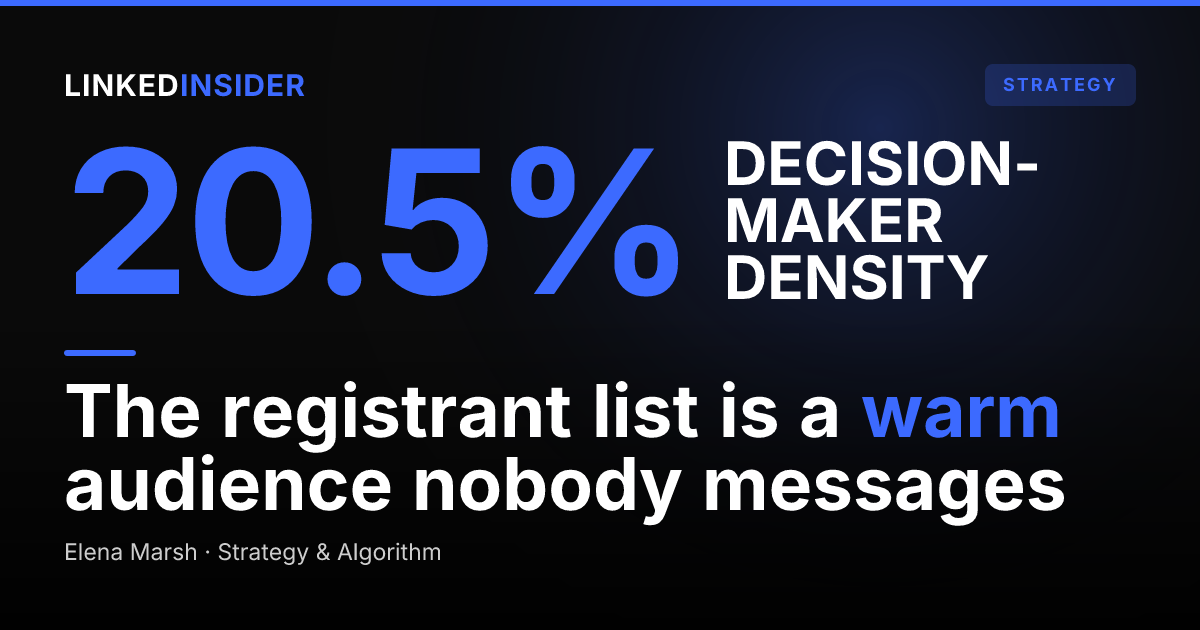
The density is what makes it worth working. Reachium's platform data, drawn from a universe of a multi-million-lead B2B universe, shows a large share flagged as decision-makers. An event on a sharp B2B topic skews that ratio even higher, because the people who give up 45 minutes for a webinar on a budget-relevant problem tend to own the budget. You are not building a list. You are concentrating one. For the mechanics of turning attention into an opted-in audience, see Linked Insider: how LinkedIn lead magnets work. [SYNTHESIS]
How do you follow up with attendees without burning a week?
You follow up on a fixed four-touch cadence so the work is a checklist, not a judgment call you make 200 times. The cadence has four moments, and each one has a single job.
- At registration: a short message that confirms the spot and restates the one thing they will walk away with. This sets you as the host, not a stranger, before the event.
- Day-of: a reminder that doubles as a soft ask, naming the specific takeaway tied to their role.
- No-show: the highest-value touch nobody sends. A no-show registered, which means the interest was real and the calendar was the problem. Offer the recording plus a 15-minute version of the value.
- Post-event for attendees: reference what they saw, then make the soft offer.
The reason a cadence beats one-off DMs is speed plus consistency. Registrant interest decays within days, and a founder picking off messages between meetings cannot move fast enough across a list of 150. A defined sequence, run start to finish, captures the window before it closes. The same discipline applies to any warm signal, which is why a structured LinkedIn follow-up and nurture motion outperforms ad hoc outreach across the board.
Want to put this into practice?
Reachium automates LinkedIn outreach, content publishing, and inbox management in one platform.
Start Free →What does the message sequence look like that books meetings?
The sequence leads with the event topic, references their attendance as the connective tissue, and lands a low-friction offer. Below are two templates a founder can hand to whoever runs the outreach.
Hi {first name}, thanks for registering for {event topic}. The one thing most {their role} take away is {specific insight}. I will send the recording after, and if {problem the event solves} is live for you right now, happy to share the 15-minute version one-to-one.
Why it works: it confirms the opt-in, names a role-specific payoff, and offers value before asking for anything. The meeting ask is implied, not pushed.
Hi {first name}, you registered for {event topic} but I did not see you make it. No problem, here is the recording. The part most people flag as useful starts around {timestamp}. If you want, I can walk you through how it applies to {their company} in 15 minutes.
Why it works: it recovers the no-show, the largest and least-worked segment, by removing the guilt and re-offering the value on their schedule. The registration is proof of intent, so the bar to a call is low.
For more on pre-selling the offer before the conversation even starts, the LinkedIn Featured section pre-sell strategy shows how to stage proof so the registrant arrives already half-sold.
How do you keep follow-up safe at volume?
You keep it safe by sending through the verified LinkedIn API and pacing within the daily cap, not by blasting the whole list in an afternoon. A registrant list of 150 tempts founders into one mass send, and that is exactly the move LinkedIn flags. Volume is the trap, not the cure.
Reachium's data names the trap directly: acceptance peaked at 32.01% for accounts sending 10-19 invites a day and fell to 26.65% at 20-29 a day. More volume produced fewer accepts, a pattern the analysis calls the volume tax, detailed in the LinkedIn outreach benchmarks study. Browser-automation and extension tools that promise high daily throughput run straight into it, and they carry account risk on top. The widely reported HeyReach restrictions in March 2026 underscored that browser-driven sending sits outside LinkedIn's sanctioned path. Verified-API sending, calibrated to roughly 25 invites a day, trades raw speed for accounts that stay live. For the safety architecture in full, the LinkedIn lead generation strategies for 2026 breakdown covers the difference. [SYNTHESIS]
Should you run the attendee outreach yourself or hand it off?
You hand it off, because the math rarely favors the founder doing it. Working a 150-person registrant list properly across a four-touch cadence is several hours of writing, sending, pacing, and inbox triage, repeated for every event. That is time a funded founder is supposed to spend on the event content and the offer, which only they can produce.
The hand-off is clean because the parts split naturally. The founder owns the event, the topic, and the offer. A done-for-you team owns the cadence, the verified-API sending, the targeting against the decision-makers in the list, and the inbox. Nothing about the outreach requires the founder, and the outreach is the part that fails first when calendars get tight. For a wider view of when to bring in help, compare the options in the best LinkedIn lead-gen agencies and the best LinkedIn tool for founders.
Want to put this into practice?
Reachium automates LinkedIn outreach, content publishing, and inbox management in one platform.
Start Free →How do you know the event motion is working?
You watch two leading indicators and one number that actually matters. The leading indicators are connection acceptance and reply rate, which tell you the targeting and messaging are landing before any meeting is booked. Reachium's data across 180,155 matured connection requests shows a 27.11% average acceptance rate and replies from 27.55% of accepted connections, which gives a realistic bar to measure your event list against. [SYNTHESIS]
The only number that matters is booked calls. Acceptance and replies are diagnostic; meetings are the output. If acceptance looks healthy but calls are not booking, the offer or the call-to-action is the problem, not the list. Track booked meetings per event, then per registrant, and you will know within two events whether the motion is real or whether the offer needs work. To sanity-check the inputs feeding it, the B2B lead data quality study shows how list accuracy moves the downstream numbers.
FAQ
How do you follow up with LinkedIn event attendees?
Use a fixed four-touch cadence: confirm at registration, remind day-of, recover no-shows with the recording, and make a soft offer to attendees afterward. Speed matters more than length, because registrant interest decays within days.
Does hosting a LinkedIn Event actually generate leads?
The event itself does not; the follow-up does. Hosting concentrates a warm, opted-in list of decision-makers, but that list only becomes pipeline if someone runs a disciplined sequence against it before it goes cold.
How do you get meetings from a webinar registrant list?
Lead with the event topic, reference the registration, and make a low-friction offer such as a 15-minute walkthrough or the recording. Work the no-shows hardest, since they registered, which means the interest was real and only the calendar got in the way.
Should a busy founder run LinkedIn Events themselves or hand the outreach off?
Hand the outreach off. The founder should own the event, the topic, and the offer, while a done-for-you team runs the cadence, the verified-API sending, and the inbox. The outreach is the first thing that fails when a founder's calendar tightens.