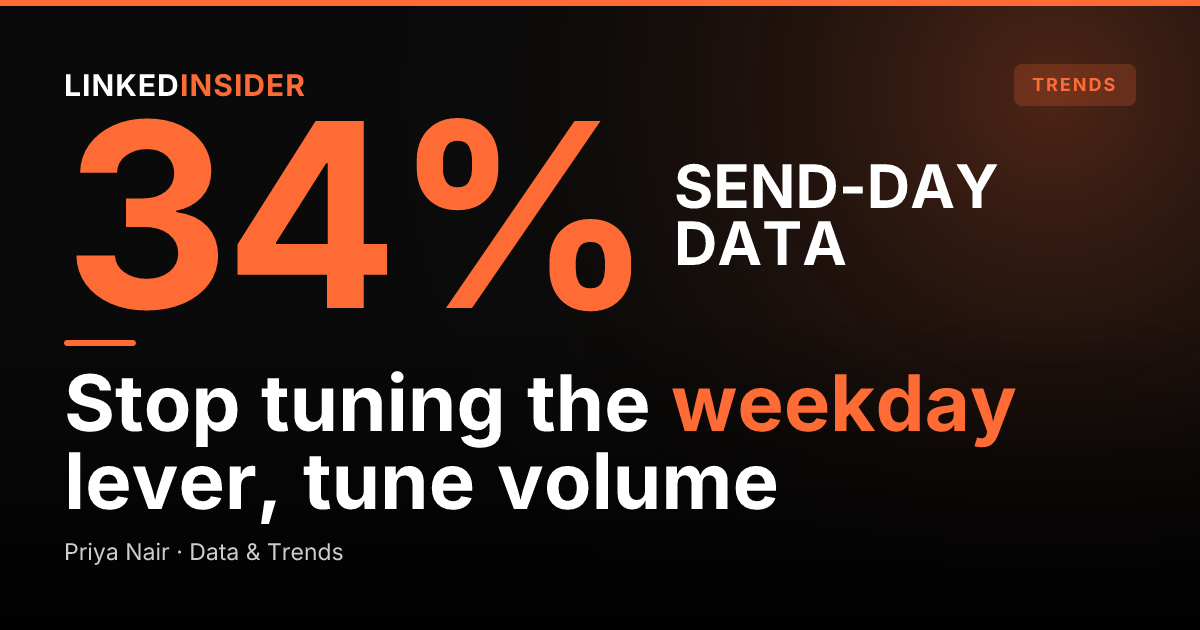
Weekday vs Weekend LinkedIn Outreach: What the Reply Data Actually Shows
By Priya Nair, Data & Trends. Last updated: 2026-08-06
- People obsess over Tuesday versus Saturday and ignore that they send 40 invites in one burst.
- Most "best day" advice is really about when to post content, not when to send outreach.
- Weekend sends are not dead, they just work for a narrow set of audiences.
- The platform caps activity by design, so timing is a rate problem before it is a calendar problem.
What is the best day to send LinkedIn outreach?
Tuesday through Thursday is the strongest window for LinkedIn outreach, with Monday close behind and Friday afternoon and the weekend trailing. That ordering comes from external engagement research (Buffer's analysis of 4.8 million LinkedIn posts, Sprout Social's study of roughly 2 billion engagements across 307,000 profiles), and it matches what most senders expect. The catch is the size of the gap. The difference between a mid-week send and a weekend send is a few percentage points of reply rate, not a doubling. If you reorganize your entire week to hit "the best day" and change nothing else, you should expect a small lift, not a transformation. [SYNTHESIS]
Most published "best day to send" advice is borrowed from content timing studies, where the question is when a post gets the most feed impressions. Outreach is a different mechanic. A connection request or DM lands in a notification queue and an inbox, not a ranked feed, so it survives longer and gets seen whenever the recipient next opens LinkedIn. That alone softens the day-of-week effect, because a request sent Friday is still sitting there Monday morning. For the content-timing version of this question, the best time to send LinkedIn messages breakdown covers the hour-level patterns separately.
How big is the weekday vs weekend gap, really?
The weekday advantage in the external research is consistent but modest, on the order of a few points rather than a step change, and no published study has cleanly isolated day-of-week for connection requests specifically. Reachium's analysis of 180,155 matured connection requests shows a 27.11% average acceptance rate, with 27.55% of accepted connections replying, and it publishes no weekday-versus-weekend split of those numbers. What its time-to-accept study does show explains why the day matters less than folklore says: the median request takes 25.37 hours to be accepted, only 46.71% are accepted within 24 hours, and acceptances keep arriving for weeks (92.04% within 30 days). A request sent on the "wrong" day is usually still sitting unanswered when the "right" day comes around, which mechanically shrinks whatever edge the send day carries. [SYNTHESIS]
There is a second reason the gap looks bigger in folklore than in the numbers. Weekend sends self-select. The people sending outreach on a Sunday are often solo founders and SDRs grinding outside hours, and the people receiving it on a Sunday skew toward a smaller, more engaged slice of the network. So weekend reply rates are noisy and depend heavily on audience, which makes a clean weekday-versus-weekend ratio hard to pin down and easy to over-read. The honest summary: weekdays win, the margin is thin, and the variance is wide. For the full send-day breakdown alongside hour-level patterns, the LinkedIn message send-time reply heatmap maps where the responses actually cluster.
Want to put this into practice?
Reachium automates LinkedIn outreach, content publishing, and inbox management in one platform.
Start Free →Why does daily volume matter more than the day of the week?
Daily volume is the larger lever because over-sending suppresses acceptance directly, regardless of which day you pick. This is the finding worth changing your process over. Reachium's analysis surfaced what it calls the volume tax: acceptance peaked at 32.01% for accounts sending 10-19 invites a day and fell to 26.65% for accounts sending 20-29 a day. More volume produced fewer accepts, not more. The platform caps activity around 25 invites a day by design, and pushing toward that ceiling costs you on the acceptance side before it costs you in restrictions. [SYNTHESIS]
Put the two effects side by side and the priority is obvious. The weekday-versus-weekend gap, where any study manages to measure it, is a small single-digit lever. The volume gap is measured: 5.36 points between the 10-19 peak band and the 20-29 band, and 9.24 points between the peak and the under-10 band, and it compounds because suppressed acceptance shrinks the pool that can ever reply. A rep sending 40 requests on the "best" Tuesday is tuning the small lever while yanking the big one in the wrong direction. The detail behind this sits in the LinkedIn outreach benchmarks 2026 study, and the practical daily ceiling is broken down in how much LinkedIn outreach time per day actually pays off.
How should you spread sends across the workweek?
Spread a steady, sub-ceiling number of sends across Monday through Friday rather than batching them into one or two days. The volume tax says the goal is a calm daily rate, and a calm rate is impossible if you skip three days and dump everything on Tuesday. A workable shape for a single account is 10-15 new connection requests a day, every weekday, with follow-up DMs layered on top of accepted connections. That keeps you under the suppression threshold, keeps you well clear of the daily cap, and gives every send the mid-week visibility advantage without forcing it.
The reason this beats day-picking is that consistency is itself a ranking and safety signal. A flat, human-looking daily pattern is far less likely to trigger a recoverable rate-limit than a spiky one, and it produces a predictable pipeline instead of a feast-or-famine inbox. The full cadence model for a team, including how to split the load across reps and accounts, lives in this weekly LinkedIn outreach cadence for a sales team walkthrough. If you only change one thing this week, make it the daily number, not the day.
When do weekend LinkedIn sends actually work?
Weekend sends work for audiences that check LinkedIn off-hours and against senders who batch everything for Monday. Founders, agency owners, solo consultants, and people actively job-hunting tend to read and respond on weekends, when their inboxes are quieter and a thoughtful message stands out. If your ICP skews owner-operator rather than corporate nine-to-five, a Saturday or Sunday morning send can land in a near-empty notification queue and earn an outsized reply. The data here is thin and audience-dependent, so treat it as a hypothesis to test on your list, not a rule.
The opposite is true for large-enterprise buyers and heavily managed teams, where the work calendar is the inbox calendar and weekend messages slide unread under Monday's pile. The practical move is not to declare weekends good or bad but to match send timing to how your specific audience uses the platform. That same audience-fit logic governs message format too, and the case for LinkedIn voice messages in outreach shows how channel choice can matter more than calendar choice for certain segments.
Want to put this into practice?
Reachium automates LinkedIn outreach, content publishing, and inbox management in one platform.
Start Free →Should you automate send-day timing at all?
Automating the timing removes the part of this that humans get wrong, which is consistency. The day-of-week edge and the volume tax both reward a steady, sub-ceiling daily pace, and that is precisely the behavior a manual sender abandons under a busy week. Scheduling tools enforce the calm daily number, hold sends inside working windows, and stop you from batching into a spike, which protects acceptance more than any single "best day" ever could.
The risk is the tool you automate with. Browser extensions and scraping tools that simulate clicks are the ones that get accounts restricted when volume climbs, and the publicly reported HeyReach ban in March 2026 is the cautionary case. A scheduler built on the verified LinkedIn API spaces sends through the sanctioned channel instead of automating the browser, which is why timing automation and account safety are really the same decision. The AI personalization reply-rate data covers the other half of this, which is that what you say still beats when you say it.
FAQ
Is Tuesday really the best day to send LinkedIn outreach?
Tuesday through Thursday lead for reply rates, with Tuesday often cited as the peak, but the advantage over other weekdays is small. The send day matters far less than how many invites you send per day.
Does sending LinkedIn requests on the weekend hurt your reply rate?
Not necessarily. Weekend reply rates are lower on average but highly audience-dependent, and they can outperform for founders, consultants, and active job seekers who check LinkedIn off-hours.
How many LinkedIn connection requests should I send per day?
Reachium's volume tax data shows acceptance peaks for accounts sending 10-19 invites a day, and the platform caps activity around 25 a day. A steady 10-15 per weekday per account is a safe, high-acceptance pace.
Why does sending more LinkedIn invites lower my acceptance rate?
Higher daily volume correlates with lower acceptance in the data, a pattern called the volume tax, where acceptance fell from 32.01% to 26.65% as daily sends rose. Slower, steadier sending keeps acceptance higher.
Should I schedule LinkedIn outreach or send manually?
Scheduling enforces the consistent, sub-ceiling daily pace the data rewards, which manual senders tend to abandon under a busy week. Use a tool built on the verified LinkedIn API to avoid the account risk that comes with browser-automation tools.
Sources
- Reachium
- Reachium research: The volume tax
- LinkedIn outreach benchmarks 2026
- Weekly LinkedIn outreach cadence for a sales team
- What is the best day to send LinkedIn connection requests
- Buffer: Best Time to Post on LinkedIn (4.8M posts analyzed)
- Sprout Social: Best Times to Post on LinkedIn
- LinkedIn Help: invitation limits and best practices
- LinkedIn Sales Solutions