DFY-to-AE Handoff: Getting Booked LinkedIn Meetings to Closers Clean
By Elena Marsh, Strategy & Algorithm. Last updated: 2026-05-30
- The meeting gets booked, then dies in the silent gap between the setter and the closer.
- The partner walks in cold, the prospect repeats their whole story, and the call stalls.
- A no-show lands in nobody's queue, so it never gets reworked.
- Everyone blames "bad leads" when the real failure was the handoff.
What is the LinkedIn booked meeting handoff process to an account executive?
Most outsourced meetings die in the handoff, not in the booking. The done-for-you team does its job, the calendar fills, and then the context evaporates on the way to the person who has to close. The partner or account executive walks in knowing a name and a time and almost nothing else, so the first ten minutes get burned re-asking what the prospect already explained in the LinkedIn thread.
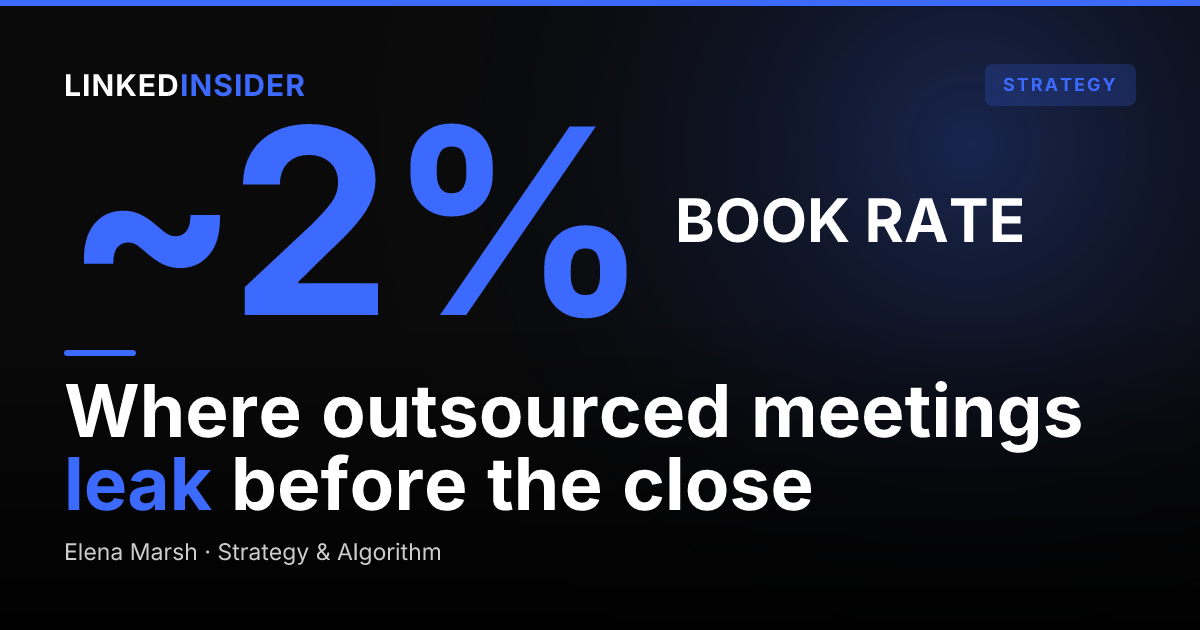
That gap is expensive because the supply is thin. Across 441,965 LinkedIn outreach sequences run on the verified API, Reachium's data shows 1.99% of accepted connections turn into a booked meeting. When roughly one in fifty accepted connections produces a calendar slot, treating any booked meeting as disposable is a strategic error. The meeting-rate data makes the math plain: protecting the meetings you already earned beats grinding for more raw volume. [SYNTHESIS]
The misdiagnosis is the dangerous part. Firms see stalled calls and conclude the leads were unqualified, then ask the setter to "tighten targeting." Often the targeting was fine and the transfer was broken. A clean handoff is the cheapest conversion lever a firm has, because the leads are already in the room.
What should the handoff note include so the closer walks in informed?
The handoff note should give the closer everything they need to skip the discovery questions the prospect already answered. At minimum it carries the prospect's stated trigger (why they replied now), the exact qualification criteria they met, any objection or hesitation raised in the chat, the full conversation history, and the decision-maker context (their title, who else is on the buying committee, budget signals).
The format matters less than the discipline of writing it every time. A short structured block beats a long narrative:
Trigger: replacing a legacy vendor after a renewal price hike. Qualified on: VP Finance, 200-person firm, named a Q3 timeline. Raised: skeptical about migration effort. History: 4 messages, asked about onboarding twice.
Why it works: the closer reads it in thirty seconds and opens the call on the prospect's actual problem instead of a cold "so tell me about yourself." That single change turns a re-discovery call into a continuation of a conversation the prospect already started, which is the whole point of the first-meeting speed advantage a managed motion is supposed to deliver.
Want to put this into practice?
Reachium automates LinkedIn outreach, content publishing, and inbox management in one platform.
Start Free →What qualification bar must the DFY team and the closer agree on first?
Both sides must agree on what counts as a real meeting before anything hits the calendar. The single biggest source of handoff friction is two definitions of "qualified" running in parallel: the setter optimizing for booked count, the closer expecting fit. Write the bar down and make it binding.
A workable bar has three gates. The title or seniority gate confirms the prospect can actually buy or champion (Reachium's multi-million-lead B2B universe flags decision-makers as their own layer, so a setter targeting that layer is in range). The intent gate requires a stated trigger or a specific question, not just a polite "sure, let's chat." The disqualifier list names what kills a meeting before booking: wrong company size, no budget authority, a competitor fishing for intel. The questions to ask a DFY provider before you sign should include exactly this, and the qualified-meeting guarantee math shows why a vague bar makes any guarantee meaningless. [SYNTHESIS]
When the bar is shared, "bad leads" arguments mostly disappear, because both sides agreed in advance on what good looks like.
How should calendar routing and reminders be wired?
Calendar routing should put the prospect directly onto the closer's calendar with buffers and a confirmation cadence built in. Every manual relay step (setter forwards to ops, ops emails the partner, partner replies with times) adds hours of latency, and latency is where warm intent cools into a no-show.
Route the booking link straight to the person who will run the call, with a 15-minute buffer on either side so back-to-back calls do not bleed. Then layer a confirmation cadence: an immediate calendar invite, a reminder 24 hours out, and a short reminder the morning of. The publicly reported research on B2B scheduling consistently points to confirmation touches reducing no-shows, and our review of the field suggests the firms with the lowest no-show rates are simply the ones reminding most reliably, not the ones with better leads. This is the same operational discipline that separates a strong onboarding walkthrough from a chaotic one.
Who owns no-show and reschedule follow-up?
No-show follow-up needs exactly one named owner, not a shared assumption. "Everyone chases it" reliably becomes "no one chased it," and a booked meeting that no-shows without a rework is a dead asset the firm already paid for.
Decide explicitly: in most professional-services setups the DFY team owns the re-engagement, because the relationship lives in the LinkedIn thread they built, not in the closer's cold inbox. Set a re-engagement window (a same-day nudge, then a 48-hour reschedule offer, then a graceful close after the second miss). Keeping the original thread warm is far easier than restarting, which is why managed conversations matter: when the whole history sits in one place, the follow-up references the exact prior context instead of starting over. For the deeper playbook on chronic no-shows, see why booked meetings no-show and the no-show follow-up tactics built for outsourced setups.
Want to put this into practice?
Reachium automates LinkedIn outreach, content publishing, and inbox management in one platform.
Start Free →How do you close the feedback loop so the next batch converts better?
You close the loop by tagging every meeting outcome and routing it back to the team running outreach. A handoff system that only flows forward (setter to closer) and never flows back (closer to setter) gets no smarter over time. The closer knows which meetings actually had fit and which wasted an hour, and that signal is the most valuable input the outreach team never receives.
Build a weekly review ritual: tag each meeting as showed/no-show, qualified/not, and progressed/dead, then map outcomes back to the sequence and segment that produced them. Over a few weeks the team sees which triggers, titles, and message angles produce closers, and it can double down. This is the difference the month-1 vs month-3 data captures: early meetings teach the system, and a real feedback loop is why month three converts better than month one. It is also the honest version of meeting quality over quantity, because quality is something you measure and feed back, not something you assert.
FAQ
What should a meeting handoff note from a DFY team include?
The prospect's stated trigger, the exact qualification criteria they met, any objections raised in chat, the full conversation history, and decision-maker context. The goal is letting the closer skip every question the prospect already answered.
Who owns no-show follow-up, the setter or the AE?
Name one owner explicitly. In most professional-services setups the DFY team owns it, because the relationship and the full thread live in the outreach platform, making re-engagement faster than a cold restart by the closer.
How do you build a feedback loop so booked meetings actually convert?
Tag each meeting outcome (showed, qualified, progressed) and map it back to the sequence and segment that produced it in a weekly review. Over a few weeks the outreach team learns which triggers and titles produce closers and doubles down.
What qualification criteria should both sides agree on before a meeting counts?
A title or seniority gate, an intent gate (a stated trigger or specific question, not just polite agreement), and a written disqualifier list. Agreeing on this in advance is what keeps booked count and real fit aligned.