Meeting Quality vs Quantity: What to Demand From a DFY LinkedIn Service
By Elena Marsh, Strategy & Algorithm. Last updated: 2026-05-30
- The provider's dashboard shows 12 meetings booked, but eight no-show and three are clearly out of budget.
- "Meetings" is the metric on the sales call, yet nobody agreed in writing what a qualified meeting actually is.
- Every wrong-fit call still costs 30 minutes of prep plus the call itself, and that time is gone.
Why is a full calendar of unqualified meetings a loss, not a win?
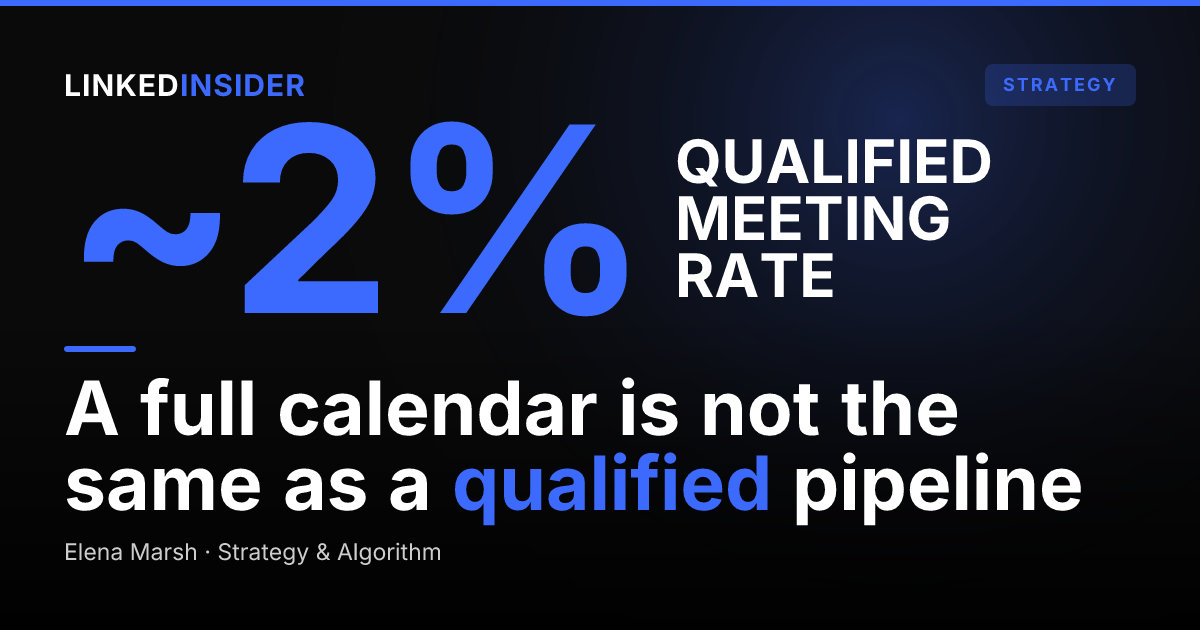
A full calendar of unqualified meetings is a loss because it spends the founder's scarcest resource, time, on conversations that were never going to close. Twelve wrong-fit calls are a worse outcome than three right-fit ones, even though the dashboard looks healthier. Each meeting carries fixed overhead: research, prep, the call itself, and the follow-up that goes nowhere.
The cost compounds. A founder who learns that "your meetings" means a half-day of disqualifying strangers starts dreading the calendar and stops trusting the provider's numbers. Raw bookings are a vanity metric precisely because they feel like progress while quietly draining the time and attention that should go to the deals that can actually move. The right question is not how many meetings landed but how many were with a buyer who fits and could buy.
What actually counts as a qualified meeting?
A qualified meeting is one that clears a written, four-part bar agreed before the engagement starts: the right title, the right company-size band, a budget signal, and a stated need. Miss one and it is a conversation, not a qualified meeting, and it should not count toward the KPI.
Spell each part out in plain language. Title means the person can influence or sign off on the purchase, not an analyst three layers down. Company-size band means the revenue or headcount range where the offer is a fit. A budget signal means the prospect acknowledged a problem worth spending on, even loosely. A stated need means they named a pain the offer addresses, rather than agreeing to a call out of politeness. Getting this defined up front is the single highest-leverage thing a buyer can do, and it belongs in the brief before any sends start. For how to put it in writing, see how to brief a LinkedIn lead gen agency.
Want to put this into practice?
Reachium automates LinkedIn outreach, content publishing, and inbox management in one platform.
Start Free →What metrics expose a provider gaming meeting count?
Four metrics expose a provider optimizing for raw count: qualified-meeting rate, show rate, meeting-to-opportunity rate, and the source mix of who got booked. Watch all four together, because each one alone is easy to dress up.
Qualified-meeting rate is the share of booked meetings that clear the written bar. A high raw count paired with a low qualified rate is the signature of quantity-gaming. Show rate catches meetings booked from soft, pressured yeses that evaporate before the call. Meeting-to-opportunity rate tells you whether anything downstream is happening at all. The source mix reveals whether bookings cluster among titles and company sizes outside the ICP, which is what happens when a provider casts wide to hit a quota. Linked Insider has covered the realistic benchmarks for these in detail in the DFY meeting-rate data breakdown and the qualified-meeting guarantee math.
How does chasing quantity lower LinkedIn lead gen meeting quality?
Chasing volume lowers quality because more sending does not just dilute fit, it measurably reduces acceptance. Across 180,155 matured connection requests, Reachium's data shows acceptance peaked at 32.01% for accounts sending 10-19 invites a day and fell to 26.65% at 20-29 a day. More volume produced fewer accepts, a pattern worth calling the volume tax, detailed in the outreach benchmarks study. [SYNTHESIS]
The mechanism is intuitive once you see the number. To hit a meeting quota, a provider pushes send volume; to push send volume, it loosens targeting and thins personalization into mass templating. Both moves drag down acceptance and reply quality at the same time. Quantity targets and quality outcomes are not neutral toward each other. They pull in opposite directions, which is why a contract that rewards raw count is structurally betting against the founder.
How do you write the quality bar into the engagement?
You write the quality bar in by making the qualification definition and the qualified-meeting rate contractual, not aspirational. Four clauses do most of the work, and they all sit in the statement of work before sends begin.
First, define the ICP filter: the exact titles, company-size band, and exclusions the provider must target. Second, set qualified-meeting rate plus show rate as the headline KPI, not raw bookings. Third, require reply triage and disqualification logic, so out-of-fit conversations are filtered out rather than dumped on the calendar. Fourth, set a review cadence, usually a monthly read of the four metrics above against the bar. Tie the commercial terms to this. Whether you run a retainer or a retainer-versus-performance model, the unit being paid for should be the qualified meeting, and the SLA and reporting expectations should report against it. For the arc of how this plays out over a quarter, the month 1, 2, 3 expectations guide sets a realistic baseline.
Want to put this into practice?
Reachium automates LinkedIn outreach, content publishing, and inbox management in one platform.
Start Free →What does a quality-first managed motion look like in practice?
A quality-first managed motion starts from targeting and personalization, not send volume. It points outreach at decision-makers, tunes the message to the qualification bar instead of mass templating, and runs reply triage so wrong-fit conversations are disqualified politely before they ever reach the founder's calendar.
The targeting math matters here. Reachium's universe holds a multi-million-lead B2B universe, of which a large share are flagged as decision-makers, which means the raw material to book right-fit meetings exists without casting wide. A motion built on this prioritizes filtering over flooding: fewer, better-aimed sends, a reply layer that screens for the four-part bar, and a calendar that only fills with calls worth the founder's prep time. That is the opposite of the volume-tax trap, and it is what a buyer should expect when the KPI is qualified meetings rather than raw count. [SYNTHESIS]
FAQ
Should I pay per meeting or per qualified meeting?
Pay per qualified meeting against a written bar, or use a retainer with qualified-meeting rate as the KPI. Paying per raw meeting rewards the provider for booking calls that no-show or fall outside your ICP.
What show rate is realistic for DFY LinkedIn meetings?
Treat show rate as a core metric rather than an afterthought, and expect some no-shows even from good targeting. A consistently low show rate is usually a sign of soft, pressured yeses booked to hit a count, not a scheduling problem.
How many qualified meetings per month is reasonable?
Fewer than most dashboards imply. Reachium's data shows only 1.99% of accepted connections book a meeting, so a sustainable number depends on send pace and ICP density rather than a flat promise of a busy calendar.
How do I disqualify a meeting without burning the relationship?
Build polite disqualification into the reply triage layer before the call, by confirming fit on the four-part bar in the conversation. A short, respectful "this may not be the right time" keeps the door open and protects the founder's calendar.