How Many Follow-Ups Should a LinkedIn Outreach Sequence Have?
By Daniel Okoro, Outreach Tactics. Last updated: 2026-05-24
Most sales reps running LinkedIn outreach have a sequence problem they cannot see. They send one message, wait a few days, send another, and call it a sequence. The reply rate sits at 5-8% and they assume the copy is the issue. Usually it is not.
The structural problem shows up in the data: the majority of replies in a well-designed multi-touch sequence do not arrive on the first message. An SDR who sends one message and moves on is leaving most of their potential pipeline untouched. That is the tension this piece resolves: not just how many follow-ups to send, but exactly what each one should do, when it should go, and when to stop.
How many LinkedIn follow-up messages should a sequence actually have?
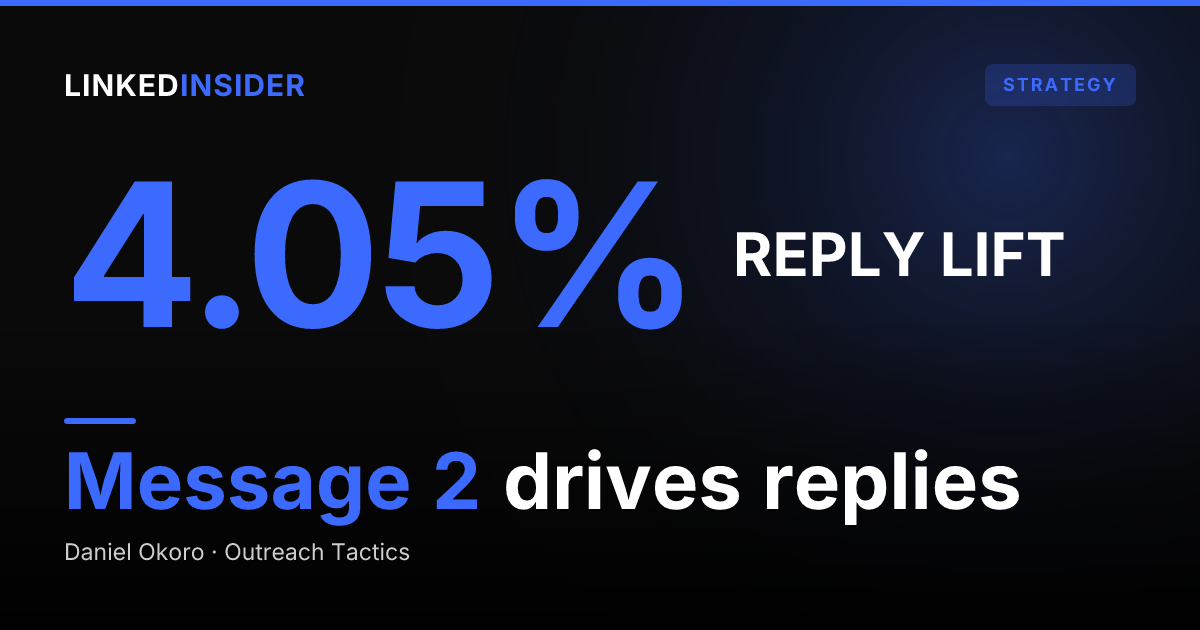
Expandi's analysis of 13.2M connection requests between May 2025 and April 2026 found that a second follow-up adds 4.05% to reply rate over a single-touch sequence. A third adds roughly another 1%. The incremental lift drops steeply after message three. [SYNTHESIS]
The practical recommendation from that data: three to four messages total. That means the initial message after connection is accepted, two follow-ups, and a break-up close. Below three messages, the majority of replies are left uncaptured. Beyond four, the risk of generating a block or a "please stop messaging me" reply increases faster than the incremental reply benefit justifies.
A multi-step sequence like this is what most tools call a LinkedIn drip campaign: an automated series of paced touches sent to one prospect over days or weeks, with each step firing on a time delay or a conditional signal.
Cold sequences and warm sequences behave differently. A prospect who has already viewed your profile, commented on a post, or engaged with a lead magnet starts the sequence at a higher temperature. They may convert in fewer touches and typically respond better to a more direct first message. That distinction (routing messages by behavior rather than just by time) is covered in the conditional branching section below.
One number worth noting: the commonly cited B2B sales benchmark of 8-12 touchpoints needed to close a deal is a general sales figure, not a LinkedIn-specific number. LinkedIn-specific data from Expandi and Belkins consistently points to 3-4 messages as the effective ceiling before diminishing returns on cold outreach.
What should each message in the sequence actually say?
Each message in a sequence has a distinct job. Mixing up those jobs (putting the ask in message one, or sending another piece of value content in message three when a direct close is called for) is the most common structural error.
Message 1 (connection note or first DM post-accept): Earn the right to a reply. Reference something real about the prospect: a recent post, a job change, a company announcement. Ask nothing. The connection note (if used) is 200 characters maximum and is not a pitch; it is a reason to accept. The first message after acceptance is where the conversation starts: a specific insight or relevant hook, one low-friction question.
Message 2 (follow-up, day 4-5 after no reply): Add value rather than re-ask. Share a relevant data point, a resource, or a short observation tied to their role or company. End with a soft close: "Thought this might be relevant. Happy to share more if useful." The goal is re-engagement, not a calendar invite. For the specific copy patterns that work at this step, the outreach templates that hit 40% reply rates post covers the frameworks in detail.
Message 3 (follow-up, day 9-10): Make the ask explicit but keep it low-stakes. "Worth 15 minutes?" is easier to accept than "Are you free for a demo?" Two to three sentences maximum. Connect the ask back to the value angle from message two.
Message 4 / break-up (day 14): The permission close. "I will stop reaching out after this one. Is there a better time to reconnect, or is it not the right fit right now?" Break-up messages outperform a fourth hard pitch because they remove pressure and occasionally prompt replies from prospects who were waiting for an easy exit and found the direct question more engaging than they expected.
Want to put this into practice?
Reachium automates LinkedIn outreach, content publishing, and inbox management in one platform.
Start Free →How many days should I wait between LinkedIn follow-up messages?
The published consensus across 2025-2026 outreach research: 3-5 business days between messages is the optimal spacing for cold LinkedIn sequences. Multiple sources (Expandi, Belkins, Letterdrop) converge on this window. Under three days reads as pressure. Over seven days loses context; prospects genuinely forget who you are. Reachium's published timing data backs the window: its study of 12,911 acceptance-to-reply pairs found a median of 31.01 hours from acceptance to first reply, with 64.63% of replies arriving within 72 hours and 79.58% within 7 days, so a follow-up inside three days steps on prospects who were already replying, and one past day seven lands after most of the curve has cleared. [SYNTHESIS]
Day-of-week data from Closely's LinkedIn response rate analysis shows Tuesday through Thursday sends get the highest reply rates (Tuesday peaks at 6.90%, Monday at 6.85%). Time windows of 8-10am or 2-4pm in the prospect's local timezone perform best, though getting the spacing right matters more than the exact day of send. [SYNTHESIS]
A practical timing template for a two-week sequence:
- Day 0: Connection accepted; first message sent
- Day 4-5: Message 2 (value-add follow-up)
- Day 9-10: Message 3 (explicit ask)
- Day 14: Message 4 (break-up close)
Total sequence window: two weeks from first message. Short enough to stay in context, long enough to catch prospects who were busy during the first touch.
When should I stop following up on LinkedIn?
Four signals that mean stop:
- An explicit "not interested" or "please don't message me": stop immediately, tag the contact, never re-contact.
- No reply across all four messages and no profile view or engagement in the sequence window: they are not there or not interested.
- A positive reply at any step: the sequence must halt automatically and route to the inbox for a human response.
- A meeting booked.
The mistake that costs SDRs the most is not stopping when a positive signal fires. A rep running a manual sequence who fires message 3 into a conversation where the prospect replied to message 2 burns the relationship. The sequence has to halt on a positive reply, which is a systems problem, not a willpower one.
After four messages with no engagement, the prospect has made a decision. Sending a fifth or sixth message does not change their mind; it conditions them to mark future messages as spam, which affects deliverability across the entire account.
Archive the contact, mark the reason (no reply, wrong timing, wrong ICP), and consider a retargeting campaign at a later date if the fit is still strong. That is a re-engagement motion, not a continuation of the cold sequence. The companion post on LinkedIn outreach mistakes that kill reply rate covers the sequencing errors that suppress results at the account level.
Should I use conditional branching in my LinkedIn sequence?
Conditional branching means the sequence checks a behavior signal before firing the next message rather than sending on a fixed time interval regardless of what happened.
The most useful conditions on LinkedIn:
- if_profile_viewed: The prospect looked at your profile after message 1. They are interested. Send a warmer, more direct follow-up that acknowledges the curiosity without naming it directly. "Noticed you came across my profile after my last message. Would a short conversation be worth it?" outperforms a standard value-add nudge for this segment.
- if_replied: Halt the sequence immediately and route to the inbox.
- if_not_replied and not_profile_viewed: Send the standard value-add follow-up as planned.
A prospect who viewed your profile is not the same prospect as one who never engaged. The first deserves a message that moves the conversation forward. The second needs more credibility or a different hook before another direct ask. Treating them identically is the gap that separates a well-designed sequence from a batch-and-blast one.
Reply.io has reported that teams using conditional sequences see substantially higher reply rates compared to fixed-interval sends. The exact multiplier varies by team and is based on vendor-platform data, but the underlying logic is sound: routing messages by behavior reduces irrelevant follow-ups and increases the proportion that land at the right moment.
Most SDRs do not use conditional branching because their tool does not support it or because they are running sequences manually. That is the gap where an automated campaign engine with conditional step logic does the heavy lifting. Skylead's Smart Sequences are the most-cited example of conditional logic in a cloud-based tool. For a comparison of how that conditional logic holds up against a verified-API implementation, see Reachium vs Skylead. Teams that want conditional branching without building the logic themselves can start a free trial and run the if_profile_viewed and if_replied conditions natively.
Want to put this into practice?
Reachium automates LinkedIn outreach, content publishing, and inbox management in one platform.
Start Free →What is a good reply rate for a LinkedIn outreach sequence?
Baseline benchmarks from Expandi's 13.2M-data-point dataset (May 2025 to April 2026): the platform-wide post-connection message reply rate sits at 10.4%. Campaigns that pair a message with a profile visit trigger reach 11.87% (Belkins 2025 study). Top-performing sequences with strong personalization and conditional branching consistently exceed 20%. As a published data point, Reachium's data across 48,836 accepted connections shows 27.55% replied, 7.47% of all connection requests sent. That gap between the platform-wide 10.4% and the 27.55% post-acceptance figure shows how much of the performance difference comes from building the right sequence after the connection is made, not before it. The full funnel breakdown is in LinkedIn outreach benchmarks 2026. [SYNTHESIS]
Reachium publishes a 25%+ reply rate across its client base as a marketing figure. That aligns with the top-quartile band in independent data and reflects what well-structured, personalized, conditional sequences produce at volume. [SYNTHESIS]
For the connection-request-to-meeting conversion math (how many requests a quota actually requires when those reply rates are multiplied through), see the LinkedIn outreach-to-meeting math.
A sequence reply rate below 8% is almost always a targeting or relevance problem, not a volume or timing problem. The fix is ICP tightness and first-message specificity, not sending a fifth follow-up. The LinkedIn reply rate diagnostic post covers the full repair checklist for sequences stuck below benchmark.
If the goal is a full benchmark picture (acceptance rate by stage, reply rate by industry, positive-reply rates), the LinkedIn response rate benchmarks post has the complete table with Expandi, Belkins, and Closely data.
FAQ
Is four follow-ups too many on LinkedIn?
No, if structured correctly. Four messages total (connection, follow-up 1, follow-up 2, break-up close) is the productive ceiling supported by current data. Each message should serve a distinct purpose. A fourth message that is simply a re-send of the third is too many. A fourth message that is a genuine permission close ("I will stop reaching out after this") adds value and often prompts replies from prospects who were on the fence.
Can I automate my LinkedIn follow-up sequence?
Yes, and for most SDRs running more than 30 active prospects at a time, automation is not optional. It is the only way to ensure correct timing, conditional branching, and automatic halt-on-reply. The platform used must run on LinkedIn's verified API to avoid account flags. Browser-extension automation at sequence scale is a restriction risk; API-based automation is not.
What should I write in a LinkedIn follow-up message if they viewed my profile but did not reply?
This is the conditional branching scenario. The prospect is interested but not yet ready to reply. A good follow-up for this situation: reference the curiosity implicitly ("I noticed you came across my profile after my last note"), restate the specific value angle from the first message in one sentence, and make the ask explicitly low-stakes ("Worth 15 minutes to see if there is a fit?"). Keep it under 60 words.
How do I know if my LinkedIn sequence is working or just annoying people?
Three signals the sequence is working: reply rate above 8%, positive reply rate above 3%, and no increase in connection removals or "not interested" responses over a 30-day window. If reply rate is flat and connection removals are ticking up, the sequence is annoying people. The fix is usually the first message, not the number of follow-ups.
Should LinkedIn follow-ups be short or long?
Short. The highest-performing follow-up messages in 2026 are under 60 words. The follow-up is not where the value proposition gets explained; it is where the conversation gets reopened or the ask gets made. Every sentence that does not advance one of those two goals should be cut.
Sources
- LinkedIn response rate benchmarks, Linked Insider
- Low LinkedIn reply rate fix, Linked Insider
- LinkedIn outreach mistakes that kill reply rate, Linked Insider
- Reachium: Time to accept, time to reply (12,911 acceptance-to-reply pairs)
- Expandi LinkedIn Outreach Benchmarks 2026, 13.2M connection requests, May 2025-April 2026
- Belkins B2B LinkedIn Outreach Benchmarks 2025
- Closely: LinkedIn Response Rates by Day, When to Send Messages for Maximum Replies
- Linked Insider: LinkedIn outreach benchmarks 2026