Should You Use AI to Write Your LinkedIn Posts? (How to Keep It Sounding Like You)
By Elena Marsh, Strategy & Algorithm. Last updated: 2026-05-23
How much LinkedIn content is AI-generated now?
Over half. Originality.ai analyzed 8,795 long-form LinkedIn posts published between January 2018 and October 2024 and found that 54% were likely AI-generated. AI-assisted posts surged 189% after ChatGPT launched at the end of 2022. [SYNTHESIS]
The result is a feed with a texture problem. When the majority of long posts on a platform read as machine-generated, human-sounding content earns disproportionate attention. Not because AI is inherently bad. Because sameness is the signal 360Brew now actively penalizes.
For the head-on trends question of whether LinkedIn will penalize AI content in 2026, the short answer is that LinkedIn's May 2026 update suppresses heavily AI-generated posts that lack original perspective, not AI-assisted posts with a real point of view. That is a quality penalty, not an authorship penalty, and it reinforces every workflow note below.
There is a real upside to acknowledge: AI has lowered the cost of a first draft. The problem is that most people publishing AI content are skipping the step between first draft and published post. That gap is where reach lives.
Does LinkedIn penalize AI-written posts?
Not directly. LinkedIn's 360Brew model (a 150-billion-parameter system deployed in March 2026, publicly detailed in a January 2025 arXiv paper) does not run a binary AI detector. It uses semantic reasoning to evaluate content quality signals: lexical diversity, sentence rhythm variation, and structural unpredictability. These are the qualities that naturally-written content has and that AI drafts tend to flatten. [SYNTHESIS]
Generic AI output scores poorly on all three. Predictable transitions ("In today's fast-paced landscape..."), uniform paragraph length, and hedged thesis-first structure are patterns 360Brew's language model recognizes as low-quality signals, without ever labeling them as "AI." LinkedIn penalizes generic content. AI is the most common way generic content gets made at scale.
The reach data supports this. Richard van der Blom's Algorithm Insights Report 2025, which analyzed 1.8 million posts, found that views are down 50% year-over-year, engagement down 25%, and follower growth down 59% for most creators. The drop is not uniform: creators posting specific, expert-level content with high lexical variation are seeing stronger results than pre-2026 benchmarks. The algorithm has separated the generic from the specific, and AI slop is the clearest example of generic. [SYNTHESIS]
For more on how the LinkedIn algorithm update changed what earns reach, the mechanics behind 360Brew explain why voice consistency is now a distribution variable. Advisors using AI to draft posts in a regulated context should pair this with the compliant LinkedIn content for advisors framework, which lays out what holds up under FINRA Rule 2210 and the SEC Marketing Rule.
Want to put this into practice?
Reachium automates LinkedIn outreach, content publishing, and inbox management in one platform.
Start Free →Where does AI-written LinkedIn content fail?
Three places, consistently.
The hook. AI defaults to broad, thesis-first openers. LinkedIn's feed requires a specific, dwell-triggering first line. Generic AI openers are among the clearest signals to both the algorithm and human readers. The reason is structural: AI produces statistically likely continuations from its training corpus, and the statistically likely opener for a professional post is a soft thesis statement. That is the opposite of what hooks that stop the scroll actually do. A hook is a disruption. AI produces consensus.
The specific detail. AI cannot know what happened in last Tuesday's sales call, what the founder said that changed the product roadmap, or what the client result actually was. These specifics are what earn trust on LinkedIn. An AI post without injected specifics reads as theoretical. Theoretical posts earn polite likes from colleagues. They do not earn shares from strangers or saves from people who forward things to their team.
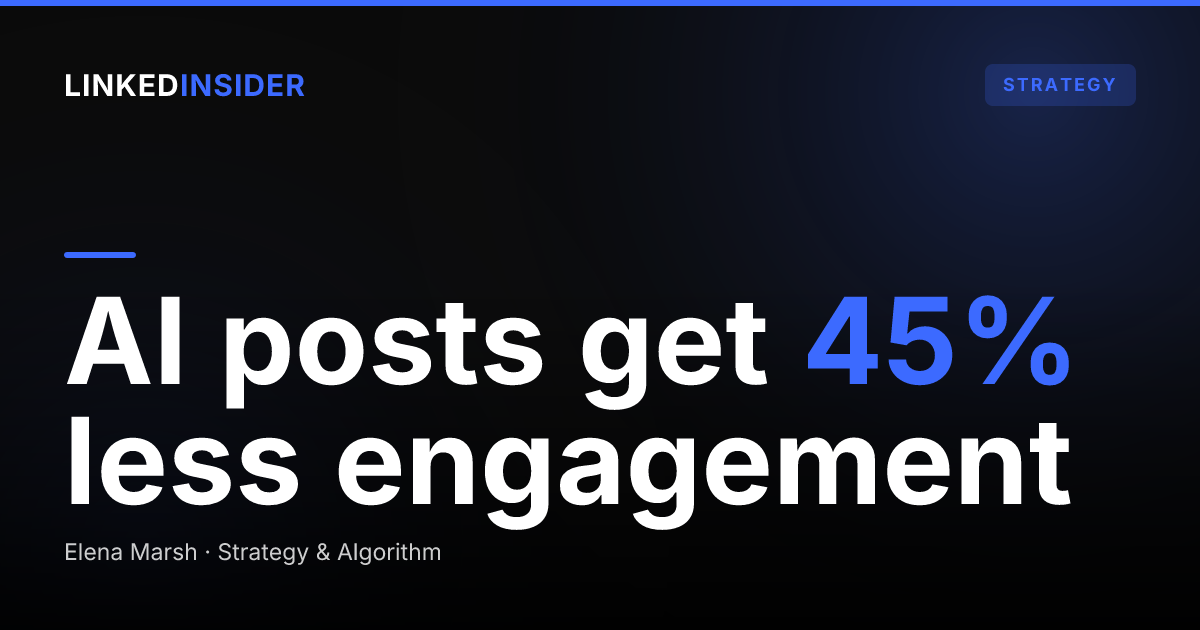
The voice. AI learns from a corpus of internet text with a consistent character: helpful, hedged, structured, mildly corporate. That voice is not the voice that built the audience. The result is a subtle uncanny-valley effect: readers who follow the account notice something is off without being able to name it. Over months, this erodes the trust relationship the content was meant to build. Originality.ai's 2025 engagement study found that likely-AI-generated posts received 45% less engagement on average than likely-human-authored ones. The industry distribution is uneven: leadership and inspiration content saw AI posts outperform human posts by 75% in that study, while healthcare and government showed human posts outperforming AI posts by 40-44%. The consistent pattern across all verticals is that voice consistency drives performance regardless of whether AI was involved in drafting. [SYNTHESIS]
Where does AI actually help with LinkedIn content?
Three places, genuinely.
Idea generation. AI is useful for generating a list of topic angles from a rough direction. The output is unfiltered and repetitive, but one solid idea from ten mediocre ones is still faster than staring at a blank page. A concrete prompt pattern: "Here are my last five posts and the ICP I write for. Generate 10 topic angles for this week." The writer provides the editorial judgment; the AI provides volume.
Structure and outline. AI is good at applying a structure you specify to a set of points you provide. If the writer gives it the 40/30/20/10 bucket framework, a topic, and two or three specific points they want to make, AI produces a solid skeleton faster than building it manually. The key constraint: the writer provides the points. AI provides the connective tissue. This is a structural tool, not a judgment tool.
First draft from a detailed outline. When the outline already contains specific details, named examples, and a named hook direction, an AI-drafted prose pass is a legitimate starting point. The draft is raw material, not output. Editing a draft is faster than writing from zero. The ratio of effort should feel like: AI does the structural lift, the writer does the voice and specifics.
What AI should never do alone: generate the hook, choose which personal detail to include, decide what the conclusion implies about the writer's authority, or post without a full human rewrite pass. The writer's job is not eliminated. It is compressed to the decisions that require judgment.
What is the workflow for AI-assisted LinkedIn content that keeps your voice?
Three layers, applied in sequence.
Layer 1: brand voice input before drafting. Give the AI actual examples of the writer's voice before asking it to draft anything. Paste three to five best-performing posts and instruct: "Write in this voice." The output will still need work. The point is to calibrate the starting position. An AI that has read your actual posts produces something closer to you than one drafting from a generic instruction.
Layer 2: inject specifics into every paragraph. Every paragraph should contain at least one detail the AI could not have known. One structural note worth enforcing here: an analysis of 236 LinkedIn posts found the 600-1,200 character range produced a 10.3% engagement rate, while posts over 2,000 characters fell to 1.9%. AI drafts tend to run long; cut aggressively to the range that performs. See LinkedIn outreach benchmarks 2026 for broader performance context. A real number, a real quote, a real conversation, a real outcome. This is the irreplaceable step. If a section contains no injected specifics, it should be rewritten or cut. Specifics are what separate a LinkedIn post that earns trust from one that earns a like from someone who was scrolling anyway.
Layer 3: the out-loud voice check. Read the draft aloud. Any sentence that is something you would not say in a conversation with a peer gets cut or rewritten. The voice test is not "does this sound smart?" The voice test is "does this sound like me?" These are different standards. AI consistently passes the first and fails the second.
The compounding benefit: a writer who applies this workflow consistently produces a body of posts that becomes data for the next round. The AI is now learning from the writer's actual output, not from the internet corpus. That is the difference between AI that drafts in your voice and AI that drafts in the voice of everyone who has ever written a professional post.
This workflow is also the practical reason not to skip the out-loud check. The sentences that survive are the ones that sound like a specific person. The sentences that fail are the ones that sound like LinkedIn. Given that LinkedIn content strategy that books meetings depends on a reader trusting a specific voice, this distinction compounds over time.
Want to put this into practice?
Reachium automates LinkedIn outreach, content publishing, and inbox management in one platform.
Start Free →What is the best AI for LinkedIn posts that sounds like you?
No tool sounds like you out of the box. Every major option on the market, ChatGPT, Jasper, Taplio, Shield, and most scheduler-native drafting features, drafts from a general corpus unless it has been explicitly trained on the writer's own posts. The distinction matters: a tool that learns from your posts and drafts in that pattern is meaningfully different from a tool that produces well-structured generic text.
What to look for in any AI content tool: first, does it learn brand voice from existing posts, not just a style prompt? Second, does it generate content ideas across a structured framework rather than uncategorized topic lists? Third, does it surface ranked ideas for the writer to choose from, rather than auto-selecting? A ranked idea the writer chose is always better than an auto-selected one. The writer's editorial judgment is the quality signal the algorithm rewards.
One category worth distinguishing here: AI outreach tools like SalesRobot, which layer AI voice clones and AI video messages on top of automation sequences, are a different use case from AI content drafting. Those tools are about personalization at the outreach layer, not content creation for the feed. If that comparison is relevant, Reachium vs SalesRobot covers where AI personalization in outreach is genuinely useful versus where it sits on an unsafe browser-automation base. For the reply-rate data behind that distinction, see the AI personalization reply rate data, which separates the kind of AI personalization that earns a reply from the kind that reads as the new spam pattern. For founders and consultants who have decided they want a human writer rather than an AI-assisted workflow, how to outsource LinkedIn content without losing your voice covers the tier breakdown from freelance ghostwriters to managed content services, including the quality signals that separate a $2,500/month engagement from a $500/month one.
FAQ
Can LinkedIn detect AI-generated posts?
Not through a binary detector. LinkedIn's 360Brew model evaluates posts semantically and scores for lexical diversity, sentence rhythm variation, and structural unpredictability. It does not label posts as "AI" or "human." It deprioritizes posts that score poorly on the signals correlated with authentic, expert voice. Generic AI output consistently scores poorly on those signals. The practical outcome is the same as detection, lower distribution, without a flag or a warning.
Will using AI to write LinkedIn posts get my account flagged or restricted?
Content quality scoring under 360Brew does not trigger account restrictions. Restrictions are a separate enforcement mechanism tied to outreach automation patterns, not content drafting. The risk from AI-generated posts is reach loss and trust erosion, not account action. For the distinction between content quality and account safety, see is LinkedIn automation safe in 2026?.
How do I prompt AI to write LinkedIn posts in my voice?
Start with examples, not instructions. Paste three to five of your best-performing posts into the prompt before asking for a draft. Add the content framework you use so the structure is specified rather than guessed. Provide the specific points you want to make and any real details (numbers, quotes, events) the post should include. Then treat the output as a raw draft and rewrite any sentence that would not survive the out-loud voice check.
Is there a tool that learns my LinkedIn voice and drafts for me?
Yes. Reachium's Content Generator is built specifically for this. It learns brand voice from the marketer's own posts through brand identity profiles, generates ranked content ideas across the 4-bucket framework, and drafts posts in that voice for the marketer to review and approve. It is not a "publish for me" button. It is a content system that starts much closer to your voice than a generic AI prompt can.
Should I disclose that I used AI to write a LinkedIn post?
LinkedIn does not require disclosure and does not label AI-generated posts. The editorial case for disclosure is independent of policy: readers in trust-based industries (healthcare, legal, financial services) are more sensitive to AI-generated content, and the engagement data reflects that. The practical answer is that a post substantially rewritten with your specific details, hook, and voice does not meaningfully require disclosure. A lightly edited AI draft that still reads generic is the one readers notice regardless of whether you say anything.
Sources
- Reachium
- Originality.ai. Over Half of Long Posts on LinkedIn Are Likely AI-Generated Since ChatGPT Launched
- Originality.ai. 50%+ of LinkedIn Posts Were Likely AI in 2025 + Engagement Insights
- LinkedIn. Algorithm Insights Report 2025, Richard van der Blom (via Scribd)
- Falia. 360Brew: LinkedIn's New Algorithm Explained (2026)
- Linked Insider. LinkedIn Algorithm Update 2026
- Linked Insider. LinkedIn Hooks That Work
- Linked Insider. What to Post on LinkedIn: The Framework
- Linked Insider. LinkedIn Content Strategy That Books Meetings
- Linked Insider. Is LinkedIn Automation Safe in 2026?
- Linked Insider. LinkedIn Outreach Benchmarks 2026