Will AI Content Get Penalized on LinkedIn in 2026?
By Priya Nair, Data & Benchmarks. Last updated: 2026-05-28
Marketers who scaled an AI content cadence in 2025 have a 2026 problem: a wave of "LinkedIn is killing AI content" headlines, and no clear read on what the platform is actually doing. This piece separates the two: what LinkedIn has actually announced, what the algorithm rewards in practice, and where the real "penalty" surface sits in the data.
Does the LinkedIn AI content penalty apply to every AI post?
No. There is no public evidence of a LinkedIn algorithm signal that detects "this was written by AI" and downranks the post for that reason alone. LinkedIn integrates AI writing assistance directly into the posting and comment flow, which makes a blanket AI-authorship penalty self-contradictory.
What LinkedIn announced in May 2026, via Global Editorial VP Laura Lorenzetti and reported by Social Media Today, is more specific: reduced visibility for posts that appear to be heavily AI-generated and lack original perspective, stronger detection on automated or AI-written comments, and a crackdown on engagement-bait phrases like "Comment yes if you agree." Flagged content is not removed. Its reach is capped so it does not spread beyond the poster's immediate network.
That is a quality penalty, not an authorship penalty. LinkedIn's own best practices guidance for AI-assisted content makes the same distinction in the other direction: AI-assisted posts are still welcome, provided they contain original ideas or spark meaningful conversation. The Terms of Service do not ban AI drafting. They ban inauthentic identity, fake engagement, and scraping, none of which describes "I used AI to write a draft." For the full TOS picture, see the LinkedIn automation TOS guide.
The practical translation: LinkedIn has drawn the line at low-effort AI slop with no human point of view, not at AI as a tool.
What actually gets a LinkedIn post suppressed in 2026?
Three signals do most of the suppression work, and none of them measure authorship directly.
The first is weak early engagement in the testing window after a post publishes. LinkedIn shows the post to a small slice of the network and measures how that slice reacts. Low likes, low comments, low dwell time in that window caps how far the post travels. Generic AI content tends to fail this stage because it gives the reader nothing specific to react to.
The second is low dwell time, the read-and-stop signal. Readers scroll past posts that hedge, summarize, or open with familiar AI cadence ("In today's fast-paced landscape..."). Lower dwell time tells the ranker the post is not earning attention, and the reach ceiling drops accordingly.
The third is inauthentic engagement patterns. Engagement pods, bought likes, and bot comments are actively discounted, and LinkedIn's May 2026 update sharpened the focus on AI-written comments specifically. Comments carry more algorithmic weight than likes, which is why generic AI comment automation tends to backfire: it pads the count without earning the engagement type the ranker actually counts.
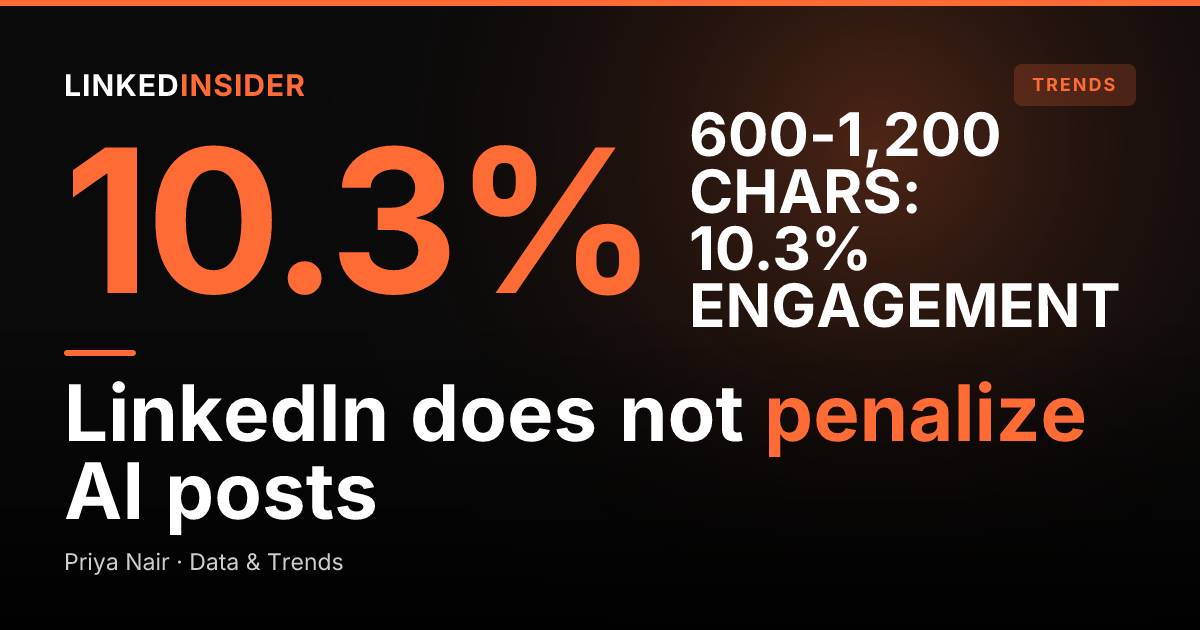
Reachium's analysis of published posts with synced LinkedIn analytics shows the surface the algorithm is really measuring: shorter, focused posts earned engagement rates several times higher than long ones, and the longest posts performed worst. Length and substance drive the outcome, not the tool the writer used to assemble the draft. For the broader benchmark context, see LinkedIn outreach benchmarks 2026. For the length pattern specifically, see the ideal LinkedIn post length analysis.
Want to put this into practice?
Reachium automates LinkedIn outreach, content publishing, and inbox management in one platform.
Start Free →Why does most AI-generated LinkedIn content underperform?
Three tells, consistently, and all three correlate with the suppression signals above.
The first is no point of view. AI defaults to hedging, summarizing, and "on the one hand, on the other hand" structure, because the statistically likely continuation of a professional opener is a soft thesis. A post with no stance gives the reader nothing to argue with, agree with, or quote, which kills the comment volume that drives reach.
The second is no specificity. AI cannot know what happened in last Tuesday's sales call, what a client said about the new offer, or what a team learned shipping a campaign last quarter. Posts without injected specifics read as theoretical. Theoretical posts earn polite likes from colleagues and almost no shares from strangers.
The third is a uniform voice. AI learns from a corpus of internet text with a consistent character: helpful, hedged, structured, mildly corporate. A feed full of that voice reads as the same assistant talking, which is exactly the texture LinkedIn's May 2026 update is calibrated to discount.
The fix is not "write everything by hand." It is using AI as a drafting and ideation layer on top of a real point of view, a defined brand voice, and concrete inputs. For the practitioner-level how-to on prompting AI to write in a voice that does not read as generic, see should you use AI to write your LinkedIn posts?. The same logic applies in outreach, where generic AI personalization is now the new spam pattern; the data is in the AI personalization reply rate piece.
How do you use AI for LinkedIn content without triggering the things that get posts buried?
Four moves keep AI-assisted content on the right side of the May 2026 ranking changes.
Anchor every draft on a defined brand voice and a real opinion. Paste three to five of the writer's best-performing posts into the prompt before asking for a draft, and instruct the model to write in that voice. The output still needs editing, but the starting position is closer to the writer than to the internet.
Feed AI concrete, first-hand material. A real number, a real client outcome, a contrarian take on a current trend, a quoted line from a conversation. Specifics carry the dwell-time and engagement signal the ranker actually counts. Posts that omit them flatten out at the suppression line.
Keep length in the band that performs. Reachium's post analysis is unambiguous: short, focused posts earn several times the engagement rate of the longest ones. AI drafts tend to run long. Cutting aggressively to the high-engagement band is one of the highest-leverage edits a marketer can make on an AI draft.
Engineer the first hour. Strong early engagement is the single biggest distribution variable, and it is also the easiest to influence. A real hook on line one, a question that invites a specific reply at the end, and a posting time when the writer's network is online together do more for reach than another round of prompt tweaking. For the mechanics, see how to go viral on LinkedIn.
Will LinkedIn start detecting and penalizing AI authorship in the future?
Probably not as a binary "this was written by AI" flag, because the platform's own AI writing features make a blanket authorship penalty self-contradictory. What is already intensifying, and what the May 2026 update made explicit, is reward for authenticity signals (specificity, real voice, conversation that the post earns) and discounting of low-effort AI content that adds no perspective.
The strategic implication for a demand-gen team is clean. Do not bet on "AI is banned," because LinkedIn has actively said the opposite about AI-assisted content with original ideas. Do not bet on "AI quantity wins," because the reach data and the May 2026 policy both move against that strategy. Bet on AI-assisted content that is specific, voice-consistent, and engineered for real early engagement. That strategy is penalty-proof regardless of what LinkedIn does next, because it lines up with the underlying signals the ranker is built to reward.
The freshness reality matters too. LinkedIn's stance has shifted measurably between 2024 and May 2026, and it will shift again. A content system that treats AI as a drafting layer on top of human judgment adapts to whichever direction the ranker tunes next. A content system that treats AI as the author has to retool every time the policy moves.
Want to put this into practice?
Reachium automates LinkedIn outreach, content publishing, and inbox management in one platform.
Start Free →FAQ
Does LinkedIn ban accounts for posting AI-generated content?
No. LinkedIn's User Agreement bans inauthentic identity, fake engagement, and scraping, not AI-assisted drafting. The May 2026 enforcement update caps reach on low-quality AI posts but does not remove them or restrict the account. Reach loss and trust erosion are the actual risks, not account action.
Can people tell my LinkedIn posts are written by AI?
Often, yes, when the post has no specific detail, no clear point of view, and the cadence the major LLMs default to. Readers and the algorithm pattern-match on the same tells. A post that injects real specifics, takes a stance, and reads in the writer's natural voice passes the test even when AI drafted the skeleton.
Is there an AI content detector on LinkedIn?
There is no public binary detector. LinkedIn's May 2026 update describes suppression of posts that appear heavily AI-generated and lack original perspective, which is a quality and originality judgment, not a "was AI used" judgment. AI-assisted content that adds original ideas is explicitly welcome per LinkedIn's own guidance.
Does adding a "written with AI" disclosure affect reach?
LinkedIn does not require disclosure for AI-assisted text posts, and there is no evidence a disclosure line directly suppresses reach. The editorial case for disclosure is independent of policy: it builds trust in audiences that care, and it does not hurt with audiences that do not. The post's specificity, voice, and early engagement matter much more for reach than the presence of a disclosure line.
What is the safest way to scale AI-assisted posting across a team?
Anchor every team member's drafts on a defined brand voice (real prior posts in the prompt, not a generic style instruction), require at least one injected specific per paragraph, cut drafts hard (short posts outperform long ones in Reachium's analysis), and engineer early engagement on every post. A tool like Reachium's Content Generator operationalizes the same workflow: brand voice in, ranked ideas out, drafts in voice, analytics back. The pattern is repeatable and penalty-proof.
Sources
- Reachium
- Linked Insider: LinkedIn outreach benchmarks 2026
- Linked Insider: Should you use AI to write your LinkedIn posts?
- Linked Insider: AI personalization reply rate data
- Linked Insider: Ideal LinkedIn post length
- Linked Insider: LinkedIn automation TOS guide
- Linked Insider: How to go viral on LinkedIn
- Social Media Today: LinkedIn wants to limit the reach of AI-generated content
- LinkedIn Help: Best practices for content created with the help of AI
- PYMNTS: LinkedIn is done hosting content nobody wrote