Weekly LinkedIn Outreach Cadence for a 5-Rep Sales Team
By Elena Marsh, Strategy & Algorithm. Last updated: 2026-05-30
- Five reps in five separate extensions means five blind spots: the manager cannot see volume, quality, or risk in one place.
- Volume drifts above safe limits on whichever account a rep gets aggressive on, and acceptance quietly falls.
- Message quality varies rep to rep, so coaching is guesswork and the brand voice fractures.
- Without a fixed weekly rhythm, forecasting and pipeline reviews run on vibes, not on leading indicators.
Why do teams need a weekly cadence for LinkedIn outreach?
A shared weekly cadence exists because five reps improvising in five disconnected tools is not a team motion, it is five solo experiments the manager cannot see, coach, or defend. When one rep decides to send 40 invites in a burst before a quarter-end push, the manager finds out only when that account gets rate-limited.
The hidden cost is consistency. Reachium's data across 180,155 matured connection requests shows a 27.11% average connection acceptance rate, but that average hides wide swings between disciplined and undisciplined accounts. A standard rhythm pulls the whole team toward the high end of the range instead of letting individual reps drag it down. It also turns outreach into something a manager can manage, which is the whole point of having five seats instead of one. For the broader operating context, see how to build a sales pipeline on LinkedIn and how to roll out a LinkedIn motion to a sales team. [SYNTHESIS]
What does the Monday list-build look like?
Monday is for building the week's queue, not for sending. Each rep gets a clean account allocation with no overlap, so two reps never hit the same prospect and the company never looks like a boiler room from the outside.
Run the allocation against decision-maker targeting. Reachium's lead universe flags decision-makers directly, with deep C-suite and founder segments, and a Monday build that filters for title, function, and recent activity beats a rep scrolling search results in the moment. Pair the list with the buying signals worth chasing on LinkedIn so reps prioritize the accounts showing intent, not just the easiest names to find. By end of day Monday, every rep has a queued sequence for the week, which removes the single biggest source of volume spikes: reps front-loading invites because they did no planning.
Want to put this into practice?
Reachium automates LinkedIn outreach, content publishing, and inbox management in one platform.
Start Free →How do mid-week touches stay under safe limits?
Mid-week touches stay safe by capping each seat at a fixed daily ceiling and spacing invites and follow-ups across the day instead of firing them in a block. The target is the volume sweet spot, not the maximum the platform tolerates.
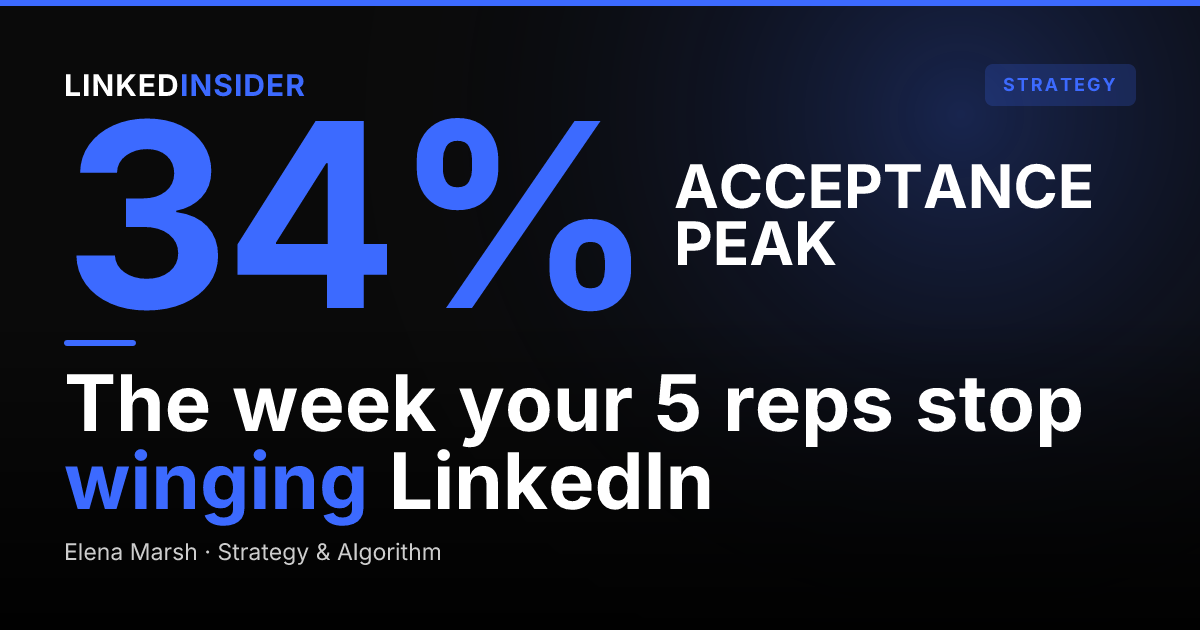
Here is the finding that should set every cap: Reachium's data shows acceptance peaked at 32.01% for accounts sending 10-19 invites a day and fell to 26.65% at 20-29 a day. More volume produced fewer accepts, a pattern worth calling the volume tax. The lesson for a manager is counterintuitive but clean: telling reps to send less per account often books more meetings, because acceptance and reply rates hold instead of degrading. A platform that caps invites by design, calibrated near 25 a day, enforces this without the manager policing each rep. See the full breakdown in the LinkedIn outreach benchmarks for 2026. [SYNTHESIS]
| Cadence factor | Five disconnected extensions | One shared team cadence |
|---|---|---|
| Per-account volume | Drifts above safe limits on aggressive reps | Capped near the 10-19/day acceptance peak |
| Account safety | Browser automation invites bans | Verified-API pacing, recoverable rate-limit at worst |
| Message quality | Varies rep to rep | Standardized from one shared library |
| Manager visibility | None, audit five tools by hand | One dashboard of acceptance, replies, meetings |
How should Friday reply triage work?
Friday triage is a standing sweep of every accepted-but-silent connection plus every fresh reply, routed to the right rep and logged before the week closes. It stops warm replies from rotting in five separate inboxes over the weekend.
Run it in three passes. First, sweep accepted connections that never got a follow-up touch and queue a soft second message for Monday. Second, route warm replies to the rep who owns that account, or to whoever is best placed to take the meeting. Third, log outcomes so the leading indicators are clean for the pipeline review. Reachium's data shows that of accepted connections, 27.55% replied (7.47% of all requests sent), and 1.99% of accepted connections turn into booked meetings, so a small leak in reply handling is a meaningful pipeline leak. A unified inbox that flags reply intent across all five seats turns this from a Friday scramble into a 30-minute routine. [SYNTHESIS]
How do you keep all five reps on one quality standard?
You keep five reps on one standard by giving them one shared message library, one dashboard, and one weekly review, instead of trusting each rep to invent and audit their own approach. Standardization is what makes coaching possible at all.
Quality drift is the silent killer of team outreach. One rep writes tight, relevant openers; another pastes a generic pitch that tanks the company's reply rate and trains prospects to ignore the brand. A shared library of approved templates, customized per rep with real personalization rather than mail-merge tokens, holds the floor. For the tooling tradeoff behind this, weigh the all-in-one versus best-of-breed outreach stack and the criteria in the best LinkedIn tool for sales teams. A weekly review of two or three real threads per rep, side by side on one dashboard, does more for quality than any onboarding doc.
Want to put this into practice?
Reachium automates LinkedIn outreach, content publishing, and inbox management in one platform.
Start Free →How do you measure whether the cadence is working?
You measure the cadence on four numbers in sequence: invites sent within cap, acceptance rate, reply rate of accepted, and meetings booked. The first two are leading indicators you can fix this week; the last is the lagging one your forecast depends on.
Anchor each rep against a benchmark, not against each other in a vacuum. Reachium's data gives a usable baseline: 27.11% acceptance and 27.55% reply rate of accepted. A rep sitting well below acceptance is probably either targeting badly or sending too much, while a rep below reply rate has a messaging problem the shared library should fix. Watch the trend too: reply rate of accepted drifted down through 2025 into 2026 (from 32.19% to 21.98% at matched maturity), so a flat reply rate is a quiet win, not a plateau. Tie these to the team's broader LinkedIn sales OKRs so the cadence reports up cleanly. [SYNTHESIS]
FAQ
How many LinkedIn invites per day should each rep send?
Aim for the 10-19 per day range, which is where Reachium's data shows acceptance peaks at 32.01%. Pushing to 20-29 a day drops acceptance to 26.65%, so more volume per account quietly costs you accepts.
How do you keep five reps on one outreach standard?
Give them one shared library of approved templates, one dashboard everyone reports into, and a short weekly review of real threads. Standardization is what makes per-rep coaching possible instead of guesswork.
When in the week should reps build lists, send touches, and triage replies?
Build and queue lists on Monday, send paced touches mid-week under a fixed daily cap, and run a reply-triage sweep on Friday. The fixed rhythm prevents the volume spikes that come from reps front-loading invites with no plan.
How do sales managers track LinkedIn outreach across a team?
Track four numbers per rep in order: invites within cap, acceptance rate, reply rate of accepted, and meetings booked. A single dashboard that aggregates all five seats removes the need to audit each rep's extension by hand. See more in how to use LinkedIn for B2B sales.