Should You Post on LinkedIn on Weekends?
By Priya Nair, Data & Trends. Last updated: 2026-05-29
The standard advice is simple: do not post on LinkedIn on weekends. Every color-coded heat map puts Saturday and Sunday in the bottom row and moves on.
The problem with that advice is that it measures total engagement volume, not per-post performance. When fewer posts compete for the same feed slots, the posts that do go out earn more distribution per post. That is a different question, and the two findings are not contradictory. They measure different things.
This piece works through both sides of the data, identifies the audience and content conditions where weekend posting earns its place in a content calendar, and names the one condition that makes the entire debate academic: without a scheduling system, the answer is almost always "you probably will not remember to."
Does LinkedIn engagement drop on weekends?
Yes, in aggregate. Sprout Social's 2026 analysis of engagements across more than 307,000 social profiles consistently ranks Saturday and Sunday as the lowest-performing days on LinkedIn. Buffer's analysis of 4.8 million posts identifies Tuesday through Thursday, with strong afternoon and early-evening windows, as the peak period across accounts. Weekends are the bottom of the distribution on both datasets. [SYNTHESIS]
That finding is real and worth respecting. LinkedIn is primarily a professional network. The majority of its users log in during work hours, between meetings, during commutes, or during what Buffer's 2026 data describes as a shift toward late-afternoon and early-evening engagement windows on weekdays. On weekends, that professional context is absent for most users.
The important distinction: "bottom of the distribution" is not zero. LinkedIn is used seven days a week. The question is who is on the platform Saturday morning, and whether they represent the audience the content is meant to reach.
What does the data actually say about weekend posting on LinkedIn?
The headline consensus from major datasets is consistent. Buffer's 4.8 million post analysis and Sprout Social's large-panel studies both rank weekdays, particularly Tuesday through Thursday between 10 a.m. and early afternoon, as the peak window. Saturday and Sunday are the weakest days in every large-sample study that treats engagement volume as the metric. [SYNTHESIS]
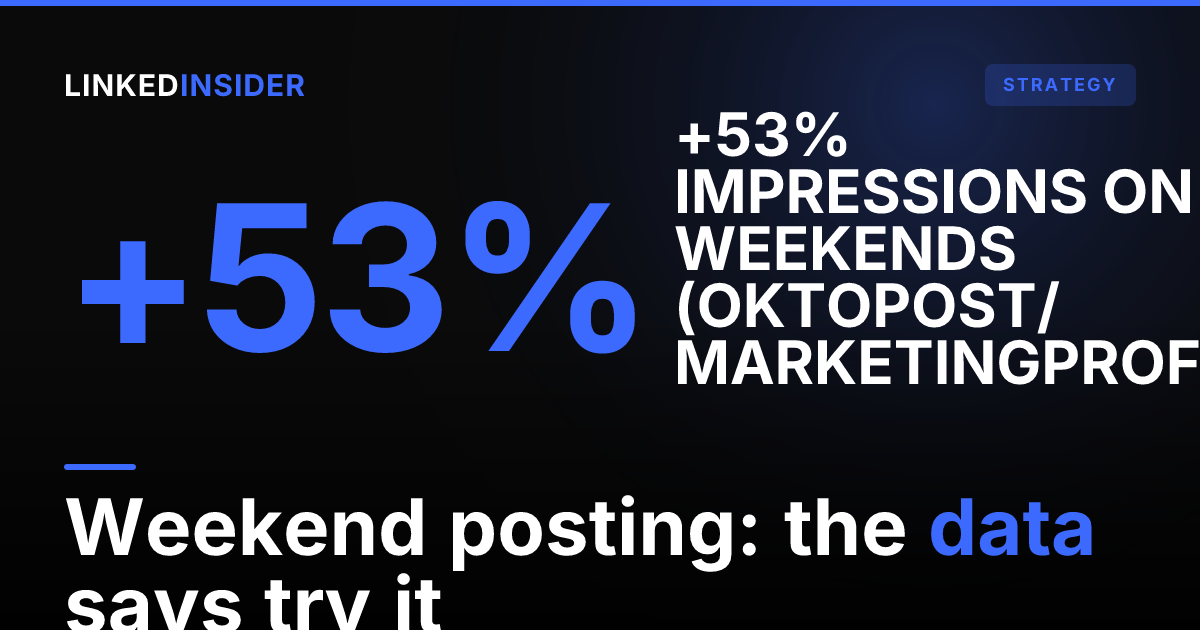
The counterpoint comes from a different measurement. An Oktopost analysis of LinkedIn company page posts, published by MarketingProfs in 2025, found that native posts published on weekends averaged 2,554 impressions per post compared to 1,667 on weekdays, a 53% increase. Weekend posts reached 1,853 users on average versus 1,224 on weekdays (a 51% improvement), and averaged 340 engagements versus 145 on weekdays. These are per-post figures on native content, meaning posts without external links. [SYNTHESIS]
Two findings, both accurate. Total engagement volume on LinkedIn falls on weekends. Per-post performance for native content can exceed weekday averages precisely because fewer posts are competing for the same feed space. A smaller audience competing with less content produces different per-post math than a larger audience competing with a full week's publishing volume.
The quotable version: the problem with weekend posting on LinkedIn is not the algorithm. It is the smaller audience. The same post competing with less content can earn more distribution than it would on a crowded Tuesday.
Note on scope: the Oktopost data covers company page posts. Personal profile data may produce different per-post numbers; company pages and personal profiles have meaningfully different audience dynamics and algorithmic treatment.
Want to put this into practice?
Reachium automates LinkedIn outreach, content publishing, and inbox management in one platform.
Start Free →Does lower weekend competition actually produce more reach?
The mechanism is algorithmic, not speculative. LinkedIn's feed scores and distributes posts based on early engagement velocity: how many reactions, comments, and shares a post earns in the first 60 to 90 minutes after publication. Fewer competing posts published on weekends means each post faces less displacement pressure in the feed during that initial window. The same absolute number of engagements in that golden hour earns more distribution than it would on a high-volume Tuesday when dozens of other posts are competing for the same slots.
The Oktopost finding (company page posts, published via MarketingProfs) makes the mechanism concrete: native posts averaging 2,554 impressions on weekends versus 1,667 on weekdays. The differential holds specifically for content without external links. [SYNTHESIS] Posts containing external links are deprioritized by the LinkedIn algorithm regardless of day of week. For a detailed breakdown of how the feed scoring works by content type, see LinkedIn algorithm update 2026.
The constraint is real: this advantage applies only to native content. Weekend audiences are smaller, the window for generating early engagement velocity is narrower, and posts with external links fare worse on weekends than on weekdays for the same reasons. The mechanism that helps native posts on weekends actively compounds the disadvantage for linked posts.
What this means for content planning: authority posts, long-form text content, and carousels that do not require an external link are the candidates for weekend scheduling tests. A roundup post driving traffic to a gated resource is not.
Who should actually post on LinkedIn on weekends?
Weekend posting is not a universal tactic. It is a test-worthy tactic for specific audience and content combinations.
It works better when the ICP includes founders, entrepreneurs, and independent professionals who browse LinkedIn on weekend mornings as a deliberate learning habit rather than a work-mode task. That audience is real: the LinkedIn users most active on Saturday mornings tend to self-identify as builders who own their own growth, a psychographic that aligns with the entrepreneurially inclined B2B buyer more than with the corporate professional who treats LinkedIn as a work inbox. For content, native posts without external links benefit from the lower-competition mechanism described above. The goal should be reach and brand authority rather than immediate click-throughs.
It works worse when the ICP is corporate buyers with strict Monday-through-Friday professional identities. It also underperforms when the content type relies on external link traffic, or when the team is already struggling to maintain a consistent weekday cadence. Adding weekend posts before solving the weekday rhythm is the wrong sequence.
For a framework on matching content type to audience intent, see what to post on LinkedIn: a framework. For how different post formats perform across the week, LinkedIn post types and engagement breaks down the format-by-format picture.
The tactical question: does the ICP scroll LinkedIn on Saturday mornings? If yes or probably, run the test. If no or unknown, build weekday consistency first.
Does posting on weekends hurt LinkedIn reach for the rest of the week?
No credible primary source supports a mechanism by which a weekend post penalizes weekday performance. LinkedIn's algorithm scores posts individually based on engagement velocity and content signals. There is no documented "weekly goodwill budget" that a weekend post consumes.
The real risk is different. A post that receives low engagement because the timing is poor for the audience it reaches does not generate a positive signal. A string of low-engagement posts, on any day of the week, can train the algorithm to distribute future posts more conservatively. The concern is not day-of-week per se. It is low-engagement posts, and that risk exists on a bad Tuesday as much as on a bad Saturday.
The implication for a demand-gen marketer: the risk of weekend posting is not posting on weekends. It is posting content that does not resonate with the specific audience active at that time, which is the same risk that exists for any post on any day. The question "will this land with the people who are on LinkedIn right now?" does not change by day.
Want to put this into practice?
Reachium automates LinkedIn outreach, content publishing, and inbox management in one platform.
Start Free →How does scheduling make the weekend-posting question irrelevant?
The practical problem with manual weekend timing: even if Saturday 9 a.m. is the right window for the audience, publishing a post manually on a Saturday morning requires the content creator to be at their desk or phone at a specific time on a day off. That friction means weekend posts either do not happen or get published at the wrong time (8 p.m. Saturday, when the weekend LinkedIn audience has already closed the app). In both cases, the test never runs.
Scheduled publishing removes the tradeoff entirely. If a content calendar includes a Saturday 9 a.m. slot, the post goes out at the right time whether or not the marketer is working that day. The test becomes frictionless. This is the same principle behind building the weekday rhythm with a scheduling system: for teams already planning and scheduling content in advance, see LinkedIn content calendar for how to structure the weekly build.
The broader principle: the debate over weekend versus weekday timing is only worth having once the team has infrastructure that can execute any timing decision without additional manual work. Without a publishing system, the "should I post on weekends?" question is mostly academic.
For teams producing content in volume (planning multiple posts at once rather than one at a time), batch LinkedIn content covers the workflow that makes weekend slots easy to fill as part of a broader session rather than a separate decision.
FAQ
Should I post on LinkedIn on Saturday or Sunday?
Saturday outperforms Sunday across most datasets, with Buffer's analysis identifying Saturday morning as the best weekend window, while both days underperform the Tuesday through Thursday peak. If the ICP includes founders, entrepreneurs, and professionally ambitious operators who treat Saturday morning LinkedIn scrolling as a learning habit, Saturday is worth testing. Sunday generally reaches a smaller, less receptive audience and is the weakest day in large-panel studies. For most B2B marketers, Saturday is the better test case if weekends are being explored at all.
What time should I post on LinkedIn on the weekend?
Saturday around 9 a.m. in the audience's local timezone is the best-supported weekend window based on Buffer's 4.8 million post analysis. Early morning tends to capture the deliberate Saturday scroller before off-platform weekend activity takes over. Later slots (afternoons and evenings) see further audience thinning. Sunday morning follows a similar pattern but with a smaller base audience. Scheduling tools make hitting these windows automatic so the test does not require manual intervention.
Does LinkedIn penalize posts published on weekends?
No credible primary source supports a penalty mechanism for weekend posts. LinkedIn scores posts individually based on engagement velocity in the first 60 to 90 minutes after publication. A weekend post that earns strong early engagement will distribute normally. The risk is not the day of the week itself but a low-engagement outcome (from a small audience or mismatched content) that produces a weak signal and trains future distribution more conservatively.
Does posting too many days a week hurt LinkedIn reach?
The LinkedIn algorithm does not document a hard penalty for high post frequency, but there is a practical ceiling. Publishing too frequently can dilute per-post engagement because the audience has a finite attention budget. Most large-sample analyses find that two to five posts per week produce the best per-post outcomes for most accounts. Adding weekend slots works best as a supplement to a solid weekday rhythm, not as a way to compensate for inconsistent weekday publishing. See how often to post on LinkedIn for the frequency data in full.
Is Saturday or Sunday better for LinkedIn content?
Saturday. Every major dataset that distinguishes between the two days ranks Saturday ahead of Sunday for LinkedIn engagement. Sunday is consistently the weakest day across Sprout Social's and Buffer's large-panel analyses. Saturday morning gives access to the deliberate weekend scroller, a real audience that exists even if it is smaller than the weekday base. Sunday engagement patterns suggest most LinkedIn users have mentally closed the professional-network session by the time Sunday arrives.
What content works best on LinkedIn weekends?
Native content without external links performs best on weekends, based on the Oktopost analysis. The mechanism is the lower-competition feed environment: fewer posts competing for attention allows posts with strong early engagement signals to distribute further. Content types that perform well include authority posts, long-form text, and carousels where no external click is required. Posts with external links are deprioritized by the LinkedIn algorithm regardless of day, and that penalty compounds on weekends when the early-engagement window is narrower and the audience is smaller.
Sources
- Oktopost / MarketingProfs: Maximizing B2B LinkedIn Engagement With Weekend Posting
- Buffer: Best Time to Post on LinkedIn in 2026 (4.8M Posts Analyzed)
- Sprout Social: Best Times to Post on LinkedIn in 2026
- Linked Insider: How Often Should You Post on LinkedIn
- Linked Insider: LinkedIn Content Calendar
- Reachium