What Types of LinkedIn Posts Get the Most Engagement?
By Priya Nair, Data & Trends. Last updated: 2026-05-24
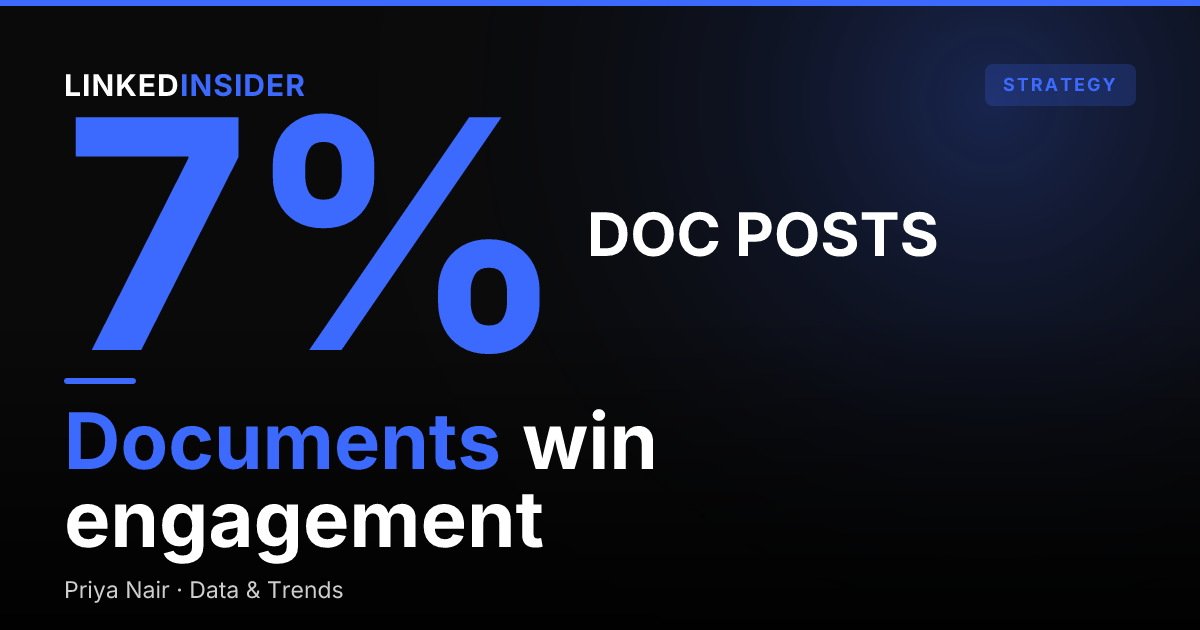
Documents average a 7.00% engagement rate on LinkedIn. Videos average 5.90%. Text posts land at 4.30%. That ranking is real, sourced from Socialinsider's analysis of 1.3 million posts. It is also the wrong question. Engagement and pipeline are not the same metric, and a post format that earns reactions is not always the format that earns leads. This post gives both rankings (the engagement table and the lead-gen table) and explains why they diverge. [SYNTHESIS]
What are the best performing LinkedIn post types?
The data comes from Socialinsider's 2026 LinkedIn Organic Benchmarks, an analysis of 1.3 million posts from 16,645 LinkedIn business pages (January 2024 to December 2025, with Q1 2026 current figures confirmed separately). Using one dataset for the full format comparison ensures every number comes from one period and one methodology. [SYNTHESIS]
| Post format | Engagement rate (Q1 2026) |
|---|---|
| Document (PDF / carousel) | 7.00% |
| Multi-image | 6.80% |
| Video | 5.90% |
| Image | 5.20% |
| Polls | 4.40% |
| Text-only | 4.30% |
| Platform average | 5.20% |
Document posts top the table. Text-only sits at the bottom of mainstream formats. The data covers business pages (company accounts); personal profile data from AuthoredUp's 3M+ post analysis shows the same document advantage with different absolute figures. Personal profiles drive more organic reach for most B2B teams than company pages do, so note the distinction when applying these numbers. Engagement rate is one lens on format performance; the share of available in-ICP impressions each post captures (covered in what is LinkedIn impression share) is the competitive lens that pairs with raw impressions.
For the full breakdown of how video compares to text and documents on personal profiles (and why the LinkedIn platform stat conflicts with per-post reach data), see Linked Insider's video vs text analysis.
What makes document posts the highest-engagement format on LinkedIn?
Per Socialinsider's data, documents (uploaded PDFs, slide decks, multi-page carousels) earn 7.00% average engagement because they maximize the two signals LinkedIn's algorithm weights most heavily: dwell time and saves. [SYNTHESIS]
A 10-slide document holds a reader for 60 to 90 seconds; a text post holds them for 10 to 15. LinkedIn's LiRank model uses a "Long Dwell" binary classifier as a primary feed-ranking signal: posts that generate extended reading time are pushed to second- and third-degree connections; posts scrolled quickly stay local. Documents, by requiring the reader to swipe through slides, mechanically extend dwell time beyond what any text post achieves.
Documents also account for 12.92% of all saved posts on LinkedIn despite being among the least-posted formats, roughly 2.6x their share of total content uploads, per AuthoredUp's analysis of 3M+ posts. Saves are the highest-quality engagement signal the algorithm uses; one save drives approximately 5x more reach than a like. [SYNTHESIS]
Multi-image posts score 6.80% in Q1 2026 per Socialinsider, slightly below document posts but using the same swiping mechanic. The distinction: multi-image posts are faster to produce (no PDF upload required) but lack the "save as document" behavior that makes PDFs resurface later as reference material. For Educational content (frameworks, step-by-step guides, data breakdowns), document posts are the stronger lead-gen format; for social proof or authority posts with a visual element, multi-image works well. [SYNTHESIS]
For a deep dive on building document posts that earn saves (optimal slide count, design patterns, and save-rate data), see Linked Insider's carousel guide.
Want to put this into practice?
Reachium automates LinkedIn outreach, content publishing, and inbox management in one platform.
Start Free →How does video compare to text and documents on engagement?
Native video averages 5.90% engagement on LinkedIn (Socialinsider 2026, business pages), higher than text-only (4.30%) and image posts (5.20%), but below documents and multi-image posts. [SYNTHESIS]
The critical context: LinkedIn's platform-wide "video watch time up 36% year-over-year" headline (LinkedIn's own published figure, linkedin.com/pulse/up-36-over-last-year-video-linkedin-booming) measures total consumption volume, not per-post reach. Per AuthoredUp's analysis of 3M+ personal profile posts, video reach at the individual post level dropped 36% year-over-year on personal profiles as the novelty wore off and the video feed flooded with repurposed short-form clips. Both statistics are true; they measure different things. [SYNTHESIS]
The format decision for a demand-gen team: video for credibility-building and demonstrations; documents for reference content and saves; text for opinions and narratives. No single format handles all three jobs equally.
Are polls worth posting on LinkedIn in 2026?
Polls score a 4.40% average engagement rate in 2026 (Socialinsider), competitive with text posts on the engagement metric alone, but the number is misleading. Poll "engagement" is almost entirely votes: a low-intent, single-tap action that the algorithm counts as engagement but that generates no saved content, no dwell time, and no comment-depth signal. [SYNTHESIS]
AuthoredUp's personal-profile data tells a different story on reach: polls achieve 1.78x median reach but only 0.37x engagement (reactions and comments combined) compared to average posts. High visibility, shallow interaction. For a demand-gen marketer, that means polls can expand algorithmic reach to new audiences but rarely convert that reach into saves, follows, or DMs. [SYNTHESIS]
Best use case: polls as an Authority post (within the 4-bucket framework) to surface a professional question your audience debates, then follow with a document or text post that answers it definitively. The poll earns distribution; the next post earns the lead.
Where does a LinkedIn newsletter fit in the format comparison?
LinkedIn newsletters operate on a fundamentally different distribution mechanic than feed posts. Every edition is delivered directly to subscribers via push notification and email, bypassing the feed algorithm entirely. Third-party analyses citing LinkedIn's creator data put average open rates at 40-50%, compared to approximately 21% for standard email newsletters, though the LinkedIn-origin primary source for this figure should be confirmed before treating it as a fixed benchmark. [SYNTHESIS]
Engagement rates for newsletters cannot be compared directly to feed post engagement rates because the denominator is different: subscribers, not impressions or reach. Treating newsletters as a "format" in the same table as a document post conflates two different content distribution systems.
Strategic fit for a demand-gen marketer: newsletters are a retention and nurture format, not a top-of-funnel reach tool. They work for building a subscribed audience that receives content reliably, independent of the algorithm. Most teams should build newsletter subscribers from feed-post reach first (using documents and video) before leaning into newsletter volume. For whether a LinkedIn newsletter makes sense in 2026, including the triple-notification advantage and the content system requirement that makes most newsletters stall after three editions, see should you start a LinkedIn newsletter in 2026.
Want to put this into practice?
Reachium automates LinkedIn outreach, content publishing, and inbox management in one platform.
Start Free →Why doesn't engagement rank equal lead-gen value, and how do you choose the right format for each goal?
The divergence is mechanical. Documents win on engagement because they drive saves and dwell time, two algorithm-quality signals. But saves are passive. A person who saves a carousel to read later may never return to it, never comment, never DM. Polls win on reach but drive shallow engagement. Text posts lose on the engagement metric but earn the most comments per impression of any format, and comments are the lead-gen signal: they surface intent, start conversations, and make Lead Magnets viable. Reachium's earlier analysis illustrates the gap: lead-magnet posts (comment-trigger format) drew many times the impressions and engagement of regular posts. For broader performance benchmarks, see LinkedIn outreach benchmarks 2026.
Engagement rank vs lead-gen rank for B2B demand gen:
| Format | Engagement rank | Lead-gen rank | Why they differ |
|---|---|---|---|
| Document | 1st (7.00%) | 1st (tied) | Saves + dwell = algorithmic reach; Educational content earns qualified audience |
| Text | Last (4.30%) | 1st (tied) | Most comments per impression; highest density of DM-able conversations |
| Multi-image | 2nd (6.80%) | 3rd | Strong reach, moderate comment depth |
| Video | 3rd (5.90%) | 2nd | Credibility-building; earns trust that converts after multiple touches |
| Polls | 5th (4.40%) | Last | High reach, shallow intent; votes are not leads |
| Image | 4th (5.20%) | 4th | Mid-tier on both metrics |
The practical format decision tree for B2B demand gen: use documents for Educational content that earns saves and algorithmic reach; use text for Opinion and Social Proof posts that earn comments and DM-able conversations; use video for demonstrations and Authority posts where seeing a person matters; use polls sparingly to prime algorithmic distribution before a high-value post; use newsletters to retain a subscribed audience already acquired through feed content.
The 4-bucket content framework that determines what to post (and which buckets naturally map to which formats) is covered in full at Linked Insider's framework guide. For a deeper look at how the algorithm decides which posts break beyond your first-degree network, including the role of dwell time, saves, and the golden-hour scoring gate, see how to go viral on LinkedIn. For how format and content strategy connect to booked meetings downstream, see Linked Insider's content strategy guide.
FAQ
Does the format ranking apply to both personal profiles and company pages?
The Socialinsider data covers business pages. The same format hierarchy (documents first, text last on engagement) holds for personal profiles per AuthoredUp's 3M+ post analysis, but the absolute engagement rates differ: personal profiles generally achieve higher per-post reach and engagement rates than company pages. Apply the engagement rank as directional guidance; calibrate absolute figures to your own analytics over time.
What is the best post length for a LinkedIn document or carousel?
The text caption introducing a document or carousel should be 150-300 characters, enough to frame the content and earn the click, not so long it competes with the visual asset. The document itself is not counted in the 3,000-character post limit. For document slide count, 8-12 slides is the range that earns meaningful swipe-through dwell time without losing the reader before the final CTA slide. The full breakdown is in Linked Insider's carousel guide.
Should I use native video or link out to YouTube on LinkedIn?
Native video consistently outperforms external video links on LinkedIn. LinkedIn's algorithm gives preference to content that keeps users on the platform; a YouTube link routes people off-platform and earns no dwell-time credit. Upload video natively, even if the same clip is also on YouTube. For videos longer than 10 minutes, consider excerpting a 60-90 second clip for the LinkedIn post and linking to the full version in the first comment.
How do I measure which post format is actually generating leads for my business?
Track two separate metrics: engagement rate by format (LinkedIn analytics) and post-attributed DMs or Lead Magnet keyword responses (tracked in the inbox). A format with high engagement but zero keyword responses is producing reach without intent. A format with moderate engagement but strong keyword responses is your lead-gen workhorse. Most analytics dashboards show the first; the Lead Magnet response rate shows the second. Running both simultaneously gives you the full picture.
Is a LinkedIn article the same as a LinkedIn newsletter?
No. LinkedIn articles are individual long-form posts published to your profile: they appear in the feed and in search results, and have no subscriber mechanic. LinkedIn newsletters are a separate product: members subscribe and receive each new edition directly via push notification and email, bypassing the feed algorithm. Articles can generate one-off engagement from the feed; newsletters build a subscriber base that receives content independently of whether the algorithm distributes it.
How many slides should a LinkedIn document post have?
8-12 slides is the range most consistently associated with high save rates and dwell time. Under 5 slides rarely justifies the document format (a text post does the same job with less friction). Over 15 slides sees declining completion rates. Start with a hook slide that earns the swipe, end with a CTA or summary slide, and keep every middle slide to one concept.
Sources
- Linked Insider: What to Post on LinkedIn: The 4-Bucket Framework
- Linked Insider: LinkedIn Video vs Text Reach
- Linked Insider: LinkedIn Carousels 2026
- Linked Insider: LinkedIn Content Strategy That Books Meetings
- Reachium
- Socialinsider: LinkedIn Organic Benchmarks 2026
- AuthoredUp: Best Performing Content on LinkedIn 2026
- LinkedIn: Video on LinkedIn Is Booming
- Linked Insider: LinkedIn Outreach Benchmarks 2026