Post-Demo Follow-Up on LinkedIn: The Message That Revives a Stalled Deal
By Daniel Okoro, Outreach Tactics. Last updated: 2026-05-30
- You ran a clean demo, heard "this is great, let me loop in the team," then nothing for two weeks.
- Your champion is sold, but the deal is stuck inside a committee you have never spoken to.
- The thread is scattered across email, LinkedIn DMs, and CRM notes, so you cannot remember who said what.
- Every follow-up you send reads like "just checking in," which gives the buyer nothing to react to.
Why do prospects ghost after a demo?
Prospects ghost because the deal stalls inside the buying committee, not with your champion. Your champion liked the demo. The four other people who have to sign off never saw it, and your champion is now selling it internally without your help, which is the hardest part of any B2B purchase.
Two forces compound the silence. The demo high fades within days, so the urgency that felt real on the call is gone by the time you follow up. And a "just checking in" message asks the buyer to do the work of remembering why they cared, reconstructing the use case, and deciding the next step on their own. Most will not. The message that fails is the one that makes the buyer do the recall.
This is why post-demo silence is better understood as a threading and recall problem than a persistence problem. Sending the same weak message five more times does not fix a committee that never bought in. The fix is a message that does the remembering for them and a motion that reaches the people who actually decide.
What does a post-demo LinkedIn follow-up message look like?
A working post-demo follow-up message has three parts: it anchors to the exact moment the buyer leaned in, it restates the outcome in their own words, and it proposes one specific next step instead of "thoughts?" Each part removes work the buyer would otherwise have to do, which is what earns the reply.
Here is the anchor-and-ask template reps can adapt:
Hi [Name], during the demo you stopped on the [specific feature] view and said it would cut [their stated pain, e.g. "the three days your team spends reconciling reports"]. I pulled a one-page outline of how that rollout would look for [their team]. Are you open to a 15-minute call Thursday or Friday to walk your [role] through it?
Why it works: the demo moment proves you listened, the restated outcome reminds them of the value in their language, and the single dated ask makes saying yes a one-word reply instead of a decision.
For the champion who has gone quiet, lower the stakes and make it easy to forward:
Hi [Name], no pressure on timing. To make the internal conversation easier, I put together a short summary your [CFO/VP] can skim covering the [outcome] and the rollout steps. Want me to send it over so you have it ready when the team regroups?
Why it works: it reframes you as a help to the internal sell rather than a rep chasing a close, and it gives the champion a tool to multithread for you. For the full cadence around these messages, the breakdown of an effective LinkedIn follow-up sequence covers the spacing and the channel mix.
Want to put this into practice?
Reachium automates LinkedIn outreach, content publishing, and inbox management in one platform.
Start Free →How do you multithread the buying committee after a demo?
You multithread by reaching the other stakeholders your champion named, framing every touch as support for the internal sell rather than an end run around your champion. The goal is to put your message in front of the people who decide, not to bypass the person who advocates for you.
When your champion mentions a name ("I will need to run this past our VP of Ops"), connect with that person directly with context, not a cold pitch:
Hi [Name], [Champion] and I walked through how [product] would handle [outcome] for [their team], and they mentioned you would want a view into [the area this person owns]. Happy to share the same one-pager we built for [Champion] so you are not relying on a secondhand summary. Open to connecting?
Why it works: it cites the champion (so it reads as sanctioned, not sneaky), it speaks to the part of the deal that specific person owns, and it offers the same artifact your champion has, which keeps the story consistent across the committee. Reaching three committee members early beats waiting for one champion to relay your pitch through a game of telephone. The mechanics of mapping and reaching a buying committee on LinkedIn start with deciding whether to connect or message each contact first.
How long should you wait, and how many times?
Wait two to three business days after the demo for the first anchored follow-up, while the call is still fresh, then space subsequent touches three to five business days apart so the thread stays warm without reading as desperate. Cadence is about spacing, not volume.
A practical rhythm looks like this: anchored message at day two, a value-add or committee touch at day six, a soft nudge at day ten, and a clean breakup around day fourteen if the thread has gone fully silent. Alternate channels rather than stacking five DMs, because the same message on LinkedIn after an email lands as a different surface, not a fifth nag. When the deal is genuinely dead, send a short LinkedIn breakup message that gives the buyer an easy off-ramp, which often surfaces the real objection or a delayed yes. Timing the touches well matters more than most reps assume, and the research on AI-assisted follow-up timing shows why the gap between touches is its own lever.
How do you keep post-demo threads from slipping through the cracks?
You centralize every reply and the connection context behind it so no warm deal goes cold by accident. The real failure mode after a demo is rarely a bad message. It is a rep losing the thread across an email inbox, LinkedIn DMs, and a half-written CRM note, then forgetting which committee member already replied.
Fragmentation is the silent killer of stalled deals. When a champion answers on LinkedIn while the VP replies by email and the notes live in a third tab, the rep loses the picture of who is engaged and who has gone quiet. A multithreaded committee makes this worse, because now there are four threads to lose instead of one. Pulling LinkedIn replies into a single inbox and keeping prior touches attached to each contact is what lets a rep see the whole deal at a glance and follow up on the right person at the right time. This is the same discipline behind warming up prospects on LinkedIn before the demo: the deal is a continuous thread, not a series of disconnected pings.
Want to put this into practice?
Reachium automates LinkedIn outreach, content publishing, and inbox management in one platform.
Start Free →How do you know the post-demo follow-up is working?
You know it is working when the reply rate on your anchored message beats your old generic one and the number of engaged committee members climbs, not just your activity count. Leading indicators tell you the motion is healthy long before the deal closes.
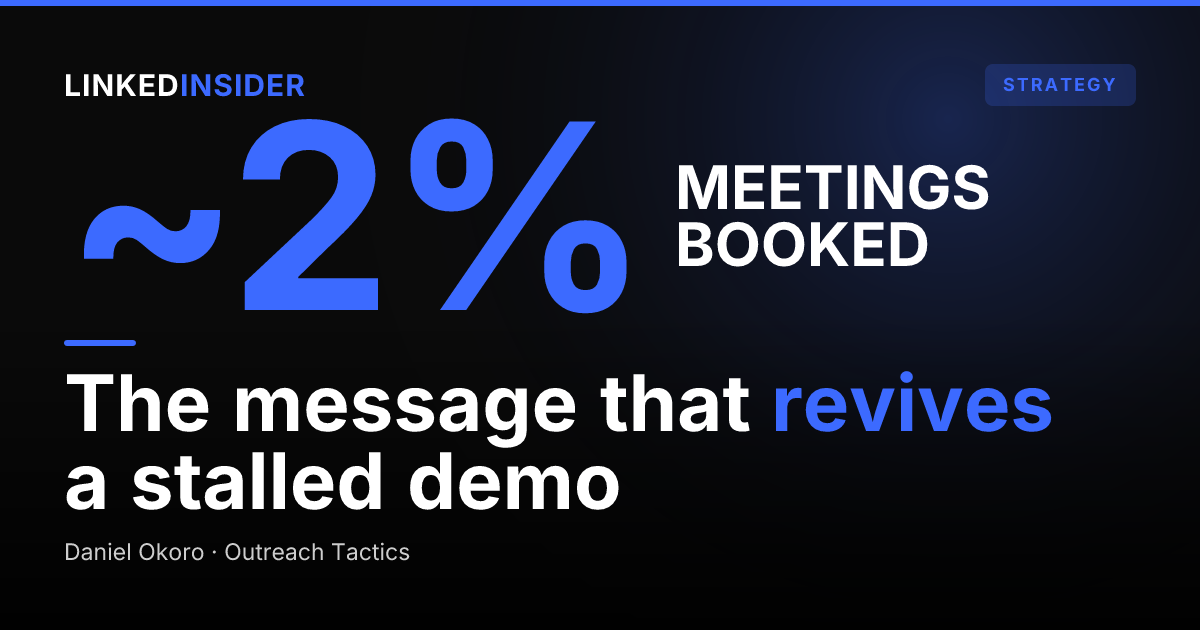
Track three things: the reply rate on the anchored-and-ask message versus the "just checking in" message it replaced, the count of distinct committee members who have engaged on each open deal, and the number of demos that get re-booked into a real next call. Reachium's data gives the context for why this matters. Across 180,155 matured connection requests, only 1.99% of accepted connections book a meeting, so a demo is one of the rarest and most valuable points in the funnel. Letting a booked demo decay because the follow-up was weak or the thread got lost wastes the scarcest thing in your pipeline. The 2026 LinkedIn outreach benchmarks detail how reply rates move step by step through a sequence. [SYNTHESIS]
FAQ
Why do prospects ghost after a demo?
The deal usually stalls inside a buying committee your champion has to sell internally, not with the champion who watched the demo. The demo high fades within days, and a generic "checking in" message gives the buyer nothing to react to, so silence follows.
How do you write a follow-up that gets a reply?
Anchor the message to the exact moment the buyer reacted during the demo, restate the outcome in their own words, and propose one specific dated next step instead of asking for "thoughts." Each part removes work the buyer would otherwise have to do.
How do you multithread without going around your champion?
Cite your champion in the connection request to the other stakeholder ("[Champion] mentioned you would want a view into this") and offer the same one-pager your champion has. That frames the touch as support for the internal sell, not an end run.
How long should you wait to follow up after a demo?
Send the first anchored follow-up two to three business days after the demo, then space later touches three to five days apart and alternate channels. Send a clean breakup message around day fourteen if the thread has gone fully silent.
Should the post-demo follow-up go on LinkedIn or email?
Use both and alternate them. The same message on LinkedIn after an email reads as a new surface rather than a repeated nag, which is why keeping LinkedIn and email replies in one view matters for staying organized.