Product-Led SaaS Still Needs Outbound: The LinkedIn Layer for PLG Founders
By Marcus Webb, Tools & Automation. Last updated: 2026-05-30
- You shipped self-serve, signups climbed, and then revenue went flat.
- Your best free users are not the people who sign the contract.
- You think outbound is the opposite of PLG, so you never built it.
- An SDR costs more than the assist motion is worth at your stage.
Why do PLG SaaS companies stall at free-to-paid?
PLG companies stall because the product attracts users, not buyers. Self-serve is excellent at acquisition and activation, and it quietly assumes the person who clicked "sign up" also controls the budget. In most B2B accounts that assumption is wrong. The free user is an analyst, an engineer, or an individual contributor who loves the tool but cannot approve a seat expansion or a team plan.
OpenView's product-led growth research has long flagged the same pattern: free-to-paid conversion for most self-serve products sits in the low single digits, and the gap is rarely about the product missing a feature. It is about no one ever asking the account to buy. The signal exists, the product-qualified lead is sitting in your dashboard, and the motion to act on it does not. That silent gap between a PQL and a paid account is where revenue leaks, and a pricing experiment will not patch it.
What is a sales-assist motion, and why does it beat pure self-serve?
A sales-assist motion is a light human nudge layered on top of self-serve, aimed only at users already showing high intent. It is not a full sales team running a quota. It is a founder or a single rep reaching out to accounts that have hit an activation milestone (invited teammates, hit a usage limit, started a trial of a paid tier) and saying something useful at the moment the account is deciding.
Pure self-serve works for the bottom of the market. The moment a deal involves more than one seat, a procurement step, or a manager who never logged in, "the product sells itself" becomes half true. The product earns the trial. A human earns the contract. The assist motion exists to expand from the one user who signed up into the buying committee around them, and to do it before the trial cools off. For more on how this complements your inbound, see Linked Insider: LinkedIn inbound vs outbound.
Want to put this into practice?
Reachium automates LinkedIn outreach, content publishing, and inbox management in one platform.
Start Free →Where does LinkedIn outbound fit the PLG SaaS assist layer?
LinkedIn fits because it is the only channel that reliably reaches the signup's boss and peers, not just the signup. A self-serve user gives you a name and a company. LinkedIn turns that into the org chart: the VP who owns the budget, the two peers who would also use the tool, the head of the function who signs off on the annual plan.
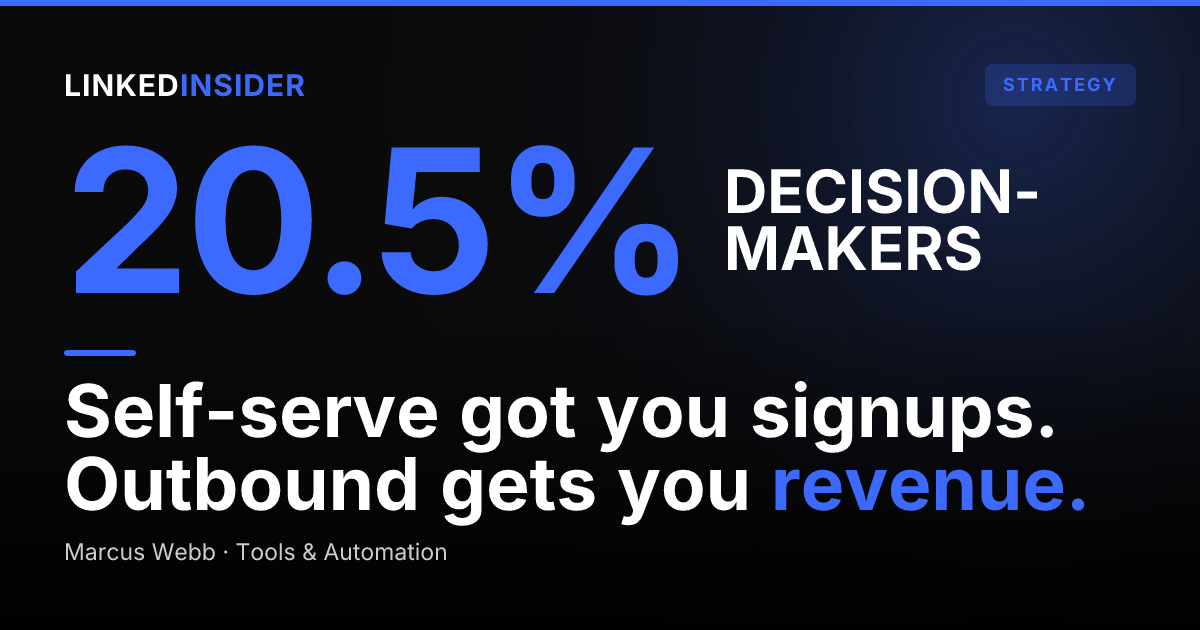
The decision-maker density is the reason. Across Reachium's dataset of a multi-million-lead B2B universe, a large share flagged as decision-makers, per its flagship benchmark study. For a PLG company, that means the people who can convert a free workspace into a paid team are findable and reachable on the same platform where your user already works. You also walk in warm: product usage gives you a real reason to reach out, which is the difference between a cold pitch and a relevant nudge. The same warm-context principle drives founder-led plays elsewhere, like a Series A funding LinkedIn script or a podcast guest pitch on LinkedIn. [SYNTHESIS]
Can a founder run this without hiring an SDR?
Yes, and at early stage the founder should. A fully loaded SDR in B2B SaaS runs roughly $5,000 to $8,000 a month once you count base, ramp, tooling, and management overhead, and our review of public compensation reports from sources like RepVue and The Bridge Group supports that range. That is a real line item to validate a motion you are not yet sure works.
The assist job does not need a headcount. It needs a few dozen well-aimed touches a day to accounts already raising their hand, which is 30 to 45 minutes of a founder's time if the targeting and sending are handled by software. The founder writes the angle once, the system runs the sequence, and the founder steps in only for the replies that turn into calls. That is the cost gap: a $99-per-month tool versus a $60,000-plus-per-year hire for a motion that, early on, is measured in dozens of conversations a week. For the broader build-vs-buy math, compare it against a done-for-you LinkedIn motion for SaaS and the common founder outreach mistakes that waste the time you do spend.
What makes the outreach safe enough to scale?
Safety comes from how the outreach connects to LinkedIn, not from how careful you are with volume. A founder running an assist motion cannot afford to lose the account that carries the company's name, and most outreach tools put exactly that account at risk because they drive a logged-in browser session (a Chrome extension or headless automation) that LinkedIn can detect and restrict. The publicly reported HeyReach enforcement action in March 2026 is the cautionary case: browser-automation approaches get caught.
The verified LinkedIn API, accessed through a sanctioned partner like Unipile, is the safer architecture because it is an approved integration rather than a simulated human. The other half is restraint. Reachium's data surfaced a "volume tax": acceptance peaked at 32.01% for accounts sending 10-19 invites a day and fell to 26.65% at 20-29 a day, so more requests bought fewer accepts. The takeaway for a founder is that the assist motion wants 25 or so high-intent invites a day, which is well inside both safe limits and what one person can follow up on. If you do bump the ceiling, read what to do at the LinkedIn connection limit. [SYNTHESIS]
Want to put this into practice?
Reachium automates LinkedIn outreach, content publishing, and inbox management in one platform.
Start Free →How do you know the assist layer is working?
You watch leading indicators before revenue, because revenue lags the motion by a full sales cycle. The early signals are acceptance rate, reply rate of accepted connections, and booked calls. Reachium's benchmark across 180,155 matured connection requests shows a 27.11% average connection acceptance rate, with roughly 27.55% of accepted connections replying and 1.99% of accepted connections booking a meeting. Those are the numbers to expect and to measure your own motion against. [SYNTHESIS]
The lagging signal is the one that justifies the layer: paid conversions tied back to a touch. Tag the accounts you reached in your CRM, then watch how many of those self-serve signups convert to paid versus the ones you never touched. If the touched cohort converts at a materially higher rate, the assist layer is the cheapest revenue lever you have. To get the cadence right, see the best time to send LinkedIn messages.
FAQ
Why do PLG SaaS companies stall at free-to-paid conversion?
Because the product attracts users who love the tool but do not control the budget. The product-qualified lead exists in the dashboard, but with no motion to expand from that user into the buyer, the account stays free.
What is a sales-assist motion, and who runs it?
It is a light human nudge layered on self-serve, aimed only at high-intent accounts. At early stage the founder runs it directly, spending 30 to 45 minutes a day on the touches that software cannot, like replies and calls.
Is LinkedIn outreach worth it for a self-serve product?
Yes, because LinkedIn is the channel that reaches the signup's boss and peers, not just the signup. Product usage gives you warm context, so the outreach is relevant rather than cold.
Can a founder run outbound without hiring an SDR?
Yes. A fully loaded SDR runs roughly $5,000 to $8,000 a month, while a verified-API tool runs the targeting and sending for about $99 a month, leaving the founder to handle only the high-value replies.