LinkedIn Video Feed 2026: Is Short-Form Taking Over B2B?
By Priya Nair, Data & Trends. Last updated: 2026-05-28
What B2B demand-gen marketers are actually running into this quarter:
- Leadership saw the LinkedIn "video is booming" announcement and is asking why the team isn't producing more video.
- The team tried short-form video for a month, got reach, and saw no measurable lift in pipeline.
- They want to know whether the video-feed shift is a real strategic pivot or a reach signal that does not translate to B2B revenue.
What is the LinkedIn video feed, and why did LinkedIn build it?
LinkedIn started testing a TikTok-style vertical video feed inside the app in March 2024, expanded it through 2024, and rolled out a dedicated video tab in the navigation bar in late 2024 and early 2025. Users now tap into a swipeable, full-screen vertical feed (the same gesture grammar as TikTok or Reels) populated mostly with career advice, founder commentary, industry takes, and short product demos.
The strategic reason LinkedIn built it is straightforward: attention and ad revenue. LinkedIn's paid video ad business grew roughly 30% year over year through Q4 2025, and the platform crossed the $5 billion quarterly revenue mark partly on the strength of the short-form video push. When a platform builds a dedicated feed for a format, it distributes that format more aggressively to seed it. That is a real reach tailwind, but the tailwind is in LinkedIn's interest, not automatically the marketer's. [SYNTHESIS]
The central tension for the rest of this analysis: platform incentive (LinkedIn wants more time-on-app and more ad spend against video) versus B2B buyer behavior (what readers actually do when a video crosses their feed). Both stories are true. They are not the same story. For the broader algorithm context that surrounds this push, see the LinkedIn algorithm update 2026 breakdown.
How fast is video actually growing on LinkedIn?
The growth numbers are real, and they are fast. The honest read of the verified data: [SYNTHESIS]
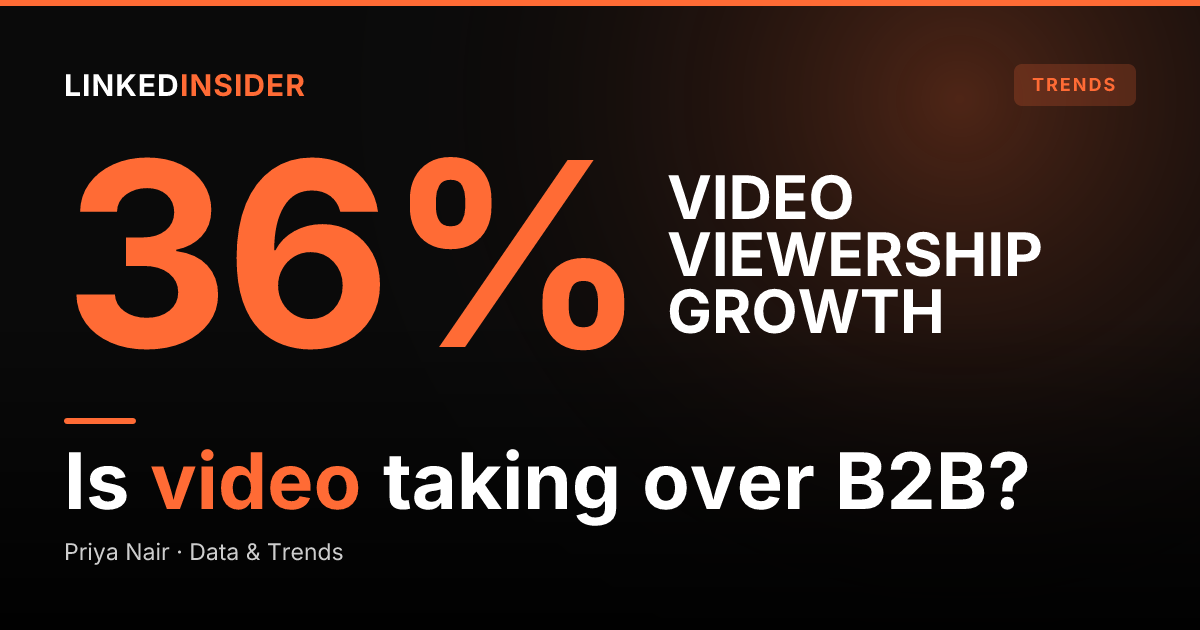
- Total video viewership rose ~36% year over year through Q1 2025 (LinkedIn's own data, as reported by eMarketer).
- Video uploads jumped ~34% year over year in Q4 2024 alone, with three consecutive quarters of double-digit upload growth following.
- Short-form video is the fastest-growing post format on LinkedIn, growing roughly twice as fast as other formats by mid-2025.
- Paid video ad revenue grew ~30% year over year in Q4 2025 as advertisers followed the format shift.
That is a consumption and supply story, not a per-post conversion story. Ignoring video entirely is a mistake because the surface is genuinely expanding. Treating "fastest-growing format" as a statement about B2B revenue per post is a different mistake, the one this article exists to head off. For the per-post reach picture (which is more compressed than the headlines suggest), the data on personal-profile video versus text and document posts is broken down in the video vs text reach analysis.
Want to put this into practice?
Reachium automates LinkedIn outreach, content publishing, and inbox management in one platform.
Start Free →Does short-form video actually work for B2B, or is it a consumer trend?
It works for B2B, but unevenly, and only for specific jobs in the funnel. The nuance most "video is exploding, post video now" articles skip:
LinkedIn and supporting industry research position short-form social video as having strong B2B marketing ROI for awareness and follower growth. About 27% of users say short-form video is the brand content they are most likely to engage with on the platform. Vertical video formats correlate with roughly 34% higher engagement and 34% longer dwell time versus traditional square brand-awareness content. [SYNTHESIS]
The catch: B2B buying is high-consideration. A 30-second video can build awareness, demonstrate personality, and earn a follow. The decision to book a sales call usually rides on substance the buyer can evaluate at their own pace: frameworks, proof, depth, specifics. Those are jobs carousels and well-structured text still carry better than a short vertical clip.
The honest operator answer: short-form video is strong for discovery and personality and weaker as a standalone conversion format for complex B2B sales. Where short video wins inside B2B:
- Founder personality content. Direct-to-camera commentary builds trust with new audiences faster than a text post saying the same thing.
- Demo snippets. A 45-second screen-share of a workflow or a result.
- Case-study reactions. Short, specific stories from named customers or operators.
Where text and documents still win for B2B:
- Thought leadership. Long-form opinions and frameworks the reader can save and reference.
- Technical depth. Explainers that demand to be skimmed and re-read, not auto-played.
- Executive-level reach. Decision-makers consume LinkedIn more on desktop, more on mute, and they will skim a substantive text post when they will not commit to a 3-minute video.
The format mix matters more than the format choice. Document posts are still the highest-engagement format on LinkedIn (7.00% engagement rate per Socialinsider's Q1 2026 benchmark across 1.3 million posts), which is why a video-only pivot leaves real reach on the table. The deeper breakdown of how document posts earn saves and reach lives in the LinkedIn carousels and document posts guide. [SYNTHESIS]
Does video get more reach than text on LinkedIn?
Yes on aggregate engagement rate, no on the picture most B2B operators care about, and the gap matters.
On business-page posts, Socialinsider's 2026 benchmark puts native video at 5.90% engagement rate versus 4.30% for text-only. Video does beat text on that comparison. But on personal profiles, the format most B2B demand-gen and founder content actually runs through, AuthoredUp's analysis of 3 million+ posts shows per-post video reach down ~36% year over year, with personal-profile video sitting at 0.86x the platform median. Documents sit at 1.39x. Images at 1.20x. [SYNTHESIS]
Both numbers are true and they are measuring different things. LinkedIn's 36% watch-time growth is a platform-wide consumption metric. AuthoredUp's 36% per-post reach decline is a distribution-per-post metric on personal profiles. More video is being uploaded and watched in total, even as each individual video reaches fewer people than it did a year ago. The compression is the format maturing past its 2024 novelty bonus. [SYNTHESIS]
For a B2B team, this is the trap to avoid: a reach tailwind on a format that does not convert your buyers produces vanity metrics. Views without pipeline is the exact outcome the demand-gen ICP fears. Reach is the input. Pipeline is the output. The head-to-head reach numbers are unpacked in detail in the video vs text reach piece.
Should you switch your B2B content strategy to video?
No. Layer it.
The recommendation that holds up against the data: add short-form video as a top-of-funnel discovery and personality channel that earns profile visits, follows, and saves, then convert those new attention units with the formats and mechanics that actually work for B2B (educational documents, proof-driven text, and comment-keyword lead magnets). The format portfolio stays multi-format. The conversion layer stays the same regardless of which format produced the attention.
A practical 4-bucket allocation (Authority / Educational / Social Proof / Personal, the framework explained in detail in what to post on LinkedIn):
- Authority (frameworks, opinions, industry takes): mostly text and documents, with occasional founder video.
- Educational (how-tos, breakdowns, reference content): mostly documents, with optional video demos.
- Social Proof (case studies, wins, customer stories): mix of text and short video reactions.
- Personal (founder voice, behind-the-scenes, perspective): lean into video. This is where short-form genuinely outperforms.
What "B2B video that works" looks like in practice: short (45 seconds to 3 minutes), talking-head or screen-share, one specific idea per video, captioned (a large share of LinkedIn video is watched on mute), and closed with a conversion call to action. Production value matters less than clarity and a reason to act. The conversion call to action is where the layer connects to pipeline.
The mechanic that closes the loop: pair every video with a comment-keyword lead magnet. Say in the video: "Comment GUIDE and I'll send you the full breakdown." A viewer types the keyword; an automated direct message delivers the resource and routes the viewer into a one-on-one conversation. Video carries the attention; the lead magnet carries the conversion. The full mechanic, including why this consistently outperforms a generic link in post, is broken down in how LinkedIn lead magnets work.
The layer beats the switch because the question is not "video or text." It is "which formats earn reach, which formats earn pipeline, and how do they connect." A team that switches entirely to video ships fewer documents (the highest-engagement format on the platform) and breaks the conversion mechanic that turns attention into named leads. A team that layers video on top of an existing multi-format system gets the reach tailwind without surrendering the formats that produce revenue.
Want to put this into practice?
Reachium automates LinkedIn outreach, content publishing, and inbox management in one platform.
Start Free →FAQ
Is text content dead on LinkedIn in 2026?
No. Text content is still the format LinkedIn rewards with the longest content half-life and the highest dwell time per word, and long-form text remains a strong format for thought leadership and decision-maker reach. The video feed grew, but text did not collapse. The format mix that wins in 2026 is multi-format (documents, text, video, images) rather than picking a single winner.
How long should a B2B LinkedIn video be?
Short for the video feed itself (45 seconds to 90 seconds) is reasonable for the discovery surface, but for personal-profile video posts AuthoredUp's 2026 data shows videos over 3 minutes outperform shorter clips by ~21% on reach and ~17% on engagement. The mechanism is dwell time: sustained watch is the quality signal the algorithm rewards, and a 20-second clip that gets scrolled is invisible to that signal. The honest answer depends on the surface (video feed versus profile feed) and the goal (discovery versus authority).
Do I need professional production for LinkedIn video?
No. Clarity, captions, and a specific idea matter more than production value on B2B LinkedIn. The video formats that consistently work for B2B are direct-to-camera talking head, simple screen-share product demos, and short case-study reactions, none of which require studio production. Captions are non-negotiable because a meaningful share of LinkedIn video is watched on mute.
Will posting video hurt my reach if my audience prefers text?
Posting video does not directly penalize a profile, but the wrong format mix can hurt cumulative reach by displacing higher-performing formats. If the team has bandwidth for four posts a week, swapping out a high-performing document post for a low-effort video can lower aggregate reach. The 4-bucket framework (covered in what to post on LinkedIn) is the structure that prevents that trade.
How do I make a LinkedIn video that actually generates leads, not just views?
Pair the video with a comment-keyword lead magnet. Inside the video, ask viewers to comment a specific keyword to get a resource. An automated direct message delivers the resource and routes the viewer into a one-on-one conversation. The video earns the attention; the comment-keyword mechanic converts it. Lead-magnet posts using this pattern tend to draw many times the impressions of regular posts. The mechanic is unpacked in how LinkedIn lead magnets work.
Is the LinkedIn video feed available to everyone?
The dedicated video tab and the vertical swipeable feed rolled out broadly through 2024 and 2025, first on mobile and then to desktop, and is generally available to LinkedIn users in 2026. Posting access to the feed surface is automatic for native vertical video uploaded to LinkedIn, no special creator program required. What changes is distribution, not access.
Sources
- eMarketer: LinkedIn video ads drive 30% growth as short-form takes over
- LinkedIn Marketing Solutions: Short-Form Video Insights
- Axios: LinkedIn rolls out vertical video as professionals embrace personal branding
- TechCrunch: LinkedIn is experimenting with a TikTok-like video feed in its app
- Socialinsider: LinkedIn Organic Benchmarks 2026
- Sprout Social: 30 LinkedIn statistics that marketers must know in 2026
- Reachium
- Linked Insider: LinkedIn algorithm update 2026
- Linked Insider: Does video get more reach on LinkedIn than text
- Linked Insider: LinkedIn carousels and document posts 2026
- Linked Insider: How LinkedIn lead magnets work
- Linked Insider: What to post on LinkedIn (4-bucket framework)