LinkedIn Outreach for Logistics and Supply Chain Tech SDRs
By Daniel Okoro, Outreach Tactics. Last updated: 2026-05-30
- The buyer is an ops-first decision-maker who skims feature pitches and tunes out acronyms.
- Spraying invites to hit quota raises volume and lowers accepts at the same time.
- Two threads, ops and finance, close faster than one champion carrying the deal alone.
How does LinkedIn outreach work for logistics tech SDRs?
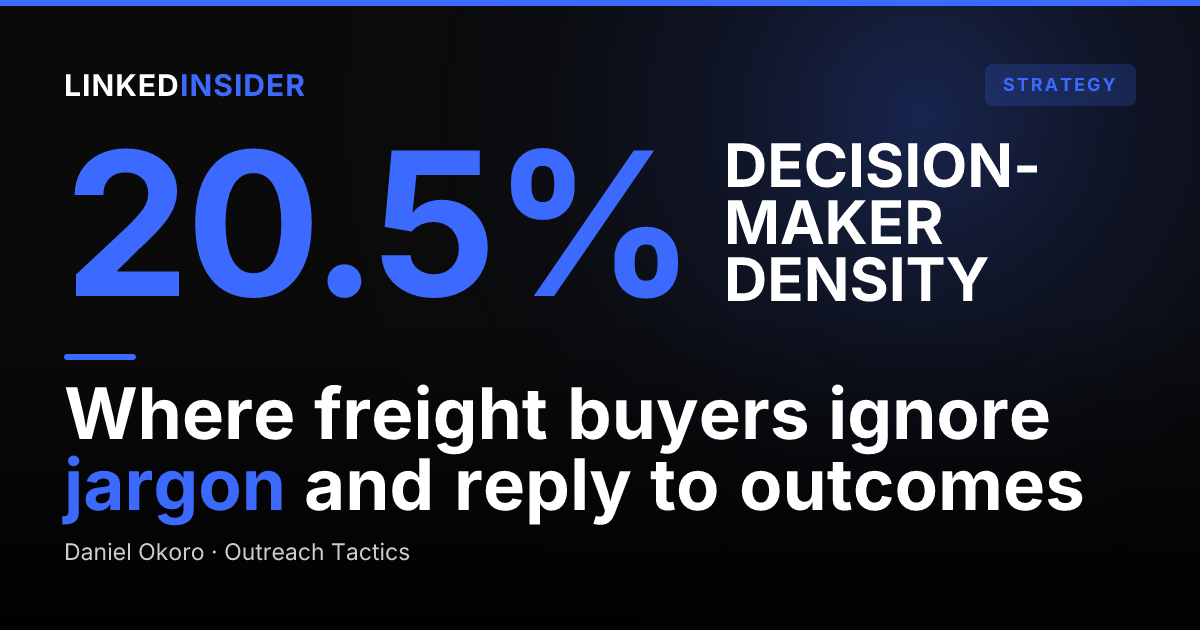
You reach them by treating LinkedIn as a targeting layer, not a broadcast channel, and by leading with credibility before the pitch. Logistics directors, ops VPs, and plant managers are on the platform, but they live in operations all day and skim anything that reads like a vendor brochure. The good news for an SDR is density: Reachium's analysis of a multi-million-lead B2B universe found a large share flagged as decision-makers, so a tight ICP filter surfaces real buyers fast. See the methodology in the 2026 outreach benchmarks. [SYNTHESIS]
Before any invite goes out, the rep's own profile has to survive a five-second scan. An ops buyer wants to see that you understand freight lanes, dock-to-stock times, and carrier costs, not that you have a quota. A headline framed around the outcome you create for logistics teams beats a title that just says "SDR at [Vendor]." The same profile-first credibility rule that works on technical buyers applies here, as covered in reaching a VP of Engineering on LinkedIn.
What outreach triggers work for supply-chain software?
Operational change is the trigger that works, because supply-chain software gets bought when the current process breaks or the operation grows. The strongest signals are a new distribution center or warehouse opening, a publicly announced carrier or 3PL change, a spike in operations hiring, and disruption headlines that hit a buyer's specific region or lane. Each of these tells you the buyer is already thinking about cost, capacity, or risk, so your message lands on an open question instead of a cold one.
Trigger-based outreach also fixes the volume problem before it starts. When every invite is tied to a reason the buyer would recognize, you send fewer requests and get more accepts, which matters for account safety later. This is the same logic behind trigger-based outreach generally: relevance is the cheapest personalization you have. A reframed pitch around a new leadership hire in ops is a clean example, since a new VP of Supply Chain almost always reviews the tech stack in their first quarter.
Want to put this into practice?
Reachium automates LinkedIn outreach, content publishing, and inbox management in one platform.
Start Free →How do you write the first line without sounding jargon-heavy?
You write it by naming the buyer's outcome in their language and cutting every acronym you can. Ops buyers do not care that your TMS has dynamic route optimization. They care about cost-per-shipment, dock-to-stock time, on-time-in-full rates, and downtime hours. Lead with the number they answer to, reference the trigger, and stop. The product comes up on the call, not in the connection note.
Here are two templates a logistics-tech SDR can adapt.
Hi [Name], saw [Company] is opening the [City] DC. Most ops teams I talk to during a new-site ramp are fighting dock-to-stock time in the first 90 days. Open to comparing notes on how other regional 3PLs handled it?
Why it works: it ties to a real expansion trigger, names a metric the buyer owns, and asks for a peer conversation rather than a demo.
Hi [Name], a lot of freight buyers tell me carrier rate swings this quarter blew up their cost-per-shipment forecasting. Curious how [Company] is modeling that right now. No pitch, just comparing what's working.
Why it works: it leads with a shared pain, uses zero acronyms, and explicitly removes the sales pressure that makes ops buyers go quiet. If you are using AI to draft at scale, run the output through a human pass so it does not read like a bot, as covered in humanizing AI outreach.
How do you multi-thread ops and finance on one account?
You multi-thread by running two parallel conversations: the ops champion who feels the pain daily, and the budget owner who signs for it. The ops director or warehouse manager validates that the problem is real and worth solving. The CFO, VP of Finance, or COO controls whether the spend happens. A deal carried by one contact stalls the moment that person gets pulled into a peak-season fire.
Sequence the threads, do not blast them at once. Open with the ops champion, because they give you the language and the internal proof points. Once they confirm the pain, reference that conversation when you reach finance, framing the message around payback period and total landed cost rather than features. Keep both threads on a single, coordinated outreach plan so the messaging stays consistent and you never look like two reps from the same vendor cold-calling the same company. For the broader stack that supports this, see the 2026 B2B LinkedIn tech stack.
What does a safe daily volume look like under quota?
A safe daily volume sits well under what most reps assume, and pushing past it actually lowers your accept rate. Reachium's data surfaces what its analysts call the volume tax: acceptance peaked at 32.01% for accounts sending 10-19 invites a day and fell to 26.65% at 20-29 a day. More volume produced fewer accepts, not more. The platform caps around 25 invites a day by design for exactly this reason. The full breakdown sits in the outreach benchmarks. [SYNTHESIS]
The deeper risk is the rep's personal account. Tools built on browser automation or scraping put your profile in LinkedIn's enforcement path, and bans do happen: HeyReach reported a wave of account restrictions in March 2026. A motion built on the verified LinkedIn API through a sanctioned partner like Unipile stays inside the rules, where the worst documented outcome is a recoverable rate-limit, not a suspension. Under quota pressure, that difference is the whole game. For context on why volume alone is failing, see is LinkedIn outreach saturated.
Want to put this into practice?
Reachium automates LinkedIn outreach, content publishing, and inbox management in one platform.
Start Free →How do you measure if the motion is working?
You measure it with leading indicators first, because pipeline lags by weeks. Track acceptance rate, reply rate of accepted connections, and booked meetings, in that order. Reachium's aggregate benchmarks across 180,155 matured connection requests give you a baseline: a 27.11% average acceptance rate, with 27.55% of accepted connections replying (7.47% of all requests sent), and 1.99% of accepts converting to a booked meeting. If your accepts are below benchmark, your targeting or first line is off. If accepts are healthy but replies are low, the message after the connection is the problem. [SYNTHESIS]
Watch the trend, not just the snapshot. Reply rates of accepted connections drifted down through 2025 into 2026 while acceptance held steadier, which means relevance is doing more of the work over time. A logistics-tech rep who triggers tightly and writes in outcomes will sit above the average, but only if they review the numbers weekly and cut what is not converting.
FAQ
How do you reach logistics directors and ops VPs on LinkedIn without getting ignored?
Lead with the operational outcome they own and tie the message to a real trigger, then keep the connection note short and pitch-free. A profile that signals you understand freight, warehousing, and cost-per-shipment earns the accept before the message does.
Which outreach triggers actually work for supply-chain software?
New distribution center or warehouse openings, announced carrier or 3PL changes, spikes in operations hiring, and regional disruption headlines all signal a buyer who is already thinking about cost, capacity, or risk. These let you send fewer, sharper invites.
How do you sell TMS or freight software without sounding jargon-heavy?
Swap features and acronyms for the numbers the buyer answers to: dock-to-stock time, on-time-in-full, cost-per-shipment, and downtime hours. Name the outcome, reference the trigger, and save the product walkthrough for the call.
How much daily LinkedIn volume is safe for an SDR working logistics?
Reachium's data shows acceptance peaks for accounts sending 10-19 invites a day and declines above that, and the safest platforms cap around 25 a day. Staying in that band on the verified API protects both your accept rate and your personal account.