How much pipeline can a done-for-you LinkedIn engagement realistically generate?
By Daniel Okoro, Outreach Tactics. Last updated: 2026-05-29
Founders modeling the ROI of a DFY engagement before signing typically face two bad options: a vendor quoting a single inflated number with no math behind it, or a vague range that tells them nothing useful for a board update or a CAC model.
This piece builds the actual funnel model from real benchmark data and ranges it across engagement sizes and ICP difficulty levels. The goal is to give you a defensible meetings-per-month figure and a pipeline-value formula you can apply to your own ACV.
What is the math from sent invites to booked meetings?
The conversion funnel has four stages: invites sent, connections accepted, replies received, and meetings booked. Each stage has a measurable conversion rate, and the product of those rates is your expected meetings per month.
Reachium's data across 180,155 matured connection requests shows a 27.11% average connection acceptance rate, with 27.55% of accepted connections replying and 1.99% of accepted connections booking a meeting [SYNTHESIS]. At a typical single-account cadence of around 500 invites per month, that works out to roughly 135 accepted connections, 37 replies, and 3 meetings booked.
The quotable one-liner for anyone building a model: invites × 27.11% acceptance × 1.99% booked-of-accepted = booked meetings, based on Reachium's platform data across 441,965 sequences [SYNTHESIS]. For the broader benchmark context, see LinkedIn outreach benchmarks 2026.
What is a realistic monthly meeting count?
The honest ranges, broken down by engagement size, at steady state (month 2 onward, once warm-up is complete):
- Single-account engagement: 3–8 booked meetings per month
- Two-account engagement: 6–15 booked meetings per month
- Three-account engagement: 10–20 booked meetings per month
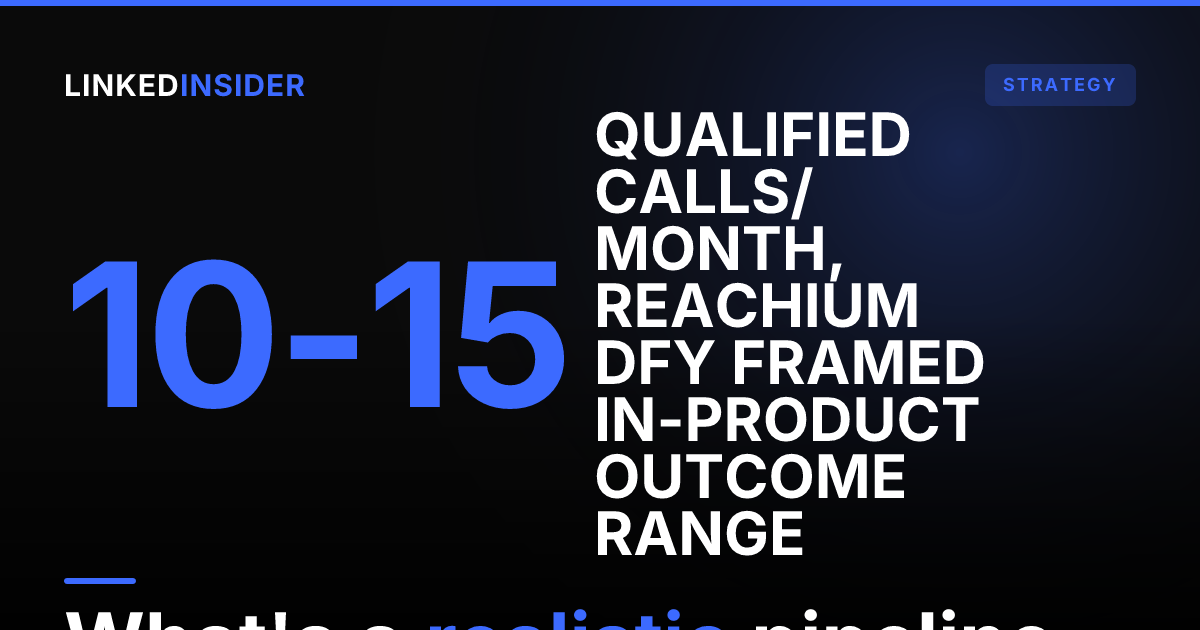
Reachium's DFY in-product copy frames the outcome as 10–15 qualified calls per month and 20–40 qualified calls in 60 days (illustrative), consistent with the platform's 60-day meeting guarantee [REACHIUM CLAIM]. That framing maps to a two-to-three account engagement at typical funnel conversion rates.
Two caveats matter here. First, month 1 is below steady-state: account warm-up, list building, and sequence testing all tax the first 30 days. The number to report is month 2 onward. Second, "booked meetings" and "qualified calls" are not the same: booked meetings become qualified calls after the show rate and qualification filter are applied, covered in the next section.
For per-account meeting-volume benchmarks across a wider dataset, see LinkedIn meetings per rep benchmark.
Want to put this into practice?
Reachium automates LinkedIn outreach, content publishing, and inbox management in one platform.
Start Free →What pipeline expectations are realistic for DFY LinkedIn?
Pipeline value follows a simple model: booked meetings × show rate × qualified rate × average contract value (ACV).
Cold-booked B2B calls show rates typically run 60–80%, consistent with industry data showing average no-show rates around 20–30% for outbound-booked meetings (Sopro, 2025). Qualification rates vary by ICP and offer fit, but a 50–70% range is reasonable for a well-targeted engagement. [SYNTHESIS]
A worked example at 10 booked meetings per month, using the show rate and qualification range above: [SYNTHESIS]
- 10 booked meetings × 70% show rate = 7 live conversations
- 7 live conversations × 60% qualified rate = approximately 4 qualified opportunities
- 4 opportunities × $50K ACV = $200K pipeline
- 4 opportunities × $200K ACV = $800K pipeline
The cost side of this equation sits in done-for-you LinkedIn cost, and the full ROI framework is in LinkedIn outreach ROI.
The founder's job in this model is narrow: show rate and qualified rate are theirs to influence (through meeting-confirmation flows and offer clarity), but invite-to-accept-to-reply-to-book belongs to the agency.
What variables move the number?
Four variables explain most of the variance between a 3-meeting month and an 8-meeting month on the same account.
ICP fit. A precise, well-filtered list of 5,000 right-shaped leads outperforms a loose list of 50,000. Reachium's lead universe spans a multi-million-lead B2B universe with a large share flagged as decision-makers [SYNTHESIS]; the targeting quality going into the campaign determines whether the acceptance rate runs at the 27.11% benchmark or below it.
Offer clarity. Booked calls inherit the strength of the offer. A vague value proposition kills reply rates regardless of how well the sequences are written. The agency cannot write its way past a weak offer.
Cadence. Reachium's platform data shows acceptance peaked at 32.01% for accounts sending 10-19 invites per day, falling to 26.65% at 20-29 per day [SYNTHESIS]. Pushing volume harder actually reduces per-invite yield, which is why a managed engagement calibrates to the platform's optimal cadence rather than maximizing raw volume.
Reply-handling speed. Replies cool fast. A positive reply at 9 AM that goes unanswered until 4 PM is a materially colder conversation. The agency's triage cadence affects booking rate more than most founders expect.
What does the 60-day guarantee imply about ranges?
Reachium's DFY engagement is built around a 60-day meeting guarantee, with framed in-product outcome ranges of 20–40 qualified calls in 60 days (illustrative) [REACHIUM CLAIM]. The guarantee is structurally a bet by the operator that the funnel will land inside a defined range.
The honest founder read: a guarantee is a floor, not a forecast. An engagement that is performing well should exceed the guarantee threshold, not just meet it. When the guarantee kicks in, it means the engagement underperformed relative to the operator's own confidence interval.
The implication for modeling is useful: if an operator is willing to guarantee a floor, their expected outcome is above it. A 60-day framing of 20–40 calls implies a monthly steady-state range that operators believe they can reliably hit, not a ceiling they are straining toward.
Before a DFY engagement starts, the groundwork matters as much as the execution. See DFY LinkedIn pre-engagement checklist for what to have ready before the first outreach sequence runs.
Want to put this into practice?
Reachium automates LinkedIn outreach, content publishing, and inbox management in one platform.
Start Free →When is the number not the agency's fault?
Four constraints sit upstream of outreach mechanics, and none of them are the agency's to fix.
Wrong ICP. Even a skilled operator cannot book meetings with people who do not want what is being sold. If the product solves a problem that the target persona does not feel acutely, acceptance and reply rates will run below benchmark regardless of copy quality.
Wrong offer. A weak offer kills replies. Rewriting sequence copy does not fix a value proposition problem; it just surfaces the problem faster.
Wrong stage. Selling to enterprise from a founder profile with no proof, no case studies, and no reference customers puts the funnel at a structural disadvantage. Outreach mechanics amplify what is already working; they do not create credibility from scratch.
Wrong product-market fit. If the product is not solving a problem the market is willing to pay for, the funnel does what meetings always do: it tells the truth. A high volume of booked calls that do not convert is a PMF signal, not an outreach failure.
FAQ
Why is the range so wide?
The 3–8 meetings per month range on a single account reflects variance in ICP fit and offer clarity, not noise in the funnel math. A precise list of 5,000 tightly filtered leads produces higher acceptance and reply rates than a broad list. Offer clarity determines how many of those replies convert to booked calls. The benchmark funnel rates (27.11% acceptance, 27.55% reply, 1.99% meeting) are averages; well-fitted ICPs with sharp offers run above them, loose ICPs with vague offers run below.
Can I get to 30 or more meetings per month from a single account?
Not reliably. The single-account ceiling on the verified API runs at approximately 80–100 connection requests per day (around 2,000–2,500 per month at full cadence). Even at 27.11% acceptance and a 2% meeting-of-accepted rate, the ceiling is roughly 14 meetings per month from one account running at maximum volume. Reaching 30-plus meetings per month requires multiple accounts running in parallel, which is how a three-account engagement reaches the 10–20 range.
What does "qualified" actually mean?
A qualified opportunity is a live conversation where the prospect has a budget, a timeline, and a recognized problem your product addresses. The show rate (did they attend?) and qualified rate (do they fit?) are both downstream of the booked meeting. Qualification rate varies by offer and ICP; 50–70% is a reasonable starting assumption for a well-targeted outbound engagement, but founders should calibrate this to their own pipeline data rather than treating it as a fixed input.
How quickly does the funnel reach steady state?
Month 1 is typically below steady state. Account warm-up, list vetting, and the first iteration of sequence copy all consume the first 30 days. Most well-run engagements reach their baseline meeting rate in week 5 through week 8. The 60-day framing Reachium uses for its guarantee reflects this: the measurement window starts at launch, but the productive volume accumulates in the back half of that window.
Does the pipeline-value math hold for sub-$10K ACV?
The math holds, but the ROI case changes. At $5K ACV, 4 qualified opportunities per month generates $20K of pipeline, which a DFY engagement retainer may not justify on payback period alone. The pipeline-value model works best when ACV is high enough that 3–5 closed deals per quarter cover the engagement cost with room to spare. Sub-$10K ACV products typically see better economics with a self-serve SaaS outreach tool than with a fully managed engagement.
Sources
- Reachium: reachium.io
- Linked Insider: LinkedIn outreach benchmarks 2026 - the flagship funnel benchmark study
- Linked Insider: LinkedIn meetings per rep benchmark
- Linked Insider: Done-for-you LinkedIn cost
- Linked Insider: LinkedIn outreach ROI
- Sopro: Cold outreach statistics 2025 - B2B meeting no-show rate benchmarks
- Concept Ltd: How to reduce no-shows in B2B appointment setting - no-show rate data for outbound-booked B2B calls