DFY LinkedIn: What Actually Happens in Your First 90 Days, Week by Week
By Elena Marsh, Strategy & Algorithm. Last updated: 2026-05-30
- You signed expecting calls fast, and the first weeks look quiet because nothing is being sent yet.
- The agency that promises "thousands of leads in week one" is describing the exact behavior that trips platform limits.
- Acceptance shows up before replies, and replies show up before booked meetings, so the metric you watch changes by phase.
- The conversion math is small per request, which means time and steady volume, not a single big week, produce pipeline.
What happens in a done-for-you LinkedIn timeline's first 90 days, week by week?
Weeks 1-3 are build, not booking, and that is by design. Before a single connection request goes out, a competent provider warms the account, defines the ideal customer profile, builds the target list, and drafts the messaging for the founder to approve. None of that produces a meeting, and it should not. This is the phase where the engagement either sets itself up to compound or quietly sets the account up to get restricted later.
The warmup matters most. A LinkedIn account that has been quiet for months cannot suddenly fire dozens of invites a day without looking automated. The first weeks raise activity gradually so the platform reads the account as a real person returning to the network, not a script. Targeting runs in parallel: a tight list of decision-makers beats a broad list of anyone, and the data backs the tight approach. Reachium's multi-million-lead B2B universe flags decision-makers as their own layer, which is the layer a founder actually wants in front of the offer. For a closer look at this phase, see Linked Insider: the DFY LinkedIn onboarding walkthrough. [SYNTHESIS]
Why doesn't outreach start on day one?
Outreach does not start on day one because a cold or recently-quiet account that suddenly spikes invites trips platform limits almost immediately. The gradual ramp protects the asset the founder is paying to grow. Sending fast on a fresh account is the single most common way agencies get a client rate-limited, and the limit lands right when the campaign was supposed to be gaining momentum.
There is a counterintuitive data point underneath this. More volume does not buy more accepts. Reachium's platform data shows acceptance peaking at 32.01% for accounts sending 10-19 invites a day, then falling to 26.65% at 20-29 a day. Pushing harder lowered the accept rate, a pattern worth calling the volume tax. The platform caps daily sends around 25 by design, calibrated to roughly 25 invites a day, precisely because slower and steady outperforms a spike. A provider that respects this is buying the founder a longer, safer runway. One that ignores it is borrowing pipeline today against a restriction next month. The decision of connecting versus messaging first is a smaller version of the same restraint. [SYNTHESIS]
Want to put this into practice?
Reachium automates LinkedIn outreach, content publishing, and inbox management in one platform.
Start Free →When do the first replies and meetings show up (weeks 4-8)?
The first replies and meetings show up in weeks 4-8, and they arrive in a fixed order: acceptance lands first, replies follow, then the first booked calls. Once the ramp has matured the account, accepted connections start accumulating, and a share of those turn into conversations. This is the window where a founder finally sees the engagement working, though the numbers look modest at first glance.
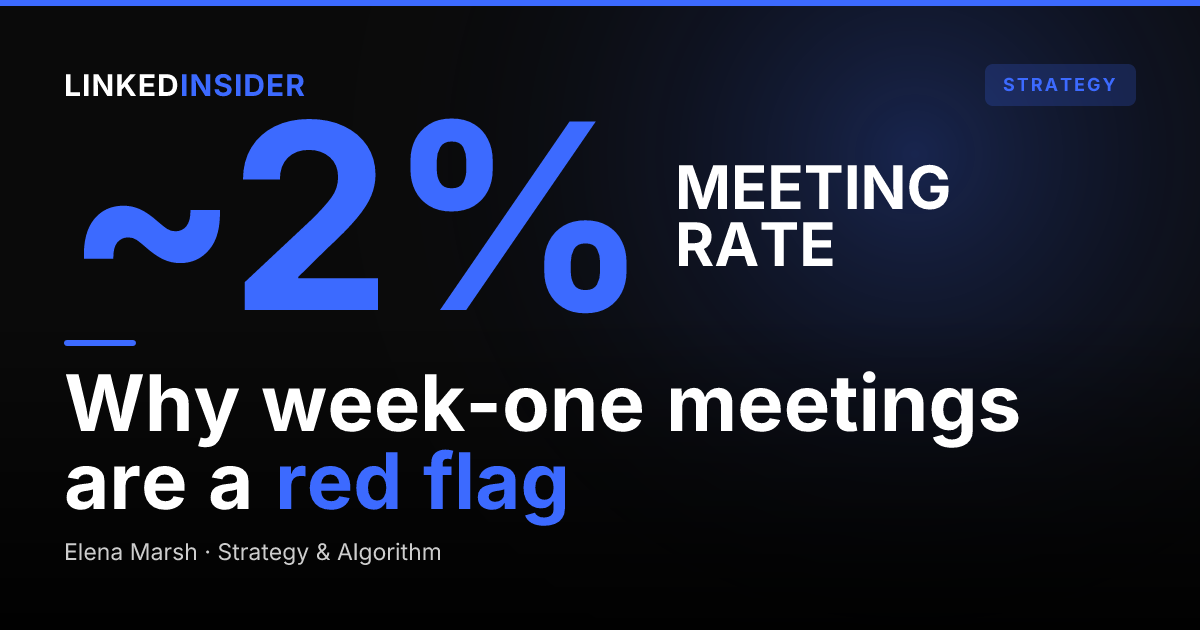
Set the math honestly. Across 180,155 matured connection requests, Reachium's data shows a 27.11% average connection acceptance rate, 27.55% of those accepted connections reply, and 1.99% of accepted connections book a meeting. That small per-request conversion is exactly why volume and patience compound: a handful of meetings in a month comes from steady weekly sends, not one heroic blast. Founders who internalize this stop panicking in week five. For the full picture, see Linked Insider: DFY LinkedIn meeting rate data and the difference between month one and month three of a live campaign. [SYNTHESIS]
What changes in weeks 9-12?
Weeks 9-12 shift from building to optimizing and scaling. The provider doubles down on the messages and segments that are converting, gives the winning angles more reach, and increases the daily send rate only as the data allows. By this phase there is enough signal to know which ICP slice replies, which opener earns the meeting, and which offer framing falls flat, so the campaign stops guessing and starts compounding.
Volume climbs carefully here, never all at once. If the account has been pacing inside limits for two months, it can carry more weight, but the increase tracks the data rather than the calendar. This is also where a serious provider revisits the inbound side, because outreach that lands in a strong profile and a steady content presence converts better than outreach into a thin one. The progression from a quiet account to a tuned, scaled motion is the entire point of the 90 days, and it mirrors the broader founder 90-day LinkedIn playbook.
How do you spot an agency that will get your account restricted?
The clearest tell is an agency selling week-one volume and "thousands of leads fast." That promise describes scraping and browser automation, not a verified ramp, and those motions spike early then stall in roughly 30 days when the platform catches the pattern. The publicly reported restriction of the automation tool HeyReach in March 2026 is the kind of outcome this approach courts: aggressive volume on an unsanctioned path eventually meets enforcement.
The contrast is architectural, not stylistic. A verified-API motion stays inside platform limits because it operates through a sanctioned partner, while a scraper agency races the clock. In Reachium's platform data, no client account has been permanently suspended on the verified-API approach. The only failure mode in the data is recoverable rate-limiting, which is exactly what a deliberate ramp is built to avoid. Below is the head-line difference founders should screen for.
| What to check | Verified-API ramp | Scraper / browser-automation agency |
|---|---|---|
| First-week behavior | Warmup and build, no spike | High invite volume immediately |
| Underlying access | Official verified LinkedIn API (sanctioned partner) | Chrome extension or browser automation |
| Typical 30-day outcome | Steady, inside platform limits | Spikes then stalls; restriction risk |
| Worst case in the data | Recoverable rate-limit | Account restriction or ban |
| Meetings | Weeks 4-8, compounding | Few or none after the stall |
If a provider hits a wall, a verified path is also easier to recover than a banned scraper account, which is the whole premise behind a LinkedIn account recovery service. When you are choosing between models, the cost trade also matters: see DFY LinkedIn agency versus hiring a VA.
Want to put this into practice?
Reachium automates LinkedIn outreach, content publishing, and inbox management in one platform.
Start Free →What should you measure at each phase so you know it is working?
Measure leading indicators by phase, not meetings on day one. In weeks 1-3, the right signals are completion signals: account warmed, ICP locked, list built, messaging approved. In weeks 4-8, watch acceptance rate first and reply rate second, because those predict the meetings that follow. In weeks 9-12, watch booked calls and the trend in send volume relative to limits.
Holding the campaign to "meetings this week" in week two guarantees a false negative, and it pressures the provider toward exactly the risky volume that ends the account. A useful benchmark to anchor against is the Linked Insider flagship outreach study, which gives the acceptance and reply baselines a campaign should track toward. One honest caveat from the trend data: reply rate among accepted connections drifted down through 2025 into 2026, so a slightly lower reply rate than last year's benchmarks is the market, not necessarily the provider.
FAQ
How long until done-for-you LinkedIn books meetings?
Expect the first replies and booked calls in weeks 4-8, after weeks 1-3 of warmup, targeting, and approved messaging. Acceptance arrives first, replies follow, then meetings, so a quiet first month is normal and expected.
Why don't I get meetings in week one?
Because nothing is being sent yet in week one, and that is deliberate. A fresh or quiet account that spikes invites immediately trips platform limits, so the gradual ramp protects the account you are paying to grow.
What gets set up before any outreach goes out?
Account warmup, ideal customer profile definition, the target list, and the messaging the founder approves. All of it happens in the first three weeks before a single connection request is sent.
How do you tell a safe ramp from an agency that will get my account restricted?
The tell is week-one volume and promises of thousands of leads fast, which describes scraping or browser automation that spikes then stalls in roughly 30 days. A verified-API motion ramps gradually, stays inside limits, and shows no permanent bans in the platform data.