LinkedIn Prospecting for Data and Analytics Platform SDRs
By Daniel Okoro, Outreach Tactics. Last updated: 2026-05-30
- The buyers you sell to (data engineers, analytics leads, CDOs) are the most-pitched audience on the platform, so "I see you use Snowflake" gets ignored.
- The volume an SDR pushes to hit quota is often exactly what gets the account restricted.
- Most advice says "personalize more" without telling you what signal to read or how hard to push.
- Acceptance rate and reply rate are leading indicators you can act on weeks before a meeting books.
How do LinkedIn SDRs find data platform buyers worth prospecting?
Read stack signals, not job titles. The strongest prospecting list for a data warehouse or BI platform is not "everyone with CDO in their title," it is accounts showing they are actively building or straining their data stack right now. Three signals carry the most weight: job posts hiring for specific tools (dbt, Snowflake, Databricks, Airflow), "we are scaling our data team" company updates, and a newly hired analytics or data leader who is in the first 90 days and looking to make a mark.
Each of those is a buying-window signal. A company posting three dbt roles is telling you its pipeline is growing faster than its tooling. A new VP of Data is telling you a budget reset is coming. Title-based lists ignore timing, and timing is most of what separates a booked meeting from a polite decline.
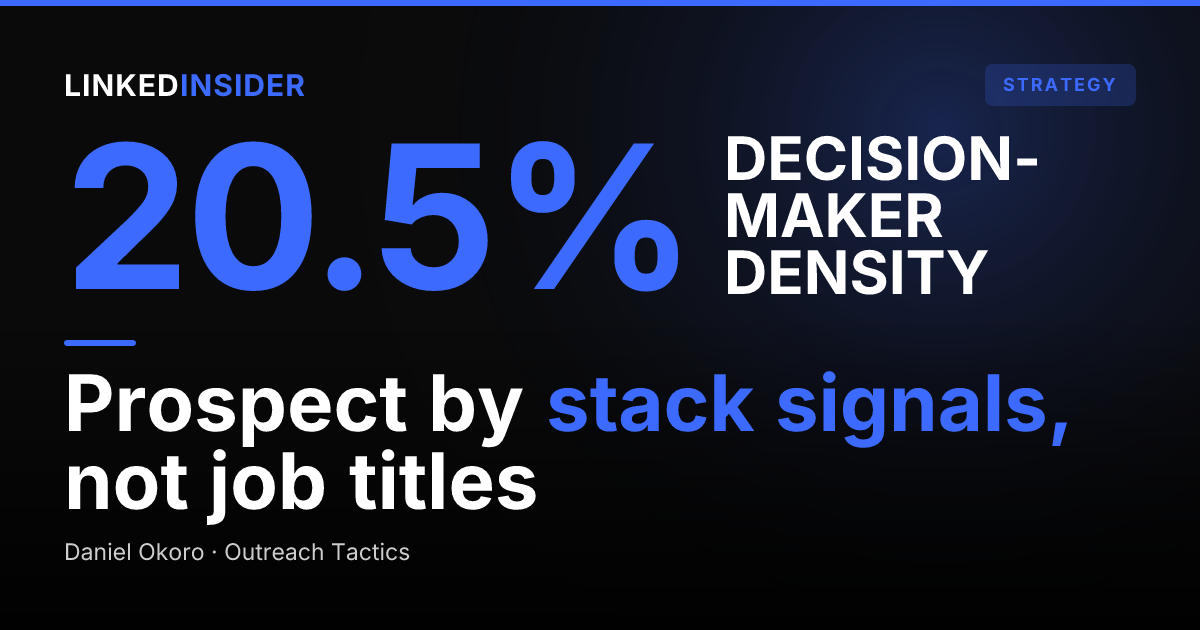
Targeting density matters too. Across Reachium's lead universe of multi-million B2B contacts, a large share flagged as decision-makers, per the platform's 2026 outreach benchmark study. For an SDR, that is the difference between burning invites on individual contributors and reaching the person who signs. Pair the signal with Sales Navigator filters and you get a list that is both timely and senior. [SYNTHESIS]
How do you open with a data-pipeline pain they actually feel?
Lead with one specific symptom, then one question. Technical buyers can smell a templated "I noticed you're in data" opener instantly because they receive a dozen a week. The opener that earns a reply names a real failure mode they live with: dashboards that take 40 seconds to load, a Snowflake bill that doubled last quarter, governance gaps that surface in every audit, or a pipeline that breaks every time someone ships a schema change.
Make one observation, ask one question, and stop. You are not pitching the platform in message one, you are confirming the pain is real for them.
"Saw you're hiring two dbt analysts. Usually that means the warehouse is growing faster than anyone can model it, and queries start timing out. Is that what's pushing the new headcount, or something else?"
Why it works: it reads a stack signal (the hiring post), names a symptom they recognize, and asks a question that is genuinely easy to answer. There is no calendar link and no feature.
"Congrats on the data lead role at {Company}. First 90 days usually means inheriting a stack you didn't choose. What's the one thing about the current setup you'd fix first?"
Why it works: it targets the buying window of a new hire, flatters without fawning, and the answer hands the SDR a discovery hook for the follow-up. Specificity in personalization is not a nice-to-have. Reachium's analysis in the AI personalization study found that openers tied to a concrete observation outperform generic merge-tag personalization on reply rate.
Want to put this into practice?
Reachium automates LinkedIn outreach, content publishing, and inbox management in one platform.
Start Free →What does a safe daily prospecting cadence look like for an SDR?
Send fewer invites than your quota instinct says, because volume above a safe ceiling actively lowers your acceptance rate. This is the finding most reps get wrong. Across 180,155 matured connection requests, Reachium's data shows acceptance peaked at 32.01% for accounts sending 10-19 invites a day and fell to 26.65% at 20-29 a day. More volume produced fewer accepts, a pattern the platform calls the volume tax. [SYNTHESIS]
The mechanism is partly LinkedIn's spam heuristics and partly recipient behavior: a profile that is obviously blasting reads as bulk, and bulk gets ignored or reported. So the safe cadence is also the higher-converting cadence, which is rare and worth internalizing.
How the account connects to LinkedIn matters even more than the count. Tools built on browser automation or scraping operate against the User Agreement and put the seat at risk; one publicly reported example is the HeyReach ban wave in March 2026. Tools built on the verified LinkedIn API via a sanctioned partner like Unipile operate inside the rules. In Reachium's data, no client account on the verified-API approach has been suspended to date; the worst case is a recoverable rate-limit, calibrated to roughly 25 invites a day. For a quota-carrying rep, that distinction is the difference between a slow week and a dead seat. Build the cadence into a 30-minute daily routine so it runs without thinking.
How do you follow up with technical buyers without nagging?
Make every follow-up carry value, and space it. Technical buyers tune out "just bumping this to the top of your inbox" immediately. The follow-up that lands gives them something useful whether or not they reply: a relevant benchmark, a short teardown of a common pipeline pattern, a link to a peer's published result. You are earning the next reply, not begging for it.
Spacing beats frequency. A reasonable rhythm is the connect message, then a value-add touch three to four days after acceptance, then a final relevant nudge a week later. Reachium's look at reply lift by follow-up count shows a measurable gain from a second and third touch, with sharply diminishing returns after that, so two to three well-spaced follow-ups is the sweet spot, not seven.
When the data engineer goes quiet, multi-thread up. Send a parallel, differently angled message to the analytics lead or CDO that frames the business outcome (cost, speed to insight, governance) rather than the technical symptom. You are not abandoning the first contact, you are giving the deal two doors instead of one.
How do you know your prospecting is working before the meeting books?
Watch acceptance rate and reply rate, because they move weeks before booked meetings do. Booked meetings are a lagging indicator; by the time the calendar is empty, the prospecting that caused it happened a month ago. The leading indicators tell you to adjust now.
Use these benchmarks from Reachium's verified-API dataset as a yardstick. Average connection acceptance runs 27.11%. Of accepted connections, 27.55% reply, which is 7.47% of all requests sent. Meetings booked of accepted connections run 1.99%. If your acceptance is well under the 27.11% average, your targeting or opener is off. If acceptance is healthy but replies lag, your follow-up sequence is the problem. [SYNTHESIS]
| Leading indicator | Reachium benchmark | What a low number tells you |
|---|---|---|
| Connection acceptance rate | 27.11% average (32.01% at 10-19 invites/day) | Targeting or opener is off, or daily volume is too high |
| Reply rate of accepted | 27.55% (7.47% of all sent) | Follow-up sequence or message relevance needs work |
| Meetings booked of accepted | 1.99% | Qualification or call-to-action in the thread is weak |
One caution on the trend, per Reachium's data: reply rate of accepted connections fell from 32.19% in 2025 to 21.98% in 2026 at matched maturity, while acceptance held steady (26.33% to 28.11%). Inboxes are getting noisier, which raises the premium on the stack-signal targeting and specific openers covered above. [SYNTHESIS]
Want to put this into practice?
Reachium automates LinkedIn outreach, content publishing, and inbox management in one platform.
Start Free →FAQ
How do you find data engineers and analytics leads to prospect on LinkedIn?
Prospect on stack signals rather than titles: companies hiring for dbt, Snowflake, Databricks, or Airflow, "scaling our data team" updates, and newly hired analytics or data leaders in their first 90 days. Each signals an active buying window. Filter with Sales Navigator to confirm seniority and fit.
What is a good first message to a data engineer or CDO?
Name one specific pipeline symptom (slow dashboards, rising warehouse cost, governance gaps) and ask one easy question. Skip the calendar link and the feature pitch in message one. Specificity tied to a real observation outperforms generic merge-tag personalization on reply rate.
How many invites a day can an SDR send safely?
Stay in the 10-19 invites a day range. Reachium's data shows acceptance peaks there at 32.01% and declines as volume rises, and the verified API rate-limits at roughly 25 a day by design. Pushing higher lowers both your accept rate and your account safety.
How do you book meetings with technical buyers who get pitched constantly?
Earn the meeting across two to three value-add follow-ups rather than one pitch, and multi-thread to the analytics lead or CDO with a business-outcome angle when the engineer goes quiet. Watch reply rate as the leading signal, and read whether the SDR role itself is changing to keep your motion current.