Is Cold Email Dying? Why B2B Is Shifting to LinkedIn in 2026
By Priya Nair, Trends & Predictions. Last updated: 2026-05-28
The leader watching the cold-email dashboard knows the feeling. Reply rates that used to land near 6% sit at 2%, deliverability complaints keep showing up in the morning standup, and the volume that bought pipeline a year ago now buys nothing. The question on the budget review is no longer "should we do more cold email." It is "should we still be doing this at all."
The honest answer is in the middle. Cold email is not dead. The volume-blast version of cold email is dying. And the center of gravity of B2B outbound is moving toward LinkedIn for structural reasons that the 2026 data makes hard to argue with.
Is cold email actually dying, or just getting harder?
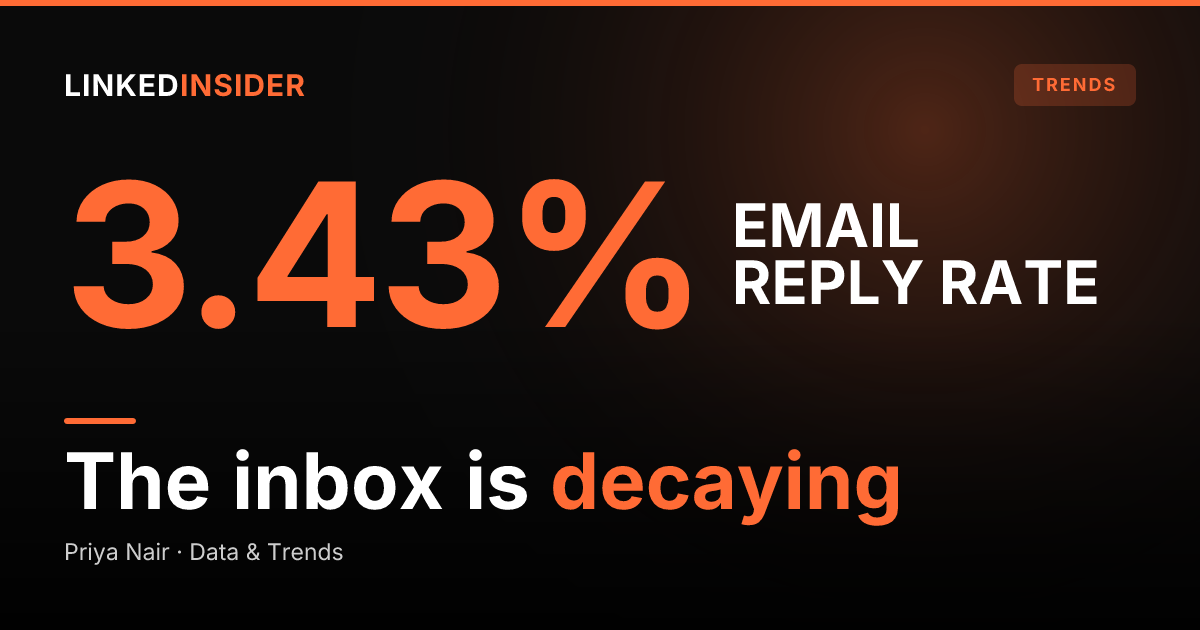
Cold email is decaying, not dead. The average B2B cold email reply rate has fallen from roughly 8.5% in 2019 to about 3.43% in 2026, per Instantly.ai's 2026 Cold Email Benchmark Report (drawn from billions of emails sent through the platform). The channel still produces pipeline for a precise minority. It is collapsing for the volume majority. [SYNTHESIS]
The performance tiers in Instantly.ai's 2026 data: [SYNTHESIS]
- Below 3% reply, something is structurally broken (list quality, deliverability, copy).
- 3% to 5% is realistic for a competent team running at scale.
- 5% to 8% is genuinely good.
- 10%+ is elite, and almost always requires precision targeting and signal-driven sends rather than volume.
The middle of that distribution, generic high-volume email to broad lists, is the part that is dying. The thesis of this piece is not "email is dead." It is "the volume-email playbook is dead, the precision-email playbook survives, and most outbound effort is moving toward LinkedIn because that is where precision is native."
For the head-to-head comparison of cold email and LinkedIn outreach across reply rate, cost, setup, and intent quality, the full channel comparison at cold email vs LinkedIn runs five dimensions side by side. This piece is the forward-looking trend.
Why are cold email reply rates declining?
Three structural causes are doing the work, and they reinforce each other.
Inbox saturation. Cold email used to be a competitive advantage for the teams that ran it well. By 2026, every B2B team runs it, often through automated cadences with five to nine touches. The buyer's inbox is the casualty. The volume of cold outreach landing in a director's inbox each week is higher than at any prior point, and the marginal reply rate of any one campaign is the inverse of that volume.
Tighter spam filters and deliverability gates. Google, Yahoo, and Microsoft tightened bulk-sender enforcement in 2024 and again in 2025, with hard caps on spam-complaint rates (under 0.3%) and bounce rates (under 2%) for high-volume senders. Mailshake's 2025 cold email statistics roundup notes the average open rate has fallen alongside the reply rate, with deliverability cited as one of the top causes. A team that used to send 10,000 cold emails a week now has to clear technical, list-hygiene, and warmup bars that did not exist five years ago, and a single bad campaign can burn a domain that takes weeks to recover. [SYNTHESIS]
The AI-outreach flood. Cheap, fluent generative AI made it trivial to send more cold email, which saturated inboxes further, which dropped reply rates, which pushed senders to send even more. The pattern is a death spiral. The personalization layer that "AI-generated outreach" was supposed to provide collapsed within months into a recognizable cadence of "I saw you do [job title] at [company], thought you might be interested in [generic pitch]," which buyers trained themselves to skim past in a second. The result: more volume, less attention, lower reply.
The data on list size makes the bifurcation concrete. Industry benchmarks compiled across 2025 and 2026 (Instantly, Mailshake) show targeted sends to small lists (under roughly 50 recipients) averaging closer to 5.8% reply, while large blasts to lists of 5,000+ recipients sit closer to 2.1%. The same channel produces wildly different results based on list discipline, and the volume side is where the average is collapsing. [SYNTHESIS]
Want to put this into practice?
Reachium automates LinkedIn outreach, content publishing, and inbox management in one platform.
Start Free →Is cold email dead, or just the volume version of it?
The dying piece is the high-volume, low-personalization blast. The surviving piece is precision, signal-driven, highly personalized email to small lists.
The volume playbook that built cold email as a B2B category looks like this: 10,000+ scraped contacts, a three-to-seven-touch cadence, light personalization tokens, and a hope that the funnel-stage math works at the platform-average reply rate. In 2019, per Instantly.ai's benchmark data, with an 8.5% reply rate and easier deliverability, that math worked. In 2026, with a 3.43% reply rate, harder deliverability, and a saturated inbox, it usually does not. [SYNTHESIS]
The precision playbook looks different. Small lists (under 100), an identifiable trigger (recent funding, a specific job change, a piece of public commentary), a first sentence that demonstrates real research, and an offer matched to a known business situation. The same Instantly and Mailshake benchmarks that show the platform-average reply rate collapsing also show top-quartile campaigns hitting 5.5% to 10%+ when the inputs are precise. The medium still works. The carpet-bomb does not. [SYNTHESIS]
The reframe for a sales leader: the right question is not "should we keep doing cold email." It is "are we running the precision version or the volume version, because the economics are now completely different on each side."
Why is B2B outbound shifting toward LinkedIn?
LinkedIn is a relationship channel, and that is the structural advantage that is pulling outbound budget toward it in 2026.
Identity is real on LinkedIn. A connection request is tied to a named professional with a profile, a company, a post history, mutual connections, and a verifiable employer. A cold email lands in an inbox anonymously. The two channels are not the same thing dressed differently. They are different surfaces, and identity is the difference that matters most for higher-ACV B2B where the buyer wants to know who is messaging them before they decide whether to reply.
Signals are visible. Job changes, role promotions, posts, comments, content reactions, and company milestones are all visible on the LinkedIn graph without paying for an enrichment layer. The signal layer that makes precision outbound work is built into the channel, not bolted on through a third-party data vendor. A team using LinkedIn for outbound has every relevant buying signal sitting one degree from the prospect's profile.
Deliverability looks different. Email's gatekeeper is the spam filter, and the spam filter is getting harder every quarter. LinkedIn's constraint is acceptance rate and per-account volume discipline, which is a different problem with a different shape. Across 180,155 matured connection requests, Reachium's data shows a 27.11% average connection acceptance rate in 2026, and reply rates on accepted connections sit at 27.55%, which lands at about 7.47% reply against all connection requests sent (detailed in the LinkedIn outreach benchmarks 2026 flagship study). Against a decaying ~3.43% email average, the reply economics on LinkedIn are favorable enough to justify the channel shift on the headline math alone, with the relationship-channel benefits stacked on top. [SYNTHESIS]
The multi-channel reality. Most teams are not abandoning email. They are leading with LinkedIn for the relationship-building first touch and using email as a supporting step inside the same sequence. The center of gravity is shifting, not the entire stack. For teams running both channels and asking which tools to keep when most features overlap, the LinkedIn and email outreach tool overlap analysis maps the five functional layers and the honest cut decision.
Will email survive as a B2B outbound channel at all?
Email will survive, but in a narrower role than it played a decade ago. The channel is moving from the primary cold first touch into a supporting role: the asynchronous, detailed, attachable second or third step in a relationship started on LinkedIn, or the high-precision first touch to a small list of triggered accounts. What dies is email-as-the-primary-cold-channel-at-volume. The "send 50,000 cold emails this quarter" playbook is the casualty. The medium itself keeps a place.
There are also two honest counter-cases where cold email still wins as a primary channel.
High-volume top-of-funnel with elite list quality. When the TAM is large (10,000+ verified contacts), the deal is transactional ($1K to $5K range), and the team has the deliverability infrastructure to send at scale, cold email's volume ceiling can produce more pipeline per dollar than LinkedIn's per-account caps allow. The economics are different from what they were in 2019, but the channel still works for the right shape of business.
APAC and EMEA where LinkedIn penetration is lower. LinkedIn density varies by region. In several APAC and EMEA markets, LinkedIn coverage of the buying committee is thinner than in North America, and email remains the more reliable surface to reach the same titles. Teams selling into those geographies should not assume the LinkedIn-first shift applies symmetrically.
SMTP-reputation-friendly setups. Teams that have invested in clean domains, sustained warmup, careful list hygiene, and tight ICP targeting still see reply rates well above the platform average. The infrastructure tax is real, but for teams that have already paid it, the channel still produces.
The point is not that email is universally worse. The point is that the default playbook (high volume, light personalization, broad lists) is no longer the right default in 2026 for most B2B teams.
Want to put this into practice?
Reachium automates LinkedIn outreach, content publishing, and inbox management in one platform.
Start Free →What does the cold-email shift mean for how a team should run outbound in 2026?
The strategic implications for a sales leader building the 2026 plan come down to four moves.
Reallocate the relationship channel to LinkedIn. Use LinkedIn as the first touch and the relationship-building surface, and stop trying to make cold email do that job. The identity, signal, and deliverability advantages compound when LinkedIn is the lead channel rather than a parallel afterthought.
Use precision email as a supporting step, not the cold channel. Drop volume blasting. Keep email in the sequence as the asynchronous follow-up touch to a relationship started on LinkedIn, or as the high-precision first touch to a tightly triggered list. The medium is still useful in that role.
Adopt precision over volume on both channels. The same Reachium platform data that shows a 27.11% average acceptance also shows the volume tax: acceptance peaks at 32.01% for accounts sending 10 to 19 invites a day and falls to 26.65% at 20 to 29 a day. More volume, fewer accepts. The discipline that wins on LinkedIn in 2026 is the same discipline that wins on email: small lists, real personalization, signal-driven sends. [SYNTHESIS]
Run the motion on one platform when possible. Operating a LinkedIn tool and an email sequencer with a Zapier glue layer is the failure mode that consolidation fixes. A single platform that runs LinkedIn natively, treats email as a sequence step, unifies the inbox, and stays the system of record alongside the CRM is the structural answer. For the consolidation case in detail, the LinkedIn and email tool overlap map walks through which functional layers are duplicated and which to cut.
The 2026 winning motion is not "more email or more LinkedIn." It is "precision over volume, with LinkedIn as the relationship channel and email as the supporting step."
FAQ
What is a good cold email reply rate in 2026?
Realistic benchmarks in 2026: below 3% means something is broken (list, deliverability, or copy), 3% to 5% is competent at scale, 5% to 8% is genuinely good, and 10%+ is elite and almost always requires precision targeting on small lists with strong personalization. The platform average across billions of emails sits at 3.43% per the Instantly.ai 2026 Cold Email Benchmark Report.
Has cold email open-rate tracking become unreliable?
Yes, materially. Apple Mail Privacy Protection (rolled out in iOS 15 and active across the Apple Mail user base since 2021) inflates open rates by pre-fetching images, which fires the tracking pixel even when the recipient never opened the message. By 2026, open rate is largely a directional signal rather than a clean metric, and most serious cold-email teams now optimize against reply rate and meeting rate instead. The reply-rate decline discussed here is the cleaner number to watch.
Is LinkedIn outreach better than cold email for B2B?
For most relationship-led B2B deals in the $10K to $100K ACV range, yes, on the 2026 data. LinkedIn post-connection reply rates average roughly 10% across published benchmarks, compared with about 3.43% for cold email. The structural drivers (real identity, visible signals, no domain-warmup tax) compound the headline-rate advantage. For very large TAMs and transactional deals under $5K, cold email's volume economics can still win. The full head-to-head is in the cold email vs LinkedIn comparison.
Should I stop doing cold email entirely?
For most B2B SaaS teams, no, but the role should change. Stop using cold email as the primary high-volume cold channel and start using it as the supporting step in a sequence that leads with LinkedIn. Keep cold email as a primary channel only if the deal is transactional, the TAM is large and email-accessible, and the team has the deliverability infrastructure to send cleanly at volume. For everyone else, the channel shift is the right move.
Can you combine LinkedIn and email in one outbound sequence?
Yes, and the multi-channel combination consistently outperforms either channel alone. The right structure is to lead with LinkedIn for the first touch and the relationship build, then sequence email as the asynchronous follow-up step inside the same campaign, with conditional logic that pauses both channels when the prospect replies on either one. Running this with separate tools requires a Zapier coordination layer that fails silently at volume; running it on a single platform removes the failure mode. The LinkedIn and email outreach tool overlap analysis walks through which tools to keep and which to cut.
Sources
- Instantly.ai: 2026 Cold Email Benchmark Report (billions of emails analyzed)
- Mailshake: Cold Email Statistics and Benchmarks
- GMass: Cold Email Reply Rate Benchmarks
- Reachium
- Linked Insider: Cold Email vs LinkedIn
- Linked Insider: LinkedIn Outreach Benchmarks 2026
- Linked Insider: LinkedIn and Email Tool Overlap