The Best LinkedIn Message to a CISO: Selling Security Without Triggering the Spam Reflex
By Daniel Okoro, Outreach Tactics. Last updated: 2026-05-30
- The hook is not the problem. CISOs ignore good hooks every day. The sender's credibility is the gate.
- A pitch on the first message confirms their suspicion that you are a vendor playing volume.
- The medium itself is a tell. A message that arrives through obvious browser automation reads as the exact behavior a security team blocks.
Why do CISOs ignore almost every LinkedIn message?
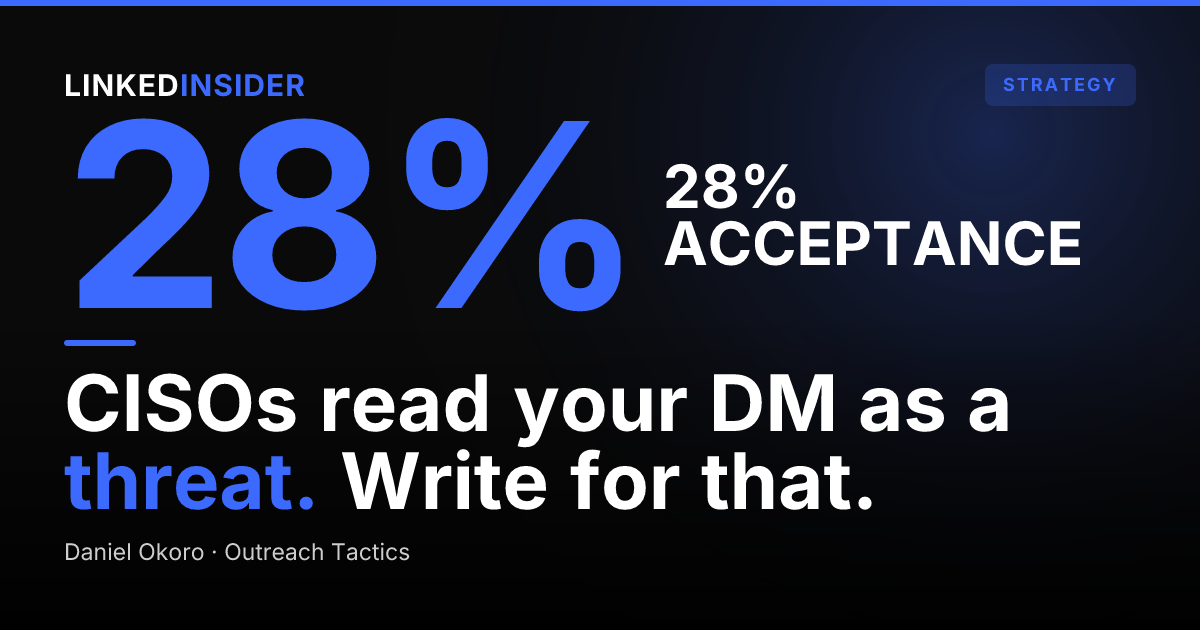
CISOs ignore most LinkedIn messages because their job is to be suspicious of unsolicited contact, and they are very good at it. A security leader spends their day classifying inbound: phishing, social engineering, vendor noise, real signal. Your cold message lands in that same mental queue. It is not judged as a sales pitch first. It is judged as a possible threat first.
That changes the math. Per Reachium's platform data, the average LinkedIn connection acceptance rate across 180,155 matured connection requests run on the verified API sits at 27.11%, and a CISO audience runs colder than that baseline because the skepticism is professional, not personal. The fix is not a cleverer opening line. It is removing every signal that says "automated vendor blast" before you ask for anything. [SYNTHESIS]
What does a CISO's threat model do to your outreach?
A CISO's threat model treats your message as untrusted input, so it gets scanned for the markers of a low-effort campaign and discarded the moment it finds one. The markers are predictable: generic personalization tokens, a pitch in sentence one, a sender with a thin or mismatched profile, and timing that screams bulk send.
Think about what a security team actually trains employees to spot. Urgency. A request before any rapport. A sender who knows your title but nothing real about your situation. Every one of those is also a hallmark of bad LinkedIn outreach. You are not just competing with other vendors. You are competing with the CISO's own internal awareness training, which has taught them to delete exactly the kind of message most tools generate by default. Treat brevity and specificity as the password that gets you past the scan.
Want to put this into practice?
Reachium automates LinkedIn outreach, content publishing, and inbox management in one platform.
Start Free →What is the best LinkedIn message to a CISO?
The best LinkedIn message to a CISO names one concrete, current thing about their world, makes no ask beyond connection, and stays under three sentences. Here are two openers built to clear the threat model.
Saw your team is hiring two detection engineers and standing up a fresh SOC rotation. I write about how security orgs sequence that build-out without burning the new hires in month one. Happy to connect if that is on your radar.
Why it works: it proves you looked at something specific (real headcount signal), it offers a point of view instead of a product, and the ask is "connect," not "demo." No urgency, no flattery, no link.
Your post on alert fatigue mapped closely to what I am seeing across mid-market security teams this quarter. Not pitching anything. Just wanted to follow the work.
Why it works: it references their own content, explicitly disarms the pitch reflex ("not pitching anything"), and positions you as a peer who reads, not a rep who hunts. The disarm only works if it is true, so the follow-up touch must also hold the line.
For the deeper mechanics of sequencing the touches after this opener, the breakdown in reply rate by sequence step shows where security-buyer conversations actually convert.
Why does the first touch never pitch?
The first touch never pitches because a pitch is the single fastest way to confirm the CISO's suspicion that you are running volume. The moment your opener contains a value prop, a calendar link, or the phrase "quick call," you have self-identified as a vendor in spray mode and the threat model wins.
The discipline is counterintuitive for outbound teams trained on speed. You earn the second message by making the first one cost the recipient nothing. Connect first. Let them see a profile that publishes real, useful thinking. The actual conversation comes on touch two or three, after you have stopped being an unknown sender and become a known voice. Strong outbound here borrows from inbound: a profile and feed that already answer "is this person credible" before you ever message. The blog-to-LinkedIn repurposing pipeline is the cheapest way to build that credible footprint, because it puts your published thinking where a skeptical buyer checks first.
How do you prove you are not a bot or a scraper?
You prove you are not a bot by being one provably real person who behaves like one, and by sending through infrastructure that does not look like automation. CISOs, more than any other buyer, will check. They will open your profile, look at your post history, and notice if your activity pattern smells synthetic.
There is a deeper layer most outreach advice misses: the delivery mechanism itself is a tell. The irony of selling to security buyers is that most LinkedIn outreach tools are Chrome extensions and browser automation, which is the exact unsanctioned-access behavior a CISO's own policies forbid. When LinkedIn cracks down, those tools take the hit. The publicly reported HeyReach ban in March 2026 was a browser-automation case. A platform built on the verified LinkedIn API behaves like a real, sanctioned client, which is why pacing matters: Reachium's data found acceptance peaked at 32.01% for accounts sending 10-19 invites a day and fell to 26.65% at 20-29 a day, more volume producing fewer accepts. That "volume tax" is documented in the LinkedIn outreach benchmarks for 2026, and it is the technical proof that restraint beats blast for this audience. [SYNTHESIS]
Want to put this into practice?
Reachium automates LinkedIn outreach, content publishing, and inbox management in one platform.
Start Free →How many CISOs should you contact at once?
You should contact CISOs in small, hand-checked batches, because this is a low-volume, high-value audience where one careless send can burn a name you will never get back. The volume tax applies double here. Reachium's platform caps sending at roughly 25 invites a day by design, and for a CISO list you should sit well under even that.
The targeting math supports going narrow. Even in Reachium's multi-million-lead B2B universe, decision-makers are a minority and C-suite profiles are a far thinner slice still, so the pool of real security leaders is finite and worth protecting. Build a list of the right 40 names, not the wrong 400. For the role-by-role mechanics of finding and qualifying senior buyers, the consultant-focused LinkedIn lead-gen playbook covers the qualification side, and a new-leadership-hire outreach script shows how to time the message to a real trigger instead of a calendar. [SYNTHESIS]
What should you never do when messaging a CISO?
You should never use fake urgency, fake familiarity, or fake personalization, because each one trips the exact pattern a security leader is trained to catch. No "I'll keep this brief" followed by four paragraphs. No "as a fellow [job title]" when you are not. No merge-tag personalization that any list could produce.
Two more hard rules. Do not attach or send links on the first touch, because an unknown sender pushing a link is the literal shape of a phishing attempt. And do not follow up aggressively. A second message two days after silence reads as a bot on a cadence. Wait, publish something useful in the meantime, and let your visible activity do the warming. The whole point is to look like a person a CISO would actually want in their network, which is incompatible with looking like a campaign.
FAQ
Should I pitch in my first LinkedIn message to a CISO?
No. A pitch on the first touch confirms the CISO's suspicion that you are running volume, which is the single fastest way to get ignored. Make the first message a relevant, no-ask connection request and earn the pitch on touch two or three.
How long should a cold message to a CISO be?
Three sentences or fewer for the opening touch. Length signals effort to most audiences, but to a security buyer it signals a script, so brevity plus one concrete, current detail beats any long value pitch.
Why does the outreach tool I use matter when messaging security buyers?
Because CISOs forbid unsanctioned access in their own orgs, and many LinkedIn tools are Chrome extensions or browser automation, the exact behavior they block. Sending through the verified LinkedIn API makes your footprint look like a legitimate client instead of a scraper.
How many CISOs can I safely message per day?
Stay well under the platform-safe ceiling of roughly 25 invites a day, and for a CISO list go far lower. This is a finite, high-value audience where the documented volume tax means more sends produce fewer accepts and more burned names.
Want to put this into practice?
Reachium automates LinkedIn outreach, content publishing, and inbox management in one platform.
Start Free →