Will AI SDRs Replace Sales Reps? What the 2026 Data Actually Shows
By Priya Nair, Data & Trends. Last updated: 2026-05-28
What sales leaders keep saying about the AI SDR wave this quarter:
- "We piloted an autonomous AI SDR for 90 days and our deliverability collapsed."
- "We're being pitched the same 'replace your team' deck by every vendor and the math doesn't hold up."
- "Our reps actually book more meetings when they run AI tooling themselves than when an agent runs them."
What is an AI SDR, and what does it actually do?
An AI SDR is software marketed to perform sales-development tasks autonomously: prospect research, list-building, enrichment, first-touch personalization, multi-step follow-up, and reply triage, with minimal human input. The category exploded in 2024 with Artisan's Ava ("the AI BDR that finds leads, sends personalized outreach, handles objections and books meetings") and 11x.ai's Alice (an outbound "digital worker" across email, LinkedIn, phone, and SMS), and broadened in 2025 to include Clay's AI agents, Default's signal-based AI workflows, and Clari's revenue-cadence automations.
The spectrum matters more than the category label. "AI SDR" ranges from fully autonomous agents (the agent decides who to contact, what to write, and when to send, with a human reviewing aggregate output) to AI-assisted software (a human runs it; AI does the heavy lifting at each step). Conflating the two is the source of most of the hype on the vendor side and most of the disappointment on the buyer side. The question "will AI replace reps?" depends entirely on which end of the spectrum the conversation is about and which part of the SDR job is being measured.
How widely are AI SDRs actually being adopted in 2026?
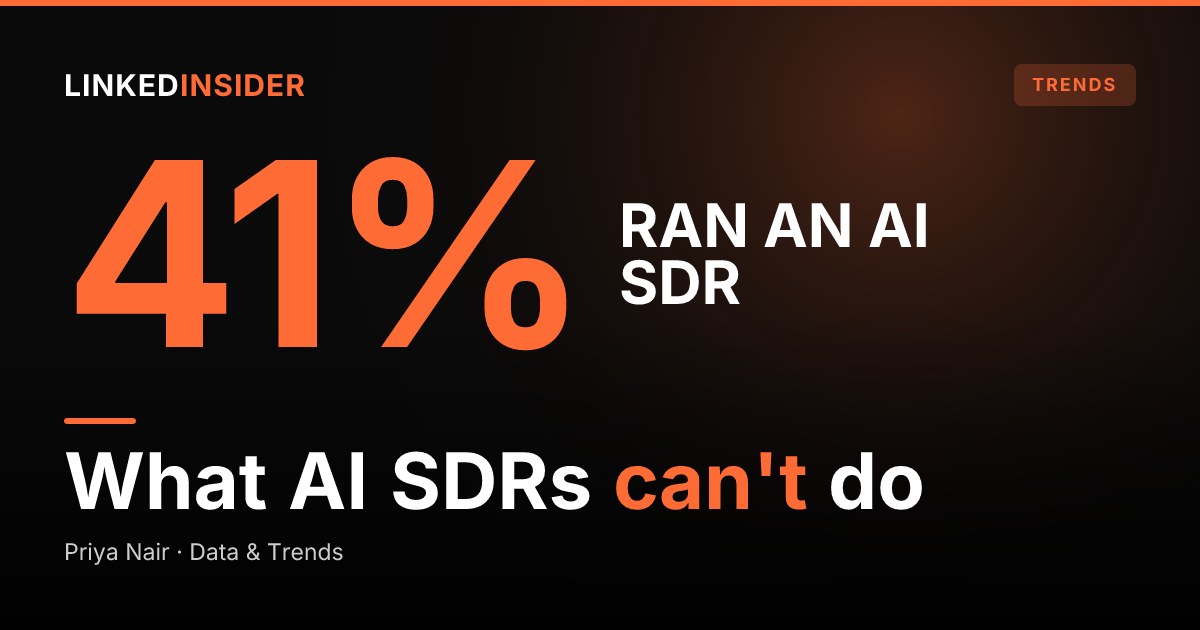
Adoption is real and accelerating, but mostly as augmentation. Per 2026 state-of-AI-prospecting reporting, around 41% of enterprise B2B teams ran at least one AI SDR in production by Q1 2026, up from roughly 12% a year earlier. About 45% run hybrid configurations (an AI SDR plus human reps splitting the funnel), and only around 22% have fully replaced their human SDR function with autonomous agents.
Read those numbers honestly. The headline is high experimentation, mostly hybrid, minority full-replacement. The category is being adopted as an augmentation layer far more aggressively than as a human replacement, and the gap between the two is what most of the "AI is replacing SDRs" coverage misses. Even teams that bought an autonomous AI SDR usually kept human reps to take the meetings the agent surfaced.
The forward view is louder than the present-day data. Gartner has projected that AI agents could outnumber human sellers by 2028 in some configurations, and several vendors quote even more aggressive projections. Predictions are predictions. The 2026 reality is hybrid, not autonomous, and treating a 2028 forecast as a 2026 operating decision is how leaders end up paying for capacity they cannot use. For the broader read on where the channel is heading, see the state of LinkedIn outreach 2026 annual report.
Want to put this into practice?
Reachium automates LinkedIn outreach, content publishing, and inbox management in one platform.
Start Free →Do fully autonomous AI SDRs actually work?
The uncomfortable answer from the 2026 data is mostly no, not yet. Public analyses of autonomous-sales-agent programs in 2026 report pure-AI configurations underperforming human and hybrid setups on closed-won by a wide margin, with deliverability problems capping a significant share of programs within the first 90 days. Several vendor-published case studies that headlined "replaced our SDR team" in 2024 quietly walked back to "hybrid" framing through 2025.
The structural reason is straightforward. Autonomous agents at scale tend toward high-volume, low-judgment outreach, which is exactly the motion that is decaying across every cold channel. Cold email reply rates have fallen from around 8.5% in 2019 to roughly 3.4% in 2026 as AI-generated outreach flooded inboxes, per Cleanlist's 2026 benchmark and Instantly's 2026 benchmark report. More autonomous volume can accelerate the very saturation that kills the channel, which is why pure-AI programs frequently hit deliverability collapse before they hit a healthy meetings cadence. For the channel-shift context, see cold email vs LinkedIn. [SYNTHESIS]
The honest conclusion: fully autonomous AI SDRs have not replaced human teams at meaningful scale in 2026. Many of these tools sell hype today and underdeliver in production, especially on closed-won and deliverability. The hype outran the results, and the buyers paying for it are quietly correcting course.
What parts of the SDR job can AI replace, and what can't it?
Splitting the job is the most useful framing a sales leader can adopt this year. AI genuinely replaces the repetitive, rules-based top of the funnel. It does not replace the relationship judgment that books and advances real opportunities. The split is clean enough to put in a table.
| SDR function | AI replaces in 2026? | Why |
|---|---|---|
| Prospect list-building | Yes | Pattern-matching on firmographics and signals is a rules-based job AI does faster and cheaper than a human. |
| Data enrichment | Yes | Lookup and synthesis across data sources is the canonical AI strength. |
| First-touch personalization | Yes (with caveats) | AI references public signals (recent posts, job changes, funding news) well; quality depends entirely on the data layer feeding it. |
| Follow-up sequencing | Yes | Rules-based timing and conditional branching are software, not human work. |
| Reply triage (early-stage) | Partially | AI sorts and drafts replies; humans still need to approve before high-stakes responses leave the inbox. |
| Multi-stakeholder navigation | No | Reading a buying committee, identifying coaches and blockers, and routing the deal is judgment. |
| Live objection handling | No | The reply that wins is context-specific, references prior conversation, and reads tone. |
| Complex deal negotiation | No | Price, terms, and concessions are commercial judgment with downstream revenue implications. |
| Booking meetings of real intent | No (alone) | Agents book meetings; the conversion to opportunity stays a human-judgment job. |
Public 2026 analyses estimate AI will replace roughly 60% to 70% of current SDR functions over the next 12 to 24 months, concentrated in the rows marked "Yes" above. The rows marked "No" are the rest of the job, and they are where the meetings actually become revenue. The SDR role is splitting, not disappearing. The repetitive layer becomes software; the judgment layer stays human. The reframe a leader needs is not "AI or human" but "which layer of my SDR motion am I willing to hand to an agent, and which do I keep in human hands?"
Should a leader buy an AI SDR, hire a human, or run software the team operates?
Three options, three different economics, three different risk profiles. Most teams default to the first two and miss the third.
A human SDR runs roughly $5,000 to $8,000 a month fully loaded, with a 60-day ramp and a 12-month average tenure across most B2B SaaS comps. The output is high-judgment but capacity-limited. The ramp risk is structural and the churn risk is constant.
A fully autonomous AI SDR outsources judgment to an agent. The pitch is "replace your team." The 2026 data is that pure-AI configurations underperformed hybrid setups on closed-won and hit deliverability problems in a meaningful share of programs, per the autonomous-agents analyses cited above. The buyer is paying for capacity but accepting the judgment risk the agent introduces, especially on inbox health.
The software-the-team-operates middle path keeps the judgment in human hands and uses software for the repetitive layer. List-building, signal triggering, first-touch personalization, and sequencing run in a platform the reps operate; replies, objections, and meetings stay with the human. The economics are the most defensible of the three for most teams in 2026 because they match the data: AI does the work it is good at, humans do the work AI is bad at, and neither the deliverability risk nor the closed-won risk of a fully autonomous agent shows up.
This is the make-vs-buy decision under a third option that most "AI SDR vs human SDR" framings ignore. The full comparison framework, including the cost math and the ramp comparison, lives at SDR vs agency vs software. Leaders who want the software-the-team-operates model without building it themselves can start a free trial and run list-building, personalization, and sequencing while reps keep the conversation.
Want to put this into practice?
Reachium automates LinkedIn outreach, content publishing, and inbox management in one platform.
Start Free →What does the AI SDR shift mean for LinkedIn outreach specifically?
LinkedIn is the channel where the human-judgment layer matters most, and it is also the channel where autonomous high-volume outreach is most punished. Two reasons.
First, LinkedIn is structurally a relationship channel. The signals that convert (a real reference to a prospect's post, a relevant note about a job change, a comment that lands in their actual feed) reward judgment over volume. The auto-generated note that scaled in 2024 is the one most likely to be ignored or reported in 2026. For the per-stage reply context, see LinkedIn response rate benchmarks.
Second, LinkedIn punishes volume directly. Reachium's data across 180,155 connection requests shows acceptance peaked at 32.01% for accounts sending 10 to 19 invites a day and fell to 26.65% for accounts pushing 20 to 29 a day [SYNTHESIS]. The volume tax is real, and the autonomous-agent model (which pushes throughput because that is how it justifies its price) runs straight into it. The verified-API safety record across Reachium-connected accounts is no permanent suspensions in the data [SYNTHESIS]; the autonomous-agent equivalent on browser automation is the public March 2026 HeyReach account-ban event.
The practical play on LinkedIn in 2026 is to use AI for what it is good at (assembling targeted lists, drafting personalized first-touch from the prospect's actual activity, sequencing follow-ups) while reps own the conversation once a reply lands. Software-with-AI, not an autonomous agent talking to your prospects unsupervised. The mechanics of doing this at scale without burning the inbox live at personalize LinkedIn outreach at scale, and the full benchmark spine sits at LinkedIn outreach benchmarks 2026.
FAQ
Is an AI SDR cheaper than a human SDR?
On a per-month sticker basis, usually yes. A human SDR runs roughly $5,000 to $8,000 a month fully loaded, while autonomous AI SDR platforms typically price between $1,500 and $4,000 a month. The full economic comparison is more complicated. Pure-AI programs that underperform on closed-won or hit deliverability problems frequently cost more per booked opportunity than the cheaper-per-seat headline suggests, especially when the inbox damage carries over to channels the team needs later. The software-the-team-operates middle path is typically the lowest cost per opportunity of the three options for most teams in 2026.
Can an AI SDR handle replies and objections on its own?
Partially, and the limits matter. AI sorts and drafts replies well, especially for early-stage low-stakes responses (yes/no/timing questions). It is materially worse at multi-step objection handling that requires reading prior conversation, identifying the actual concern under the stated one, and shaping a response to the buying committee context. Most production AI SDR programs in 2026 keep a human in the loop for any reply beyond the first one or two exchanges.
Why do autonomous AI SDRs hurt email deliverability?
Three structural reasons. Autonomous agents tend to push throughput because that is how they justify the price, which raises the inbox-provider signal of "automated sender." AI-generated message bodies share recognizable patterns that spam-classifier models now detect. And autonomous programs typically lack the inbox-health discipline (warm-up cadence, domain rotation, content variation) that a careful human-run sequence builds in. The result is the deliverability collapse pattern flagged in the 2026 autonomous-agents data.
What's the difference between an AI SDR and AI-assisted outreach software?
An autonomous AI SDR makes the decisions (who to contact, what to send, when to follow up) and acts. The human reviews aggregate output. AI-assisted outreach software does the heavy lifting at each step (enrichment, personalization, sequencing) but the human rep makes the decisions and owns the workflow. The first is an agent; the second is a tool. Reachium sits firmly in the second category; Artisan's Ava and 11x.ai's Alice sit in the first.
Will AI SDRs replace reps by 2028?
Gartner has projected aggressive AI-agent growth by 2028, and several vendors quote similar numbers. Predictions are predictions. The 2026 reality is hybrid, and the most likely 2028 outcome based on the current trajectory is that SDR headcount falls and per-rep leverage rises, not that the role disappears. The new rep is an AI-augmented strategic outreach operator: lower headcount, higher per-person revenue contribution, and more judgment work, not less.
Sources
- Reachium published benchmarks (441,965 outreach sequences, 2025 to 2026): https://reachium.io
- Linked Insider, LinkedIn outreach benchmarks 2026: https://linkedinsider.blog/linkedin-outreach-benchmarks-2026
- Linked Insider, state of LinkedIn outreach 2026: https://linkedinsider.blog/state-of-linkedin-outreach-2026
- Artisan (Ava the AI BDR): https://www.artisan.co
- 11x.ai (Alice the AI SDR): https://www.11x.ai
- Cleanlist 2026 cold email response rate statistics: https://www.cleanlist.ai/blog/2026-02-18-cold-email-response-rate-statistics
- Instantly 2026 cold email benchmark report: https://instantly.ai/cold-email-benchmark-report-2026
- McKinsey, The new B2B growth equation: https://www.mckinsey.com/capabilities/growth-marketing-and-sales/our-insights/the-new-b2b-growth-equation